
Tycho Brahe
1546 to 1601
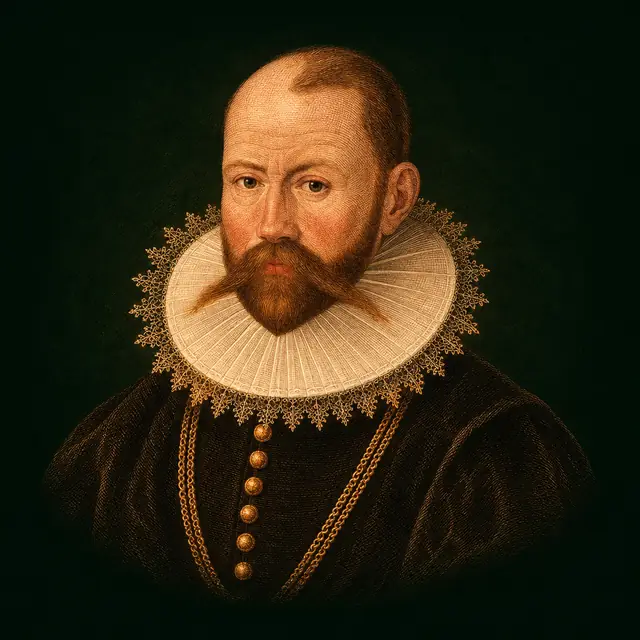
Who was Tycho Brahe, and what is truly known of them?
What is known
Danish nobleman and astronomer, born at Knutstorp in Scania. A duel in 1566 cost him the bridge of his nose, and he wore a metal one after. He measured the new star of 1572 and the comet of 1577 and showed that both lay beyond the Moon, where the schools held that nothing changed. King Frederick II gave him the island of Hven, and there, at Uraniborg, he kept twenty years of measurements with large instruments and the unaided eye, the most exact made before the telescope. He also cast horoscopes for the royal house and ran a laboratory for chemical medicines. In his own system the Sun and Moon circle the Earth and the other planets circle the Sun. He left Denmark in 1597, became imperial mathematician at Prague, took on Kepler in 1600, and died the next year.
The teaching
Taught from his own books, above all De nova stella and his book on the comet of 1577, with his oration on the mathematical arts.
Measure first
Tycho teaches that the heavens are known only by measuring them, exactly and again and again. His instruments are large, solid and fixed, finely divided, fitted with sights and set true, so that each can check the others; his observations are taken on every clear night, year after year, and not only at the moments the books single out. He corrects even for the air, which lifts a star near the horizon above its true place, and makes tables of how much. Only from such a record can astronomy be renewed, since the old tables, Ptolemy's and Copernicus's alike, had drifted from the sky.
The test of distance
A body near the Earth seems to shift against the fixed stars when it is seen from different places, or from one place as the Earth turns, and the nearer it is the more it shifts; the Moon shifts plainly. A body that shows no such shift lies far beyond the Moon. By this test, made with his own instruments night after night, he placed the new star of 1572 among the fixed stars and the comet of 1577 among the planets, and from the two placings drew two teachings.
The first is that the heavens change. The schools held that above the Moon nothing comes to be or passes away; a new star that blazes and fades among the fixed stars shows that it does. He read the star as a sign as well, as astrologers did: its colour went from a white like that of Venus and Jupiter to the red of Mars and at last to the dull hue of Saturn, and he took the colours for the natures of what it signified.
No solid orbs
The second teaching comes from the comet. It moved through the region of the planets, crossing the paths where the schools set the solid, crystalline shells that were thought to carry the planets round. No comet could pass through such shells, so there are none: the heavens are open and fluid, and the planets move through them freely. With the orbs gone, the old picture of the heavens as nested hard shells had to be given up, whatever system took its place.
His system of the world
In his own system the Earth stands still at the centre, the Moon and the Sun go round it, and the five other planets go round the Sun. He gives his reasons. The Earth is a heavy, sluggish body, unfit for the swift motions Copernicus gives it, and Scripture speaks of it as at rest. And if the Earth went round the Sun, the fixed stars should show a yearly shift; his instruments, the best of the age, found none, so the stars would have to lie at a vast distance, with an enormous empty space beyond Saturn and each star of an enormous size, which he judged against reason.
His system keeps the economy of Copernicus's arrangement while keeping the Earth still, and every measurement of his day could be fitted to it.
Looking up, looking down
Over his work stood two mottoes: by looking up I see downward, for astronomy, and by looking down I see upward, for chemistry, which he called a terrestrial astronomy. The seven metals answer to the seven planets, and the work of the furnace below to the motions of the heavens above, so the two arts are one study seen from two sides. In the laboratory beneath his observatory he made chemical medicines, among them remedies against the plague.
Those medicines are history, not counsel. The chemical remedies of his age were made with metals and salts that are poisons, and none of them is to be made or taken.
The stars incline
Astrology, for Tycho, is the use to which astronomy is put, and it is only as good as the measurements beneath it. In his oration on the mathematical arts he defends it: God set the lights in the heaven “for signs, and for seasons, and for days, and years”; the Moon moves the tides and the Sun the seasons; and so the stars act on bodies and incline the mind. But they do not compel it, and a wise man can resist what they incline him to. He cast nativities and yearly forecasts as his office asked, and laid the failures of astrologers to the bad tables they worked from.
Orders and memberships
No secret order is documented. He was a Lutheran nobleman from the families of the Danish council and held Hven as a royal fief. Rosicrucian lists that include him were drawn up long after his death.
The legend
That Kepler poisoned him for his records: his body was examined in 2010, and the results, published in 2012, found no deadly dose of mercury. That the false nose was gold: the traces left on the skull point to brass. Kepler’s own account is that he fell ill after holding his water too long at a banquet.
Their works
- De nova stellaBook, printed 1573
His short Latin book on the new star that blazed in Cassiopeia in 1572, showing from careful measurement that it lay beyond the Moon. That one fact broke the old teaching that the heavens never change, and made his name across Europe.
Ask the Oracle about it - On the Newer Phenomena of the HeavensBook, printed 1588
His book on the great comet of 1577, which he showed had moved among the planets beyond the Moon, and in which he first set out his own system: the Sun and Moon circling the Earth and the other planets circling the Sun.
Ask the Oracle about it - UraniborgBuilding, from 1576
The castle of the heavens he built on the island of Hven, with observing rooms, a printing press, a paper mill and a chemical laboratory in its cellars, later joined by the half sunken observatory of Stjerneborg. It was the first research institute of modern astronomy, and almost nothing of it stands.
Ask the Oracle about it - Instruments of the Renewed AstronomyBook, printed 1598
A large illustrated book describing his instruments, the great mural quadrant among them, with a portrait of himself at work beneath it, sent to the emperor and other patrons when he left Denmark.
Ask the Oracle about it - Introductions to the Renewed AstronomyBook, printed 1602
His long work on the new star and on the motions of Sun and Moon, with his catalogue of 777 stars, finished and seen through the press by Kepler after his death.
Ask the Oracle about it
How the house tells a life
This life is told from the record, with what is documented, what is legend and what was forged kept apart. A membership in an order is stated only where documents show it. A person’s chart explains none of their deeds.
The arts it feeds
Lives near it in time
Thinkers and teachers
Johannes ReuchlinPico della MirandolaNiccolò MachiavelliIgnatius of LoyolaTeresa of ÁvilaJohn of the CrossGiordano BrunoFrancis BaconTommaso CampanellaJohannes KeplerJakob BöhmeAthanasius KircherThe whole tree

