
John of the Cross
1542 to 1591
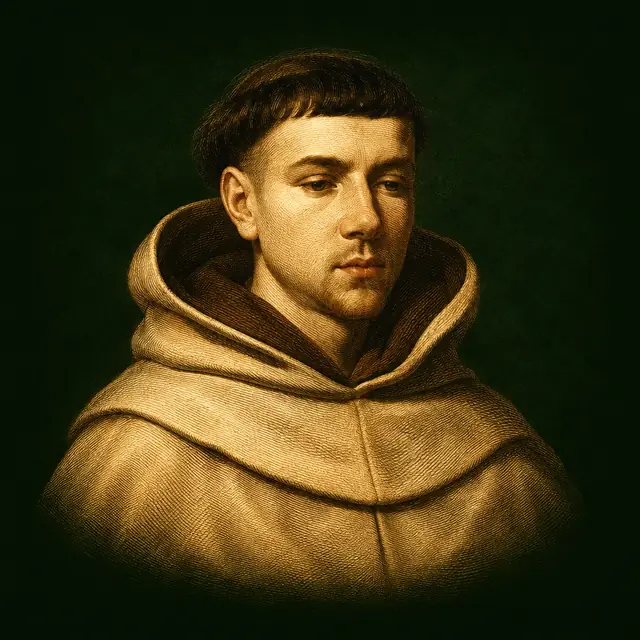
Who was John of the Cross, and what is truly known of them?
What is known
Spanish Carmelite friar and poet, born Juan de Yepes at Fontiveros in Castile, to a family of poor weavers. He joined the Carmelites at Medina del Campo in 1563, studied at Salamanca, and in 1567 met Teresa of Ávila, who won him for her reform; the first house of reformed friars opened at Duruelo in 1568. In December 1577 friars opposed to the reform seized him and held him some nine months in a cell of their house at Toledo, where he composed the first stanzas of the Spiritual Canticle. He escaped in August 1578. His prose books, The Ascent of Mount Carmel, The Dark Night and The Living Flame of Love, are commentaries on his own poems. He died at Úbeda in 1591, out of favour with his superiors, and was declared a saint in 1726.
The teaching
Taught from his poems and their commentaries, above all The Ascent of Mount Carmel, The Dark Night and The Living Flame of Love.
The nights, in brief
John teaches that the soul comes to union with God through the night: a night of the senses, in which its pleasure in created things and even its sweetness in prayer are taken away, and a night of the spirit, in which its own ways of knowing and loving are emptied for God to fill, each with a part the soul does and a part God does in it. These nights, the signs by which a guide tells them from other dryness, and the nothing, nothing, nothing of his sketch of Mount Carmel are taught on The Christian contemplatives. What follows is the rest of his teaching, as his commentaries give it.
The appetites
A soul attached to any created thing is as unlike God as darkness is unlike light, for love makes the lover like what he loves. Disordered desires, which he calls the appetites, do five harms: they weary the soul, torment it, darken it, defile it and weaken it. It makes no difference whether a bird is tied by a thin thread or a thick cord; as long as it is tied, it cannot fly. So even one small attachment, kept on purpose, holds the soul back from God.
How to enter the night
To enter the night of the senses he gives two counsels. First, to have a habitual desire to imitate Christ in everything, studying his life so as to know how to act as he would. Second, to give up, for love of Christ, any pleasure of the senses that is not purely for the honour and glory of God: if something is offered to look at or to hear that does not help toward God, not to want it. He adds maxims for leaning not toward what is easiest but toward what is harder, not toward what pleases but toward what does not, and asks that they be taken up with order and discretion, under a guide.
He is severe against penance done by self-will. Some beginners, he says, wear themselves out with fasts and penances beyond what they are allowed, hiding them from their guide; this is not virtue but a greed for spiritual satisfaction, and such penance, done against obedience, is the penance of beasts. The night is the stripping of desire, not the punishing of the body.
Faith, hope and love
On the soul's part the night of the spirit is made by the three virtues of faith, hope and love, each emptying one of its three powers: faith empties the understanding of its own knowing, hope empties the memory of what it holds, and love empties the will of every affection that is not for God. Faith is a dark night for the soul, yet it gives light, like the cloud that stood between Egypt and Israel: “it was a cloud and darkness to them, but it gave light by night to these.”
Do not lean on visions
Visions, voices and feelings in prayer, even when they come from God, are not to be desired or leaned on, for faith alone is the near means to union, and the soul that clings to such things is held back by them and easily deceived. God has nothing more to say, he teaches: in giving us his Son, his one Word, he has said everything to us at once in that one Word. Whoever now asks God for visions or revelations does wrong, for not fixing the eyes wholly on Christ.
The faults of beginners
Beginners in prayer, he says, are like a child at the breast: God gives them great sweetness, and through it they fall into faults that follow the seven capital sins in spiritual form. They grow proud of their fervour and quick to judge others; greedy for books, rosaries and new devotions; angry and impatient with their own faults; gluttonous for sweetness, so that they think nothing is happening when there is no pleasure; envious of the progress of others; and slothful before whatever is hard. The night is God's weaning, by which the soul learns to love him and not his sweets.
The log in the fire
The divine light acts on the soul in the night as fire acts on a log. First it dries it, drawing out its damp so that it weeps; then it blackens it, so that it looks darker and uglier than before; and only then does it kindle it and turn it into fire, as bright and hot as the fire itself. So the soul in the night seems worse to itself, because the light shows what was always there, and the fire that pains it now is the same fire that afterwards makes it shine.
The ladder of love
Love climbs by ten steps, which he takes from Saint Bernard and Saint Thomas. On the first the soul grows sick with love and loses its taste for everything else; on the second it seeks God without ceasing; on the third it works for him with fervour; on the fourth it suffers for him without weariness; on the fifth it longs for him impatiently; on the sixth it runs to him swiftly; on the seventh it grows bold; on the eighth it takes hold of the Beloved and does not let him go; on the ninth it burns gently in him; and on the tenth, which belongs to the life to come, it becomes wholly like him.
The living flame
The Living Flame of Love sings of the soul already on fire. The flame is the Holy Spirit, and the soul is the log become fire, whose acts of love are flames. The flame wounds tenderly in the soul's deepest centre, and that centre is God: the more love a soul has, the deeper it goes into God.
He warns there of three blind guides who can harm a soul on the road: a spiritual director who does not understand and keeps it working at meditation when God is drawing it into quiet; the devil; and the soul itself, when it does not know its own way.
Examined on love
In the evening of life, he wrote among his sayings, we shall be examined on love. And to a prioress troubled by a hard community he gave his rule in a line: where there is no love, put love, and love comes out of it.
Orders and memberships
A Carmelite friar from 1563 and, with Teresa, founder of the Discalced Carmelite friars. No other order is documented.
The legend
The early lives say the Virgin showed him the way out of his cell; the witnesses speak of a loosened lock and a rope of torn blankets. “Dark night of the soul” is now said of any low season. He meant a stage of prayer in which God is felt to be absent, and he did not use it of sadness.
Their works
- The Spiritual CanticlePoem, begun 1578
A love poem of the bride seeking the beloved through woods and meadows, after the Song of Songs, whose first stanzas he made in his cell at Toledo. Later he wrote a long prose commentary on it, stanza by stanza, as a map of the soul’s union with God.
Ask the Oracle about it - The Dark NightPoem, about 1584
Eight stanzas of a soul going out unseen on a dark night to meet the beloved, with an unfinished prose commentary. By the dark night he meant a stage of prayer in which God is felt to be absent and the soul is made ready, not any season of sadness.
Ask the Oracle about it - The Ascent of Mount CarmelBook, about 1581 to 1585
A prose treatise built on the same poem, teaching the stripping of the senses and of the mind so that faith alone can lead. He drew a sketch of the mountain for his nuns, with the path of nothing climbing to the summit.
Ask the Oracle about it - The Living Flame of LovePoem, about 1585
Four stanzas on the soul burning in the fire of the Holy Spirit, with a commentary written for a lay friend in Granada in about two weeks. It describes the height of the life of prayer.
Ask the Oracle about it
How the house tells a life
This life is told from the record, with what is documented, what is legend and what was forged kept apart. A membership in an order is stated only where documents show it. A person’s chart explains none of their deeds.
The arts it feeds
Lives near it in time
Thinkers and teachers
Marsilio FicinoJohannes ReuchlinPico della MirandolaNiccolò MachiavelliIgnatius of LoyolaTeresa of ÁvilaTycho BraheGiordano BrunoFrancis BaconTommaso CampanellaJohannes KeplerJakob BöhmeThe whole tree

