
Johannes Kepler
1571 to 1630
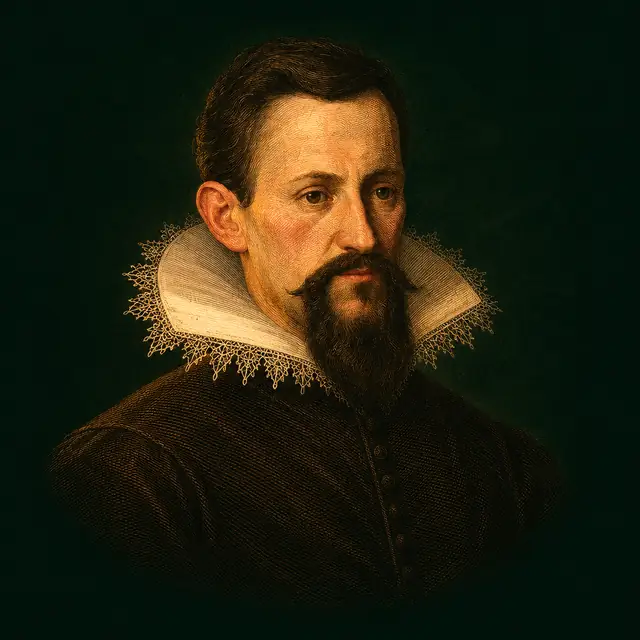
Who was Johannes Kepler, and what is truly known of them?
What is known
German mathematician and astronomer, born at Weil der Stadt. Teaching mathematics at Graz from 1594, he issued yearly calendars with forecasts, and in 1596 fitted the spacing of the six planets to the five regular solids set one inside another. In 1600 he joined Tycho Brahe at Prague and the next year followed him as imperial mathematician. From Tycho’s measurements of Mars he found that a planet moves round the Sun on an ellipse, faster when nearer (1609). The Harmony of the World (1619) adds a third law and gives each planet a tune from its swiftest and slowest motion. He cast horoscopes all his life, for Wallenstein among others, and wrote that astrology needed reform, not abolition. From 1615 to 1621 he defended his mother against a charge of witchcraft, and she was freed.
The teaching
Taught from his own books, above all The Harmony of the World, the New Astronomy and the Tertius interveniens.
The pattern of creation
Kepler teaches that God made the world after a pattern, and the pattern is geometry, as eternal as God himself. Because the human mind is made in God's image it can grasp that pattern: the figures and ratios it knows are the same ones that order the heavens, so that to find them in the sky is to think God's thoughts after him. Even the shape of the world carries the Trinity, the centre for the Father, the outer surface for the Son, and the space between them, equal at every point, for the Spirit.
The search for causes
His first book asked why there are six planets and why they stand at the distances they do, and answered with the five regular solids nested one inside another between their paths, which is taught on The Platonic solids. The answer was wrong, but the question set the course of his work: the heavens have causes, and the astronomer's task is to find them, not only to say where a planet stands.
Eight minutes
With Tycho Brahe's measurements of Mars he tried circle after circle. The best still missed Tycho's places by eight minutes of arc, a small amount, but Tycho's work was good to about two. Kepler would not let God's gift of such exact observations go to waste: those eight minutes, he writes, showed the way to the reform of the whole of astronomy. The circle had to go.
A force from the Sun
The planets are not carried by intelligences or pushed by angels; they are moved by a force that goes out from the Sun, which turns on its axis and sweeps them round, as a magnet acts at a distance, and the force grows weaker as the distance grows. So a planet moves faster when it is nearer the Sun and slower when it is farther. From this came his first two laws: each planet moves on an ellipse with the Sun at one focus, and the line from the Sun to the planet sweeps out equal areas in equal times. He called the New Astronomy a physics of the heavens, because it gave the motions a cause.
The music of the planets
The Harmony of the World finds music in those motions. It is not a sound for the ear but a ratio for the mind: take each planet's speed as seen from the Sun at its slowest and at its fastest, and compare the two. Saturn's speeds make about a major third, Jupiter's a minor third, Mars's a fifth. The Earth's make a semitone, so the Earth sings mi, fa, mi, from which, he says, one might guess that misery and famine hold sway in our home. Venus barely changes, nearly a unison, and Mercury ranges widest of all.
Together the planets make chords, which seldom all sound in harmony at once, perhaps only once, at the creation.
The third law
In the same book stands the law he sought longest. The times the planets take to go round the Sun are bound to their distances: the square of the time goes with the cube of the mean distance. So a planet twice as far from the Sun as another takes not twice as long to go round but nearly three times. He found it, he says, on the fifteenth of May 1618, after rejecting it once through an error in his reckoning.
The aspects are harmonies
Astrology, for Kepler, needs reform, and the part of it that stands firm is the aspects. The soul of the Earth, and the soul of each person, perceives the angles that the rays of the planets make with each other at the Earth, as the ear perceives a concord without counting; and the same ratios that make concords in music make the aspects work: the opposition, the trine, the square and the sextile. To these he adds aspects of his own, the quintile, the biquintile and the sesquiquadrate.
At birth the soul takes the configuration of the heavens into itself as a character it keeps for life, and later aspects stir it as they stir the weather, which he followed in diaries for years. Much of the rest, the division of the sky into houses and the lordships of the signs, he held to be human invention.
The child and the bath
His Tertius interveniens stands between a physician who wanted astrology thrown out and those who defended it whole, and its title warns theologians, physicians and philosophers not to throw out the child with the bath while rightly casting out the superstition of the stargazers. There is grain among the chaff, he argues, and it should be sifted: the heavens act on the body and stir the feelings of the soul, but they do not compel, and a person's upbringing, choices and will count for more than any figure of the stars.
The view from the Moon
His Dream carries a young man to the Moon and describes the heavens as they look from there. Those who live on its near side see the Earth hanging always in one place in their sky, waxing and waning and turning on itself, while they believe their own world stands still. The tale teaches by moving the watcher: what seems at rest to those who stand on it may be moving, and an astronomy made on the Moon would be as sure of the Moon's stillness as ours once was of the Earth's.
Orders and memberships
No order is documented. He was a Lutheran, shut out of communion at Linz because he would not sign every article of his church’s creed. He kept clear of the Rosicrucian furore and wrote against Robert Fludd’s use of number and harmony.
The legend
That he poisoned Tycho for his records, a charge raised in a book of 2004 and answered by the tests of 2012. That he scorned astrology: about eight hundred horoscopes in his hand survive, and he likened astrology to a foolish daughter whose earnings keep her wise mother, astronomy.
Their works
- The Harmony of the WorldBook, printed 1619
His great book of cosmic harmony, which gives each planet a tune from its fastest and slowest motion and sets down his third law of planetary motion. It also treats the aspects of astrology and defends them against Robert Fludd’s use of number and harmony.
Ask the Oracle about it - The Cosmographic MysteryBook, printed 1596
His first book, fitting the spacing of the six known planets to the five regular solids set one inside another. The idea was wrong, but it set him on the search for the true causes of the planets’ order.
Ask the Oracle about it - Astronomia novaBook, printed 1609
The New Astronomy, built from Tycho Brahe’s measurements of Mars, where he finds that a planet moves on an ellipse with the Sun at one focus and sweeps equal areas in equal times. It is one of the founding books of modern astronomy.
Ask the Oracle about it - Tertius interveniensBook, printed 1610
The Third Man Intervening, a book in German standing between the physician Philipp Feselius, who wanted astrology abolished, and those who defended it whole, urging that its grain be kept and its chaff thrown out. It is his fullest statement on astrology.
Ask the Oracle about it - SomniumNovel, written 1608, printed 1634
The Dream, a tale of a young Icelander whose mother, a wise woman, calls up a spirit who carries him to the Moon, which is then described as it would look to those living there. Kepler believed that copies of it fed the gossip behind his mother’s witchcraft trial; it was printed after his death.
Ask the Oracle about it - The Rudolphine TablesBook, printed 1627
Tables for working out the places of the planets at any date, built from Tycho’s measurements and his own laws and named for Rudolf II. The most exact of their age, they served astronomers and astrologers alike.
Ask the Oracle about it
How the house tells a life
This life is told from the record, with what is documented, what is legend and what was forged kept apart. A membership in an order is stated only where documents show it. A person’s chart explains none of their deeds.
The arts it feeds
Sacred geometrySound and mantraPhysics and the mysticsTarot, runes, I Ching
Lives near it in time
Thinkers and teachers
Teresa of ÁvilaJohn of the CrossTycho BraheGiordano BrunoFrancis BaconTommaso CampanellaJakob BöhmeAthanasius KircherRobert BoyleEmanuel SwedenborgThe Baal Shem TovBenjamin FranklinThe whole tree

