
Benjamin Franklin
1706 to 1790
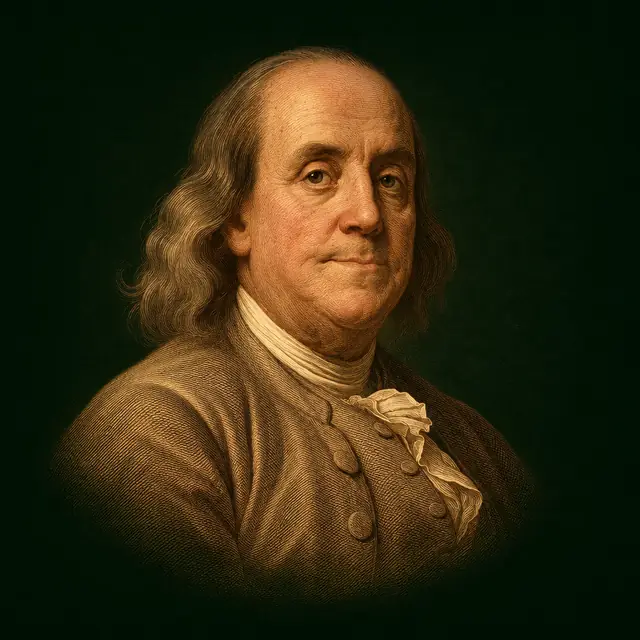
Who was Benjamin Franklin, and what is truly known of them?
What is known
Printer, writer, experimenter and statesman of Philadelphia, born at Boston. He published Poor Richard’s Almanack from 1732 to 1758, showed by experiment around 1750 that lightning is electricity, signed the Declaration of Independence in 1776 and represented the United States in France from 1776 to 1785. In 1784 he sat on the royal commission that tested Mesmer’s animal magnetism; it found no sign of the fluid and put the effects down to imagination. He died at Philadelphia in 1790.
The teaching
Taught from his own writings, above all the Autobiography, Poor Richard's Almanack and his letters on electricity.
One God, served by doing good
Franklin's creed is short. There is one God, the maker of all things, who governs the world by his providence and ought to be worshipped; the most acceptable service a person can render him is doing good to his other children; and the soul is immortal, and will be dealt with justly in another life according to its conduct in this one. These, he holds, are the essentials of every religion, and he judges a church by how far it makes people good citizens and good neighbours, not by its doctrines. He tells in his Autobiography that he never refused a small gift towards a new house of worship for any sect.
As a young printer he wrote his own epitaph in the terms of his trade. His body lies like the cover of an old book, its contents torn out and its gilding gone, food for worms; but the work will not be lost, for it will appear once more, as he believed, in a new and more perfect edition, corrected and amended by the Author.
The art of virtue
As a young man he conceived, in his own words, the bold and arduous project of arriving at moral perfection. He soon found that wishing to be good was not enough: old habits had to be broken and new ones made. So he drew up thirteen virtues, each with a short precept. Temperance: eat not to dullness, drink not to elevation. Silence: speak only what may benefit others or yourself. Order: let all your things have their places, and each part of your business its time. Resolution: resolve to perform what you ought, and perform without fail what you resolve. Frugality: spend only to do good to others or yourself, and waste nothing. Industry: lose no time, and be always employed in something useful.
Sincerity: use no hurtful deceit, and think and speak justly. Justice: wrong no one, either by injury or by leaving undone the good that is your duty. Moderation: avoid extremes, and forbear resenting injuries as much as you think they deserve. Cleanliness: tolerate no uncleanness in body, clothes or house. Tranquillity: be not disturbed at trifles, or at accidents common or unavoidable. Chastity has a precept of restraint, with care for health and for the peace of others. Humility, added when a friend told him he was thought proud, has the shortest precept of all: imitate Jesus and Socrates.
The little book
He did not work at all thirteen at once. He gave each virtue a week of strict attention, beginning with temperance, because a cool, clear head makes the rest easier, and silence next, because he wanted knowledge more by the ear than by the tongue. He kept a little book with a page for each virtue, ruled into seven columns for the days and thirteen lines for the virtues, and each night he marked a small black spot for every fault against any of them. He hoped to keep the week's own line clean, and so to go through the thirteen in thirteen weeks and the whole course four times a year, as a gardener weeds one bed at a time rather than the whole garden at once.
His day had its scheme too. On rising he asked himself what good he should do that day, and at night what good he had done. He never reached the perfection he aimed at, he wrote, but he was a better and happier man for the attempt, as a learner who copies engraved letters writes a better hand for it, though he never matches the copy.
Poor Richard's counsel
Poor Richard's Almanack teaches the same virtues to a wider public, in proverbs gathered from many nations and sharpened. Industry and thrift are its burden: lost time is never found again, God helps them that help themselves, a small leak will sink a great ship, and the sleeping fox catches no poultry.
Its astrology is a joke kept up year after year. Richard Saunders, the poor star-gazer who signs it, foretells in his first number the very hour of a rival almanac maker's death; when the rival protests in print that he is alive, Richard answers that he must be dead, for the living man, his old friend, would never have used him so ill.
The single fire
In his letters on electricity Franklin teaches that the electric fire is a single subtle fluid, present in all common matter. A body is charged when it has more than its natural share, which he calls plus or positive, or less, which he calls minus or negative, and the fire is never made or destroyed but only moved from one body to another: when a man rubs a glass tube, fire passes from him to the glass. A body with too much, brought near one with too little, shares its excess in a spark.
Pointed bodies, he found, draw the fire off silently and from a distance, and blunt ones do not. From this he reasons that lightning is the same fire in the clouds, and proposes to prove it with a pointed iron rod raised on a high place, and later with a kite, drawing the fire down its wet string to a key. If they are one fire, a pointed rod set on a house and led down into the ground will carry the lightning harmlessly away. The trials are dangerous, and a man was killed repeating them; they are history, not practice.
The test of imagination
On the commission that examined animal magnetism Franklin joined in a lesson of method. Mesmer's followers held that an invisible fluid, gathered in the magnetiser and his tubs, could be directed into a patient to heal. The commissioners did not argue about the fluid; they tested its effects. They told blindfolded subjects that they were being magnetised when they were not, and the subjects felt it; they magnetised others without their knowing, and they felt nothing. A boy led blindfold among the trees of Franklin's own garden, one of them magnetised, fell into a crisis under a tree that had not been.
Their conclusion was that imagination without magnetism produced the effects, and magnetism without imagination produced nothing, so the fluid explained nothing that belief did not.
The lodge and the club
For Franklin the lodge was one more school of the same virtues: a society of men meeting on the level to improve themselves and help one another, like the club of tradesmen he founded in his youth, which met each week to put questions of morals, politics and natural philosophy and to look for good to be done in the town. The craft's own teaching of the square, the level and the plumb is given in full in the branch on the Freemasons, among the orders and mystery schools.
Orders and memberships
A Freemason on the record: initiated in St John’s Lodge at Philadelphia in 1731 and Grand Master of Pennsylvania in 1734, the year he printed the first Masonic book in America. In Paris he joined the Lodge of the Nine Sisters, is said by the lodge’s own historians to have been present when Voltaire was received in April 1778, and served as its Master from 1779 to 1781.
The legend
That he belonged to Sir Francis Dashwood’s “Hellfire Club”: he was Dashwood’s friend and guest in the 1770s, and no list of the club names him. That the United States was founded as a Masonic design: about nine of the fifty-six signers of the Declaration are documented Masons. The bones found under his London lodgings in 1998 came from an anatomy school kept in the house by the surgeon William Hewson.
Their works
- Poor Richard’s AlmanackAlmanac, 1732 to 1758
His yearly almanac under the name of Richard Saunders, an astrologer he invented, with a mock prediction of a rival’s death, weather and tides, and the proverbs that made it famous. Its last preface was printed apart as The Way to Wealth.
Ask the Oracle about it - AutobiographyAccount, written 1771 to 1790
The story of his life up to the late 1750s, written in four parts and left unfinished: the runaway apprentice, the printer of Philadelphia, his scheme of thirteen virtues and his public projects.
Ask the Oracle about it - Experiments and Observations on ElectricityBook, printed 1751
His letters to London on electrical experiments, with the proposal to draw lightning from the clouds by a pointed rod, which first made him famous across Europe.
Ask the Oracle about it - The Constitutions of the FreemasonsBook, printed 1734
His Philadelphia reprint of the London book of Masonic history and charges, the first Masonic book printed in America, issued in the year he became Grand Master of Pennsylvania.
Written by James Anderson; Franklin printed it.
Ask the Oracle about it - Report on animal magnetismReport, 1784
The report of the royal commission that tested Mesmer’s animal magnetism, which he signed with Lavoisier, Bailly and others. Blindfolded subjects reacted only when they believed they were being treated, and the commission put the effects down to imagination.
Drafted chiefly by Jean Sylvain Bailly; Franklin was one of the signers.
Ask the Oracle about it
How the house tells a life
This life is told from the record, with what is documented, what is legend and what was forged kept apart. A membership in an order is stated only where documents show it. A person’s chart explains none of their deeds.
The arts it feeds
Orders and mystery schoolsPhysics and the mysticsConspiracies, examined
Lives near it in time
Thinkers and teachers
Johannes KeplerJakob BöhmeAthanasius KircherRobert BoyleEmanuel SwedenborgThe Baal Shem TovGeorge WashingtonThomas PaineAugustin BarruelCharles-François DupuisLouis-Claude de Saint-MartinJohann Wolfgang von GoetheThe whole tree

