
Thomas Paine
1737 to 1809
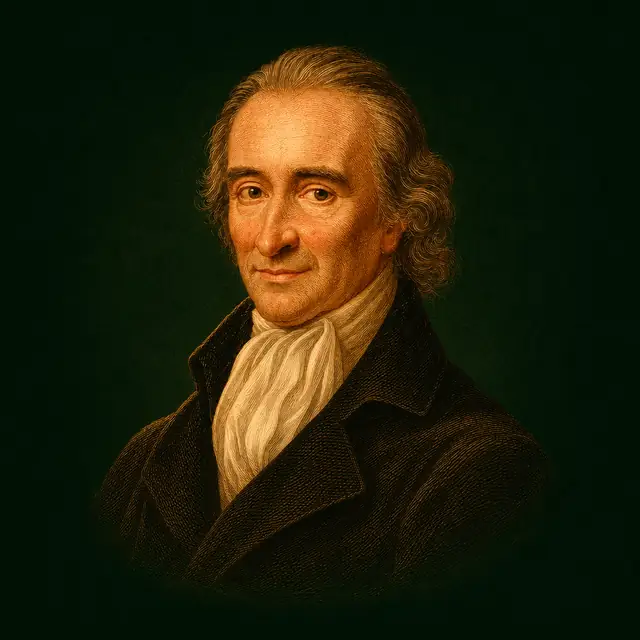
Who was Thomas Paine, and what is truly known of them?
What is known
English-born writer of the American and French revolutions: Common Sense (1776), Rights of Man (1791) and The Age of Reason (1794 to 1807). He was a deist: he wrote “I believe in one God, and no more”, held that God is known through the creation and not through any book or church, and attacked revealed religion in plain words that cost him his friends. In a late essay on the origin of Freemasonry he argued that the lodges came down from the sun worship of the Druids, and that Christianity parodies the worship of the Sun.
The teaching
Taught from The Age of Reason (1794 to 1807) and his essay On the Origin of Freemasonry.
My own mind is my own church
Paine sets out his creed at the opening of The Age of Reason. He hopes for happiness beyond this life; he believes in the equality of man; and he holds that religious duties consist in doing justice, loving mercy and endeavouring to make our fellow creatures happy. He does not believe the creed of any church, Jewish, Roman, Greek, Turkish, Protestant or other: my own mind, he writes, is my own church. Every national church is for him a human invention, set up to terrify and enslave mankind and to monopolise power and profit, yet he condemns no one who believes otherwise, since they have the same right to their belief as he has to his.
Revelation at second hand
His case against revealed religion begins with a definition. Revelation, if there is any, is something communicated immediately from God to a person. To that first person it may be revelation; when he tells it to a second, and the second to a third, it is revelation no longer but hearsay, and no one is bound to believe it on another's word. When Moses told the people that he had received the commandments from the hand of God, they had only his word for it; and the commandments, Paine notes, carry no inward proof of divinity, for any lawgiver of good sense might have made them.
The word of God is the creation
Where, then, is the word of God? Not in any book, he answers, for human language is local and changeable, open to mistranslation, to the errors of copyists and to deliberate alteration, and a word meant for all mankind cannot hang on it. The word of God is the creation we behold, which speaks a universal language every nation can read. Would we see his power, we see it in the immensity of the creation; his wisdom, in the unchanging order by which the whole is governed; his bounty, in the abundance with which he fills the earth; his mercy, in his not withholding that abundance even from the unthankful.
This is the whole of his deism: to know God by his works, and to imitate his goodness in our dealings with his creatures.
Science, the true theology
Paine holds that the sciences are the true theology. The principles of geometry and astronomy were not invented by people but discovered: they are the laws by which God governs the universe, set out in its structure as by a lecturer who invites his hearers to study and to imitate. He would have the churches teach natural philosophy in place of mysteries.
He turns astronomy against the creeds. If the stars are suns with worlds of their own, perhaps inhabited, it is past belief, he argues, that the maker of them all should leave the care of all the rest to come down and die on one small world, because one man and one woman had eaten an apple.
The Bible as a human book
In the second part he reads the Bible as he would read any ancient book, asking who wrote each part and when. The books of Moses tell of his death and burial and speak of him in the third person, so they were written after him; Genesis lists the kings who reigned in Edom before any king reigned over Israel, so it was written after Israel had kings. Mystery, miracle and prophecy, he says, are the three means by which impostors in every age have imposed on mankind.
Of Jesus he speaks with respect: a virtuous and amiable man, whose morality was of the most benevolent kind, preached in like forms by Confucius and some of the Greek philosophers before him and by good men in every age since, and never exceeded.
The Sun in the lodge
In his essay on Freemasonry Paine reads the craft as the last remnant of the religion of the Druids, and theirs as the old worship of the Sun. The lodge is laid out east and west and its Master stands in the east, where the Sun rises; the craft keeps its two great feasts at the solstices, on the days of Saint John in June and December; and its emblems of the Sun and Moon and its secrecy are, for him, the signs of a faith that hid in the lodges when the Church persecuted it. Christianity, in the same essay, is a parody on the worship of the Sun, putting a man called Christ in the Sun's place and paying him the adoration once paid to the Sun.
This is his reading. The plain record is otherwise: the craft's own documents lead back to the lodges of working stonemasons in Britain, not to the Druids.
Orders and memberships
No lodge record shows that he was a Freemason, though he wrote about the craft.
The legend
That he was an atheist: Theodore Roosevelt’s phrase, a century later, and untrue. That he was a Hermeticist, or that the United States was founded as a “Hermetic republic”: no document says so.
Their works
- Common SenseEssay, printed 1776
The pamphlet that argued in plain words for American independence and against hereditary kings, which sold in vast numbers and turned opinion towards the break with Britain.
Ask the Oracle about it - Rights of ManBook, printed 1791 and 1792
His defence of the French Revolution against Edmund Burke, arguing for natural rights, a written constitution and public help for the poor. It was banned in Britain and he was tried in his absence for seditious libel.
Ask the Oracle about it - The Age of ReasonBook, printed 1794 to 1807
His deist creed in three parts: God is known through the creation and not through any book or church, and the Bible is read as a human work. It cost him his friends and made him the most hated writer of his day.
Ask the Oracle about it - On the Origin of FreemasonryEssay, written about 1805, printed 1810
A late essay arguing that the lodges came down from the sun worship of the Druids, and that Christianity itself parodies the worship of the Sun. It was printed after his death, with passages removed.
Ask the Oracle about it - The American CrisisEssay, 1776 to 1783
A series of pamphlets written through the war to keep up the courage of the army and the people, read aloud to Washington’s troops before the crossing of the Delaware.
Ask the Oracle about it
How the house tells a life
This life is told from the record, with what is documented, what is legend and what was forged kept apart. A membership in an order is stated only where documents show it. A person’s chart explains none of their deeds.
The arts it feeds
Lives near it in time
Thinkers and teachers
Athanasius KircherRobert BoyleEmanuel SwedenborgThe Baal Shem TovBenjamin FranklinGeorge WashingtonAugustin BarruelCharles-François DupuisLouis-Claude de Saint-MartinJohann Wolfgang von GoetheWolfgang Amadeus MozartWilliam BlakeThe whole tree

