
Wolfgang Amadeus Mozart
1756 to 1791
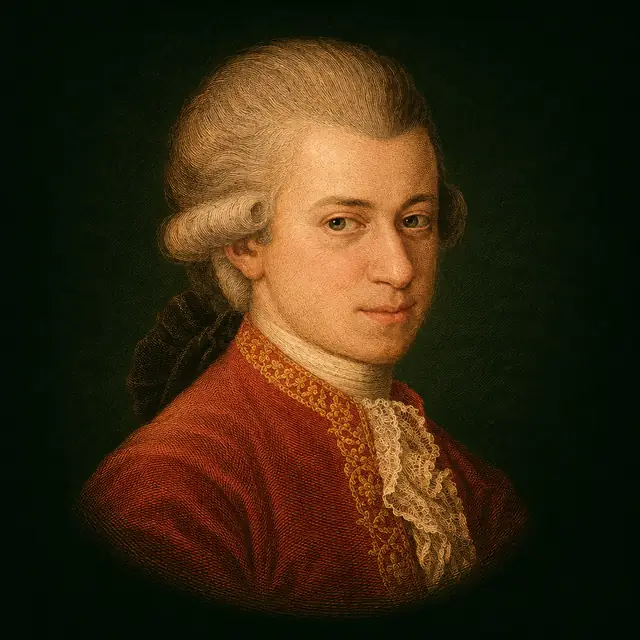
Who was Wolfgang Amadeus Mozart, and what is truly known of them?
What is known
Composer, born at Salzburg and settled in Vienna from 1781. He became a Freemason in December 1784 and wrote music for his lodge for the rest of his life: the cantata Die Maurerfreude and the Masonic Funeral Music in 1785, and a small Masonic cantata that he conducted in November 1791, less than three weeks before he died. The Magic Flute, first given on 30 September 1791 to a text by his fellow Mason Emanuel Schikaneder, sets a trial by silence, fire and water in a temple of priests and draws on the imagery of the craft. He died in Vienna on 5 December 1791 after two weeks of fever and swelling; the register gives the cause as a severe miliary fever. His lodge held a memorial and printed the address.
The teaching
Taught from his Masonic music, his letters and The Magic Flute, with Emanuel Schikaneder's text.
The craft in music
Mozart taught no doctrine in words; he set the teaching of his lodge to music. The craft's own lessons, the square, the level, the three degrees and the legend of Hiram, are given in full in the branch on the Freemasons, among the orders and mystery schools. In his music for the brethren the craft has a sound of its own: the number three, the key of E flat with its three flats, the low, veiled wind of clarinets and basset horns, and the threefold knock of the lodge door. The Masonic Funeral Music lays a chant of mourning over that dark wind, and his lodge cantatas praise light, brotherhood and the love of humankind.
Death, the best friend
In a letter to his father, then gravely ill, he set down the craft's teaching on death as his own. Since death, looked at closely, is the true goal of our life, he wrote, he had for some years made friends with this best and truest friend of mankind, so that its image no longer frightened him but brought him peace and comfort; and he thanked God for the chance, his father would understand him, of learning that death is the key to our true happiness. He never lay down at night, he added, without thinking that he might not see another day, and yet no one who knew him could say that he was gloomy.
The prince and the portrait
The Magic Flute tells the craft's way as a fairy tale. Prince Tamino, fleeing a serpent, is saved by three veiled ladies, servants of the Queen of the Night, who show him a portrait of her daughter Pamina, carried off, they say, by the tyrant Sarastro. The Queen promises him Pamina if he rescues her, and he sets out with a magic flute, together with the bird catcher Papageno, who carries a set of magic bells, and three boys to guide them.
The temple of wisdom
At the temple Tamino finds three doors, of Nature, of Reason and of Wisdom, and at the last a priest tells him that he has been deceived. Sarastro is no tyrant but the high priest of Isis and Osiris, who took Pamina out of her mother's power to keep her from harm. The world of the opera turns over: the Queen is the night, mother of lies and vengeance, and Sarastro's realm is the light of the sun, where, as he sings, one knows no vengeance in these holy halls, and a fallen man is led back to his duty by love. Tamino asks to be received, and the priests agree, if he can pass the trials.
The trials
The first trial is silence. Tamino may not speak, not even to Pamina, who comes to him in love and, finding him mute, believes herself forsaken and longs to die, until the three boys stay her hand. Papageno chatters, and fails. Then two men in armour read Tamino the writing on the pyramid: whoever walks this road full of hardship is purified by fire, water, air and earth, and if he can overcome the terror of death he will rise from the earth to heaven, and, enlightened, be able to give himself wholly to the mysteries of Isis.
Pamina is allowed to walk the last trials with him, and she leads him by the hand, for love guides her. Through the fire and through the water they pass together, he playing the flute, and come out into the light of the temple.
The night driven out
Papageno, who failed every trial, is given his Papagena all the same, for the opera has room for the plain man who wants only food, wine, a wife and children, and does not mock him. The Queen and her followers, storming the temple, are cast down into eternal night. Sarastro's last words are that the rays of the sun drive out the night, and the chorus hails the initiates and sings that strength has conquered and crowns beauty and wisdom with an everlasting crown.
What the opera teaches
Its hearers in the craft have read its lesson plainly. The way from darkness to light passes through silence, the conquest of fear and a love that keeps faith under trial; the wise rule by kindness and not by vengeance; and the light of the temple, unlike the lodges of Mozart's day, is opened to a woman who has walked the trials beside a man. The priests of Egypt, the three solemn chords of the overture and the strength, beauty and wisdom of the last chorus, the three pillars of every lodge, are the craft's own emblems, set where those who know them can see them.
Orders and memberships
A Freemason on the record: initiated on 14 December 1784 in the Vienna lodge Zur Wohltätigkeit, passed and raised in the first months of 1785, and from 1786 a member of the merged lodge Zur neugekrönten Hoffnung. His father Leopold and his friend Joseph Haydn were both received in 1785.
The legend
That Salieri poisoned him out of envy. Salieri denied it, the doctors who attended Mozart saw an illness, and there is no evidence for it. That he was thrown into a pauper’s grave: he had the plain burial in a common grave that was usual in Vienna at the time.
What was forged, or is false
That the Freemasons killed him for giving away their secrets in The Magic Flute. The tale appears in the nineteenth century, and in the 1920s and 1930s Mathilde Ludendorff turned it into a charge against Jews and Masons together. It is false: the lodge mourned him in print, and Schikaneder and the opera went on untroubled.
Their works
- The Magic FluteOpera, 1791
His German opera to a text by his fellow Mason Emanuel Schikaneder, first given in Vienna on 30 September 1791. Prince Tamino passes trials by silence, fire and water in a temple of priests of Isis and Osiris, and much of its imagery is drawn from the craft. It has been read as a Masonic opera ever since.
Ask the Oracle about it - Masonic Funeral MusicMusic, 1785
A short, grave piece for orchestra played at a lodge service of mourning in Vienna on 17 November 1785. Its sound, with low wind instruments and a chant melody, is among the most solemn he wrote.
Ask the Oracle about it - Die MaurerfreudeMusic, 1785
A cantata for tenor, male chorus and orchestra, The Mason’s Joy, written in April 1785 to honour the scientist Ignaz von Born, Master of the lodge True Concord. It was one of the first pieces he wrote for his brothers.
Ask the Oracle about it - Little Masonic CantataMusic, 1791
A cantata for the opening of a new temple of his lodge, which he entered in his catalogue on 15 November 1791 and conducted soon after. It was the last work he completed, less than three weeks before his death, and the lodge printed it after his death.
Ask the Oracle about it - RequiemMusic, 1791
A setting of the Mass for the dead, commissioned without a name by Count Walsegg in memory of his wife and left unfinished at Mozart’s death. His pupil Franz Xaver Süssmayr completed it. The tale of a masked stranger sent from the other world grew from that unnamed commission.
Unfinished; much of it was completed by Süssmayr and others after his death.
Ask the Oracle about it - Thamos, King in EgyptMusic, 1773 to 1779
Choruses and music for a play by Tobias von Gebler set among the priests of the Sun at Heliopolis. Written years before he became a Mason, it already shows the Egyptian temple and its priests that return in The Magic Flute.
Ask the Oracle about it
How the house tells a life
This life is told from the record, with what is documented, what is legend and what was forged kept apart. A membership in an order is stated only where documents show it. A person’s chart explains none of their deeds.
The arts it feeds
Sound and mantraOrders and mystery schoolsConspiracies, examined
Lives near it in time
Thinkers and teachers
George WashingtonThomas PaineAugustin BarruelCharles-François DupuisLouis-Claude de Saint-MartinJohann Wolfgang von GoetheWilliam BlakeGodfrey HigginsRobert TaylorPhineas QuimbyRalph Waldo EmersonGiuseppe MazziniThe whole tree

