
Phineas Quimby
1802 to 1866
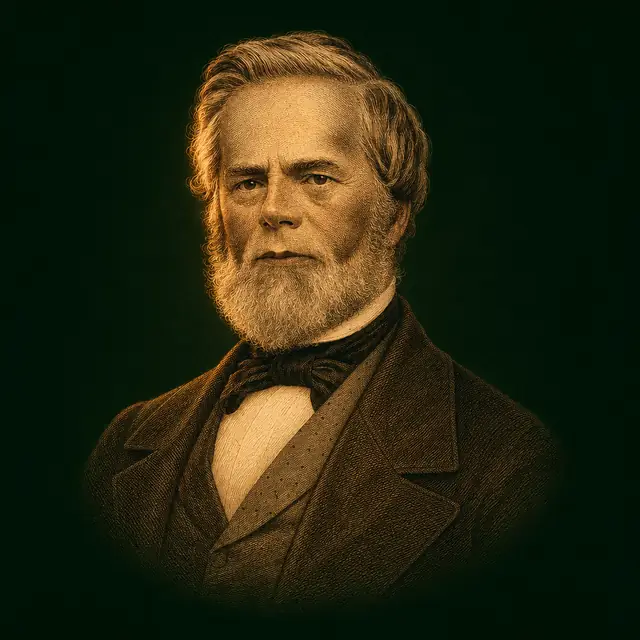
Who was Phineas Quimby, and what is truly known of them?
What is known
American clockmaker of Belfast, Maine, born at Lebanon, New Hampshire. After hearing a travelling lecturer on mesmerism about 1838 he took up the practice, and in the 1840s gave demonstrations with a young subject, Lucius Burkmar. He came to hold that the cures owed nothing to magnetism and everything to the patient’s belief, gave up mesmerism, and from 1859 to 1865 received patients at Portland, treating them by talk alone. Mary Baker Eddy, then Mrs Patterson, came to him as a patient in 1862. His notes were printed in 1921 as The Quimby Manuscripts.
The teaching
Taught from his own notes and essays, printed as The Quimby Manuscripts (1921) and The Complete Writings (1988).
The error that makes the sickness
Quimby teaches that disease is an error, a false belief planted in the mind, often by a frightening diagnosis or a fearful word, which the body then acts out, and that the explanation of how the belief arose is itself the cure. That teaching, and the movement that grew from it, are given in the branch on where it comes from, among Imagination and intention. Here is the rest of what is his, in his own terms, with the caution that belongs to it: it is his belief, never a reason to delay or refuse a doctor's care, and an illness is not the fault of the person who has it.
Truth and belief
Man, Quimby writes, is made up of truth and belief. Truth is what he calls wisdom or science: what is so, whatever anyone thinks. Belief is opinion, received from parents, priests, doctors and the talk of the world, and taken for knowledge. Most of the misery of life, in his account, comes from opinions held as truths, and his whole practice is to part the two: to find, under a patient's sickness, the belief that made it, and to show the patient that it was only a belief.
Mind as spiritual matter
His picture of the mind is not the usual one. Mind, he holds, is a kind of spiritual matter, a fine substance that receives impressions and takes shapes as soft clay does. An idea is a shape in that matter, and the body, which follows the mind, takes the shape too: a fear of a wasting disease, held long enough, forms its image first in the mind and then in the flesh. Behind the mind stands the real self, which he calls wisdom or the scientific man, which is not moved by opinions and can see them for what they are.
What the trance taught him
He came to this, as he tells it, through mesmerism. His subject Lucius Burkmar, in the trance, would describe a patient's illness and prescribe a remedy, and patients improved. But the remedies, Quimby saw, did not matter: a cheaper one worked as well when the patient believed in it, and Lucius seemed to read the patient's own belief, or the doctor's, rather than the disease. He concluded that no magnetic fluid was at work, only mind acting on mind, and he put the trance aside.
Sitting with the patient
His method was a conversation. He sat with the patient, often silent at first, and by his own account took on in himself the patient's feelings and pains, so that he could tell them what they felt and how the belief had begun. Then he explained it: who had told them what, when the fear had taken hold, and why it was an opinion and not a fact. He asked for no faith in himself and gave no medicine. When the patient saw the error, he held, the body was free to return to its own health.
Jesus and the Christ
Quimby reads the Gospels in the same light. Jesus was a man; the Christ was the science he taught and practised, the wisdom that knows truth from opinion and heals by explaining. The healings of the Gospels, in his reading, were not miracles but the work of that science, which the churches lost when they turned it into a creed, and which anyone may learn, since it is only the truth about how the mind acts on the body. He called what he practised the science of health and happiness.
The words that frighten
His hardest words are for those who frighten. The doctor who names a disease and foretells its course, in his view, often plants the very belief that makes it, and the preacher of hell and judgement makes the soul sick in the same way. Words are not idle: a sentence spoken with authority to a frightened person can do lasting harm, and the healer's first duty is to undo it. This is his teaching, given as his. A doctor's diagnosis is knowledge to act on with that doctor, and his view of medicine is no guide to anyone's care.
Orders and memberships
No order is documented. He founded none and taught no initiates; the New Thought movement, which names him as its source, took shape after his death among his former patients.
The legend
That Christian Science was taken from his manuscripts. His patients’ families said so in print from the 1880s; the Church of Christ, Scientist has always denied it, and scholars still differ on how much Mrs Eddy owed him. His own count of some twelve thousand patients cannot be tested, for he kept no case records that survive.
Their works
- The Quimby ManuscriptsPapers, 1921
His notes and essays on healing by the mind, edited by Horatio Dresser and printed more than fifty years after his death. They became the founding text of the New Thought movement and the centre of the long dispute over what Mary Baker Eddy owed him.
Edited by another hand, and some passages survive only in copies made by his patients.
Ask the Oracle about it - The Complete WritingsCollection, 1988
A fuller edition of his papers in three volumes, edited by Ervin Seale. It prints much that the edition of 1921 left out and lets his thought be read as he wrote it.
Ask the Oracle about it - The True History of Mental ScienceAccount, 1887
A lecture by his former patient Julius Dresser, printed as a pamphlet, claiming for Quimby the discovery of healing by the mind. It began the public quarrel with Christian Science.
Ask the Oracle about it
How the house tells a life
This life is told from the record, with what is documented, what is legend and what was forged kept apart. A membership in an order is stated only where documents show it. A person’s chart explains none of their deeds.
The arts it feeds
Lives near it in time
Thinkers and teachers
Louis-Claude de Saint-MartinJohann Wolfgang von GoetheWolfgang Amadeus MozartWilliam BlakeGodfrey HigginsRobert TaylorRalph Waldo EmersonGiuseppe MazziniGerald MasseyLahiri MahasayaRamakrishnaWilliam JamesThe whole tree

