
Ramakrishna
1836 to 1886
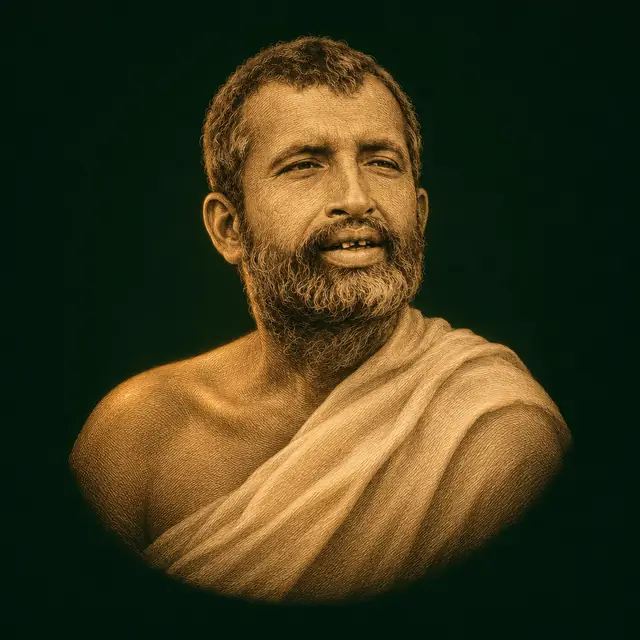
Who was Ramakrishna, and what is truly known of them?
What is known
Bengali Hindu saint, born Gadadhar Chattopadhyay in the village of Kamarpukur. From 1856 he served as priest of the temple of Kali at Dakshineswar, on the river north of Calcutta, and lived there for thirty years. His tradition records that he practised in turn the devotion of Kali, the disciplines of Tantra and the non-dual Vedanta under teachers who came to him, and for a time the ways of Islam and of Christianity, and taught that all are paths to one goal. He married Sarada Devi, whom his followers honour as the Holy Mother. His talks from 1882 were written down by a disciple and printed as the Kathamrita. He died of cancer of the throat.
The teaching
Taught from his talks as M. wrote them down in the Kathamrita, in English The Gospel of Sri Ramakrishna.
As many faiths, so many paths
Ramakrishna's best known teaching is that every sincere faith leads to God: as many faiths, so many paths. He gives it in pictures. A pond has several bathing steps; at one the Hindus draw water and call it jal, at another the Muslims call it pani, at a third the Christians call it water, and it is the same water. A chameleon lives on a tree; one man who saw it says it is red, another green, another blue, and they quarrel, until the man who lives under the tree tells them it takes every colour, and sometimes none. Each faith knows God in the colour it has seen, and only the one who has lived with God knows that he is all of them and beyond them all.
His tradition holds that he walked the paths himself to prove it, and his counsel follows from it: keep firmly to your own path, and neither hate nor mock another's.
Brahman and the Mother are one
God, for Ramakrishna, is both without form and with form. When he thinks of the Supreme as inactive, neither creating nor preserving nor destroying, he calls it Brahman; when he thinks of it as active, making, keeping and dissolving the worlds, he calls it Shakti, the Power, the Divine Mother, Kali. They are not two, any more than fire and its power to burn, or milk and its whiteness, or the snake lying still and the snake moving. The knower of non-duality and the lover of the Mother speak of one reality.
Lust and greed
What keeps a person from God is attachment, and he names its two great forms with a plain phrase of his Bengal, woman and gold, meaning lust and greed; to women, his hearers record, he spoke of man and gold. He does not tell householders to leave their homes. He tells them to live in the world like a maidservant in a rich house, who does all her work, speaks of the master's children as her own, and knows all the while that her real home is elsewhere; or like the mudfish, which lives in the mud and keeps its skin bright.
First tie yourself to God, he says, and then live in the world, as one rubs oil on the hands before cutting a jackfruit, so that its sticky milk does not cling.
The young plant needs a fence
The beginner needs solitude. A young plant must be fenced, or the goats and cattle eat it; once it is a tree, an elephant may be tied to it. So the one who is starting should go apart now and then, for a day or a few days, to pray and weep for God in secret, and should meditate in the mind, in a corner, or in the forest. Discrimination is the daily practice: to tell, in every matter, the real from the unreal, holding that God alone is real and all else passes.
Longing
The one thing needful is longing. A disciple asked his teacher how to see God, and the teacher took him to a river and held his head under the water, and when he let him up asked what he had wanted most. Air, said the disciple. When you long for God as you longed for air, said the teacher, then God is seen. Ramakrishna gives another measure: put together the worldly man's love for his possessions, the mother's love for her child and the faithful wife's love for her husband, and when one's love for God is as strong as all three together, God is seen.
The kitten and the young monkey
There are two ways of surrender, and he honours both. The young monkey clings to its mother with its own strength as she leaps, and so the striving devotee holds on to God by effort. The kitten only cries, and the mother cat picks it up and carries it where she will, now to the kitchen, now to the master's bed, and so the devotee who has given everything up rests in the Mother's care and only calls to her. Prayer for him is a child crying to its mother, and he tells his hearers to cry to her with a longing heart, for she cannot stay away from a crying child.
The servant I
The ego is the last knot. If the I will not go, he says, let it stay as the servant of God, the child of God, the devotee; that I is harmless, like a burnt rope that keeps its shape but cannot bind. What binds is the unripe I, the one that says my house, my wealth, my learning. With the poet Ramprasad he would say that he wanted to taste sugar, not to become sugar: the devotee keeps the small distance of love in order to enjoy God, while knowing that in the end there is only the One.
The salt doll
Of the highest state he speaks only in pictures, because it cannot be told. A salt doll went to measure the depth of the ocean; it had barely entered the water when it melted, and who was left to report the depth? So the one who enters the Absolute in samadhi does not come back to describe it. Every scripture, he says, has been made impure by passing over the human tongue, like food that has been tasted; but no one has ever been able to say what Brahman is, and so Brahman alone has never been defiled.
Love for this age
For the people of this age, he teaches, the way of love is the easiest: the path of Narada, of singing God's name and praying with longing, suits those whose life hangs on food and who have little time. Knowledge and love lead to the same end and he honours both, but he warns against dry learning that never prays, and against the pride of those who argue about God without ever having longed for him. Non-duality and devotion, which he joined, are taught in full in the branches on Vedanta and on bhakti, among the mystics.
Orders and memberships
By his tradition’s account he was initiated a monk by Tota Puri, a wandering teacher of the Dashanami order. The Ramakrishna Order of monks was formed after his death by his young disciples, led by Vivekananda.
The legend
That he is God come in human form is the faith of his followers, and the house leaves it as theirs. The visions told of him rest on his own words as disciples recorded them; the chief record was printed in Bengali from 1902 on, some years after the talks, by one listener.
Their works
- Sri Sri Ramakrishna KathamritaAccount, 1902 to 1932
His talks from 1882 to 1886, written down by the disciple Mahendranath Gupta, who signed himself M., and printed in Bengali in five volumes. It was put into English as The Gospel of Sri Ramakrishna in 1942. It is the chief record of his teaching.
Written down by one listener and printed years after the talks.
Ask the Oracle about it - Sri Ramakrishna LilaprasangaBiography, 1909 to 1919
The life of Ramakrishna by his disciple Swami Saradananda, a monk of his order, in five parts. It tells of his practice of many paths in turn, and it is the life his order holds as standard.
Ask the Oracle about it - Ramakrishna: His Life and SayingsBiography, 1898
A short life by the scholar Max Müller, from material sent him by Vivekananda. It first made Ramakrishna known to readers in Europe. Müller wrote as a scholar of Sanskrit and treated him with respect, as a living example of Hindu devotion.
Ask the Oracle about it - Ramakrishna and His DisciplesBiography, 1965
A life by the English novelist Christopher Isherwood, himself a follower of the Vedanta Society. It brought Ramakrishna to a wide readership in English. It was written with the help of the monks of the order, and it follows their account of his life.
Ask the Oracle about it
How the house tells a life
This life is told from the record, with what is documented, what is legend and what was forged kept apart. A membership in an order is stated only where documents show it. A person’s chart explains none of their deeds.
The arts it feeds
Lives near it in time
Thinkers and teachers
Robert TaylorPhineas QuimbyRalph Waldo EmersonGiuseppe MazziniGerald MasseyLahiri MahasayaWilliam JamesFrederic MyersFriedrich NietzscheSri YukteswarNikola TeslaÉmile CouéThe whole tree

