
Gerald Massey
1828 to 1907
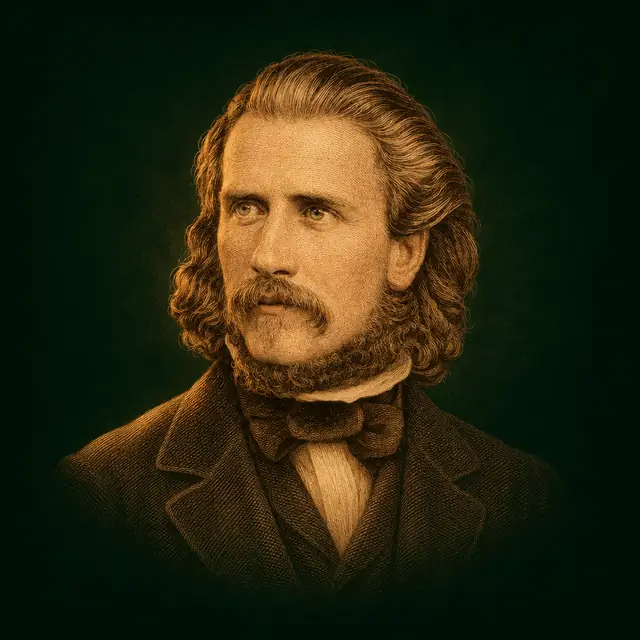
Who was Gerald Massey, and what is truly known of them?
What is known
English poet, born near Tring in Hertfordshire, the son of a canal boatman, who worked in a silk mill from the age of eight. He wrote for the Chartist press and made his name with poems in the 1850s. From the 1870s he lectured on Spiritualism in Britain, America and Australia and gave thirty years to three large works on Egypt: A Book of the Beginnings (1881), The Natural Genesis (1883) and Ancient Egypt, the Light of the World (1907). They argue that the Christian story was drawn from the Egyptian myth of Horus. He was not a trained Egyptologist and leaned on the translations of others.
The teaching
Taught from his own books, above all A Book of the Beginnings, The Natural Genesis and Ancient Egypt, the Light of the World.
Out of Africa and Egypt
Massey teaches that the beginnings of human language, myth and religion lie in Africa, and that Egypt, which he calls by its old name Kam, the black land, kept them in their fullest form. Every people that went out from the Nile valley carried part of that first learning away with it, and its traces, he holds, can be found in the words, rites and stories of Britain, India, Israel and the Americas alike. His three large works are one long attempt to follow them back to their source.
Typology: the sign before the god
His method he calls typology. The first people did not begin with ideas of gods; they began with natural facts, which they marked with signs, a type for each: the water that brings life, the mother who bears, the moon that waxes and wanes, the star that rises before the flood. Myth, in Massey's teaching, is the language of these types, and religion arose when later peoples took the types for persons and the signs for history. To read a myth rightly is to trace each figure back to the natural fact it first stood for.
Stars, moon and Sun
The types were read from the sky in a fixed order. First came the stars, in what he calls the stellar mythos: the Great Bear and the pole, the stars that never set, figured as the mother of time and of the seasons, and Sothis, whose rising announced the flood of the Nile. Then came the moon, with its changes, its dying and its rebirth each month. Last came the Sun, whose daily and yearly course became the drama of the god who dies and rises. The solar religions of the later world are, in his account, the top layer of a long building.
The two Horuses
At the heart of his reading stand two figures of Horus. The first is Horus the child, born of the mother, weak and mortal, the type of the seed and of the soul in the flesh, who suffers and is lost. The second is Horus the adult, the son of the father, who rises in power and spirit, the type of what survives. The one passes into the other through death and resurrection, and Massey reads that passage as the oldest picture of the soul's journey from the body into the life beyond.
Amenta, the land of the dead
His other great subject is the Egyptian book he calls the Ritual, the texts now known as the Book of the Dead. He reads it as the first account of the soul's journey through Amenta, the hidden land of the west: its judgement in the hall of the two truths, its heart weighed against the feather of Maat, its passage past the keepers of the gates, and its rising into the light. Every later teaching of judgement and of heaven, in his view, descends from this drama, and Spiritualism, which he held to be true, is its continuation in the present day.
The myth made history
From these strands he draws his claim about Christianity. The Gospel story, he argues, is the Egyptian drama of Horus and the Ritual of the soul turned into the life of a man by readers who had lost the key, and he derives the title Christ from an Egyptian word for the mummy, the one prepared and anointed for the life beyond. Against the faith that took the myth for history he sets a gnostic Christianity, which knew the Christ as a figure of the soul.
The plain facts answer him. Christos is the Greek for anointed, translating the Hebrew messiah, and owes nothing to Egyptian; and the Egyptian texts tell the birth of Horus otherwise, as the branch on the authors of astrotheology, among The sky in the scriptures, sets out.
Orders and memberships
No order is documented. A modern Druid order lists him among its past chiefs, and historians of Druidry treat that list as a later invention.
The legend
That Egyptian texts give Horus a virgin birth on 25 December, twelve disciples, a crucifixion and a rising after three days. These likenesses are Massey’s own readings; Egyptologists do not find them in the sources, and later books and films that repeat the list lean on him and on Alvin Boyd Kuhn, not on Egypt.
Their works
- Ancient Egypt, the Light of the WorldBook, 1907
The last of his three large works on Egypt, printed in the year of his death, arguing that the Christian story was drawn from the myth of Horus. Egyptologists do not find his likenesses in the sources, and later books and films that repeat them lean on him.
Ask the Oracle about it - A Book of the BeginningsBook, 1881
Two volumes arguing that the languages and myths of Britain and of the world began in Egypt and Africa. He was not a trained Egyptologist and leaned on the translations of others.
Ask the Oracle about it - The Natural GenesisBook, 1883
Two more volumes tracing the origins of myth, symbol and religion to Egypt. With the books before and after it, it was his thirty years of work on one thesis. Like them it leans on others’ translations, and Egyptologists do not accept its readings.
Ask the Oracle about it - Babe Christabel and Other PoemsPoem, 1854
The book of poems that made his name, from the son of a canal boatman who worked in a silk mill as a child and wrote for the Chartist press. George Eliot is said to have drawn on him for her radical hero Felix Holt.
Ask the Oracle about it - Shakspeare’s Sonnets Never Before InterpretedBook, 1866
A long study of Shakespeare’s sonnets, arguing that many were written for the Earl of Southampton and his circle. It shows the literary scholar before his turn to Egypt.
Ask the Oracle about it
How the house tells a life
This life is told from the record, with what is documented, what is legend and what was forged kept apart. A membership in an order is stated only where documents show it. A person’s chart explains none of their deeds.
The arts it feeds
Lives near it in time
Thinkers and teachers
William BlakeGodfrey HigginsRobert TaylorPhineas QuimbyRalph Waldo EmersonGiuseppe MazziniLahiri MahasayaRamakrishnaWilliam JamesFrederic MyersFriedrich NietzscheSri YukteswarThe whole tree

