
Sri Yukteswar
1855 to 1936
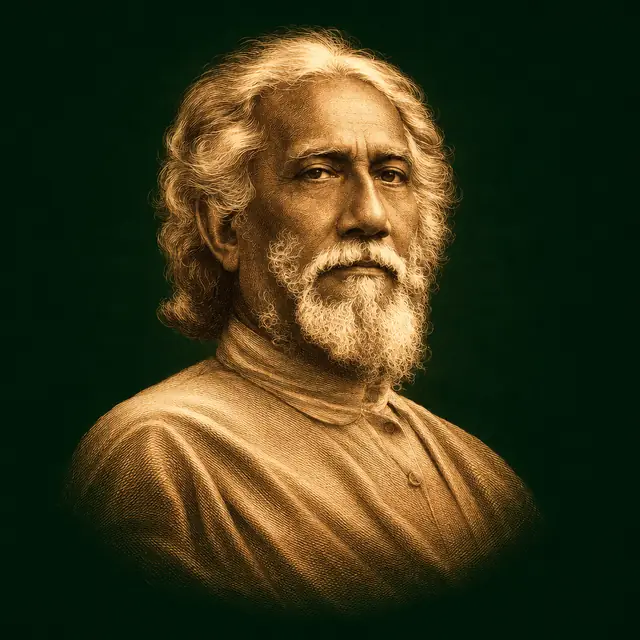
Who was Sri Yukteswar, and what is truly known of them?
What is known
Indian yogi and astrologer of Bengal, teacher of Paramahansa Yogananda, who made him known in Autobiography of a Yogi (1946). His short book The Holy Science (1894) sets passages of the Bible beside Hindu scripture and gives his own reckoning of the world ages: a cycle of 24,000 years, which he tied to the precession of the equinoxes and to the Sun moving round a companion star.
The teaching
Taught from his book The Holy Science (1894), with what Yogananda's Autobiography of a Yogi records of his teaching.
The cycle of the ages
The sun, Yukteswar teaches, does not stand still. With its planets and their moons it circles a companion star in about 24,000 years, and this circling carries the equinoxes backwards round the zodiac. It moves too round a grand centre, Vishnunabhi, the seat of Brahma, the universal magnetism, which governs dharma, the mental virtue of the inner world. When the sun comes nearest that centre, with the autumn equinox at the first point of Aries, a person can grasp everything, even the mysteries of Spirit; twelve thousand years later, with the equinox at the first point of Libra, nothing beyond gross matter can be understood. The cycle is two arcs of 12,000 years, one descending and one ascending.
Each arc has four ages, measured by what the intellect can grasp in them. Kali Yuga lasts 1,200 years, and the mind knows only the gross material of the outer world. Dwapara lasts 2,400, and the mind grasps the fine matters, the electricities and their attributes. Treta lasts 3,600, and it grasps divine magnetism, the source of all electrical forces. Satya lasts 4,800, and it comprehends all, even God the Spirit beyond the visible world. He takes the rule from a verse of Manu: Satya is 4,000 years with a twilight of 400 at either end, and in each lower age the thousands and the hundreds fall by one.
Where the world stands now
By his reckoning the descent began in 11,501 BC and reached its darkest point about AD 499. The ascending Kali Yuga ran to 1599, and in its twilight people began to notice the fine matters: Gilbert discovered magnetic forces and found electricity in all material substances, Galileo made his telescope, Newton found the law of gravitation, and steam was put to work. The twilight of Dwapara runs from 1699 to 1899, and then the true Dwapara begins, which brings a thorough understanding of the electricities. He dates his own introduction 194 Dwapara, asks that years be numbered by their age rather than by the eras of famous men, and sets the next Treta Yuga at AD 4099.
The almanacs of his day give Kali Yuga 432,000 years, and he explains the error. When the last descending Dwapara ended, he says, the wise men of the court withdrew to the Himalayas, no one was left who could reckon the ages, and the years of Kali went on being counted as though Dwapara continued. When the mistake was noticed, the learned reconciled it by calling the 1,200 years of Kali years of the gods, each equal to 360 of ours. The present, in his teaching, is no dark age with hundreds of thousands of years to run, but the early part of an age of rising understanding.
The Word and the Holy Ghost
God, Parambrahma, is everlasting, complete, without beginning or end, one indivisible Being: the Eternal Father and the only real substance, Sat. His nature is an almighty force, which is repulsion, and an omniscient feeling, which is love and attraction. The force shows itself as vibration, heard as a peculiar sound, the Word, Amen, Aum, and from it come time, space and the atom. These, with the Word, are four ideas and nothing more, which is why he calls creation a play of ideas on the one substance; beside this he sets the opening of John, that in the beginning was the Word, and the Amen of the Revelation, the beginning of the creation of God.
The atoms together are Maya, the darkness, because they keep the spiritual light out of comprehension; each atom alone is Avidya, ignorance, because it makes a person ignorant even of their own self. The love of God shines on this darkness to draw it back to Him, and that shining is the Holy Ghost, Kutastha Chaitanya. The darkness cannot receive the light but reflects it, and the reflections are the Sons of God: the light that shines in darkness, which the darkness comprehended not.
Twenty-four elders and five sheaths
Drawn by that love, the atom becomes the heart, Chitta, in which the ego appears, the idea of a separate self, which he calls the son of man. The heart has two poles: Buddhi, the intelligence, drawn toward the real, and Manas, the mind, which turns away and makes a world for enjoyment. From the heart come five electricities, and from their three qualities the five organs of sense, the five organs of action and the five objects of sense; the objects combined make gross matter in five forms, solid, liquid, fire, gas and ether. These twenty, with mind, intelligence, heart and ego, are the twenty-four principles of creation, which he reads as the four and twenty elders round the throne.
The self is wrapped in five sheaths: the heart, the sheath of bliss; the intelligence; the mind with the senses; the life force; and the gross body, the sheath of food. Creation's return to God is the withdrawing of these sheaths one by one: where the sheath of life opens there are plants, where the senses open, animals, and where the sheath of knowledge opens, the human being, who can tell right from wrong. A person who withdraws that sheath too becomes an angel, a devata; one whose heart is withdrawn is free, a sannyasi, a son of God.
The five states of the heart
He classes people not by birth but by the state of the heart, and names five states. In the dark heart a person believes gross matter is all there is; this is the natural Sudra, and an age when most people live so is Kali Yuga. In the propelled heart, comparing waking life with dreams, a person begins to doubt that the outer world is solid and struggles for the truth; this is the natural Kshatriya, who seeks a teacher. In the steady heart, baptised in the holy sound, a person grasps the fine forces within and is twice born, the state of Dwapara. In the devoted heart a person understands the heart itself and with it the whole of Maya, the state of Treta. In the clean heart, free of every outer idea, a person comprehends the spiritual light, Brahma, and is a Brahmana, the state of Satya.
Love, the guru and the holy sound
The heart's natural love, Sraddha, is the first requisite of a holy life; without it, he says, a person cannot take one step. It leads to a true teacher, the Sat-Guru, whom he knows by the effect: those who remove our troubles, clear our doubts and give peace do a godlike work, and those who increase doubt are to be avoided like poison. Whatever a person's creed, he closes, whoever cultivates this love rightly is on the right path.
The way runs through the restraints and observances of yoga, the removal of the eight meannesses of the heart, which he names as hatred, shame, fear, grief, condemnation, race prejudice, pride of family and a narrow respectability, and then a steady posture, the control of the breath and the turning of the senses inward. With the senses gathered at the door of the inner world, the disciple hears the Word as a peculiar knocking sound and sees a light. This he calls baptism, the second birth, in the holy stream that Hindus name the Ganga and Christians the Jordan.
He holds that the breath, controlled as a guru teaches it, rests even the involuntary nerves and checks the decay of the body, and he leaves the method to be learned at a teacher's feet. The house keeps that limit: breath is never held or forced from a book, and anyone with a condition of the heart or lungs asks a doctor first.
Natural living
Living depends on three choices, food, dwelling and company, and since our senses are spoiled from infancy we must choose by observation and reason. He compares the teeth and bowels of the animals, finds the human frame like that of the fruit eaters, and concludes that grains, fruits and roots, with milk and pure water, are the natural food of the human being, well chewed. The natural dwelling is fresh air, a field, a garden or a dry place under trees; the natural company is those who calm us and leave us at peace. It is his reasoning, and a change of diet is best made gradually, with a doctor's advice wherever health requires it.
The stars and the will
Yogananda records his teaching on astrology. A child is born, he said, at the hour when the rays of the heavens are in harmony with its own karma, so that the horoscope is a portrait of the past and its probable results. But the heavens show their message at birth not to fix a fate but to rouse the will to escape it: what a person has done, a person can undo, and the stars, which feel neither kindness nor malice, move least the one whose realisation is deepest. For those not yet so free he recommended an astrological bangle of metals, worn against the harsher pulls of the planets.
Orders and memberships
A swami of the Giri order of Hindu monks, and a disciple of Lahiri Mahasaya in the line of Kriya Yoga.
The legend
His 24,000 years. The traditional Hindu texts give ages vastly longer; the precession astronomers measure takes about 25,800 years and comes from the pull of Sun and Moon on the Earth, not from a companion star, and none has been found.
Their works
- The Holy ScienceBook, 1894
His short book setting passages of the Bible beside Hindu scripture to show their agreement, with his own reckoning of the world ages in a cycle of 24,000 years. Astronomers do not accept his reasons, and the traditional Hindu texts give ages far longer.
Ask the Oracle about it - Autobiography of a YogiAccount, 1946
The book by his disciple Paramahansa Yogananda, which tells of his years in Yukteswar’s hermitage at Serampore and made him known to the world. Most of what is known of him comes from it.
Written by a disciple, and its wonders rest on his telling.
Ask the Oracle about it
How the house tells a life
This life is told from the record, with what is documented, what is legend and what was forged kept apart. A membership in an order is stated only where documents show it. A person’s chart explains none of their deeds.
The arts it feeds
Lives near it in time
Thinkers and teachers
Gerald MasseyLahiri MahasayaRamakrishnaWilliam JamesFrederic MyersFriedrich NietzscheNikola TeslaÉmile CouéArthur Conan DoyleWallace WattlesWilliam Walker AtkinsonVivekanandaThe whole tree

