
Nikola Tesla
1856 to 1943
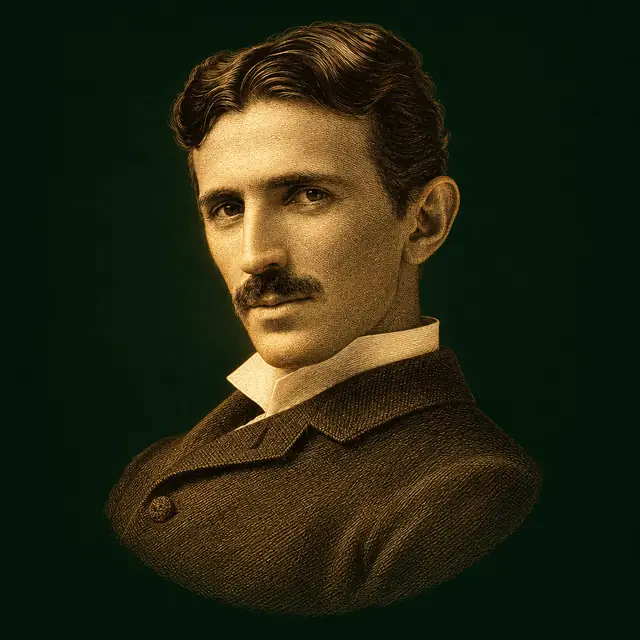
Who was Nikola Tesla, and what did he truly say of 3, 6 and 9?
What is known
Serbian-American inventor and engineer. His induction motor and polyphase system (patents of 1888) made alternating current the way the world moves power; the Tesla coil (1891) and work on wireless signalling and remote control followed. His tower at Wardenclyffe, meant to send power without wires, was never put to work. He died alone in a New York hotel in 1943. Biographers record his compulsions with the number three: he walked round a block three times before entering a building, and wanted rooms whose numbers divided by three.
The teaching
Taught from his own essays, above all The Problem of Increasing Human Energy (1900) and My Inventions (1919).
The engineer's habit of mind
Tesla's engineering, the alternating current, the turning magnetic field and the resonance of the coil, is taught in full in the branch Tesla and 3, 6, 9 of Physics and the mystics, with the sayings later laid on his name. Its core is a habit he describes himself: he builds an invention whole in his imagination, runs it, corrects it and even notes when it is out of balance, and makes it in metal only when he can find no fault. What follows is the thought of his essays, where the engineer turns to the human being.
Humanity as one moving mass
Human life, he begins, is a movement, and wherever there is movement there is a mass moved by a force. All mass has inertia and every force calls up an opposing force, so every movement in nature is rhythmical, from the swing of a pendulum to the birth, growth and death of a person, a family or a nation. Humanity is a single body in this movement. Though free to think and act, he writes, we are held together, like the stars in the firmament, with ties inseparable. He cuts his finger and it pains him, because the finger is part of him; he sees a friend hurt and it hurts him too; he sees an enemy struck down and still it grieves him. The individual passes, races and nations come and go, but humanity remains.
Its energy can be measured as the energy of any moving body is measured, by half the mass multiplied by the square of a velocity, and the great problem of science is to increase it. There are only three ways: to increase the mass, to reduce the force that holds it back, and to increase the force that drives it on. He sums them up in three words, food, peace and work, and says that after long thought he found them to be what he had been taught as a child, the keynotes of the Christian religion.
Food: increasing the mass
The mass grows by care of health, by substantial food, moderation and regular habits, by marriage and the conscientious care of children: by the precepts of religion and of hygiene. Whisky, wine, tea, coffee and tobacco shorten many lives, and he asks for moderation rather than prohibition; far more lives, he says, are lost to impure water, and he would have all drinking water boiled or sterilised. The body is to be kept clean as a priceless gift, a work of art so delicate that a word, a look, even a thought may injure it. He prefers growing vegetables to raising cattle, calls vegetarianism a commendable departure from a barbarous habit, and looks to fertiliser made by burning the nitrogen of the air in his electrical discharges, so that the soil may feed more people.
Peace: reducing what holds it back
What holds humanity back is partly friction and partly negative force. Ignorance, stupidity and imbecility are friction, resistance without direction, and ignorance is the greatest of them, made worse by the many languages and nations; it is lessened only by the spread of knowledge and the drawing together of humanity. Fanaticism and the urge to self-destruction are negative forces, which have a direction and can be turned toward good. The greatest negative force of all is organised war.
He does not believe that ever more terrible weapons will end war, nor that the nations can safely disarm at once. His hope is his own art of telautomatics, machines steered from a distance without wires, which in the end would make war a contest of machines without men and without loss of life. Beyond it lies the dream of peace, when all nations are merged into one, with one language, one country and one end.
Work: the force that drives
Motive power means work, and to increase the force that drives humanity on is to do more work. The resultant of all human effort, he holds, always lies in the direction of reason, and the practical person succeeds by setting each effort in the direction the whole is already moving. Most of the work must come from the sun, and so he turns to the power of falling water and wind, to cheaper iron and the coming age of aluminium, and above all to sending power to any distance without wires, which he calls the best means of increasing the force that accelerates the human mass.
Akasha and prana
In one essay he borrows two Sanskrit words. All perceptible matter, he writes, comes from a primary substance of a thinness beyond conception, filling all space, the akasha or luminiferous ether, which is acted on by prana, the life-giving creative force, calling all things into being in never-ending cycles. Thrown into minute whirls of prodigious speed, the primary substance becomes gross matter; when the force subsides the motion stops and matter returns to the primary substance. The greatest achievement of the human mind, as he sees it, would be to master this process, to make and unmake matter and shape it to its own designs: its crowning triumph over the physical world. The ether of his day has since been given up by physics, and the essay is a vision, not a method.
The will and the observing mind
My Inventions tells how he trained himself. As a boy he was troubled by images that flashed before his eyes and blotted out real things; he banished them first by calling up other pictures, and when that failed he began to travel in his mind each night, seeing new places, cities and countries, living there and making friends, until at seventeen the same power turned to invention. A novel, Abafi, woke his will, and he began to practise self-control; at first his resolutions melted like snow in April, but in time desire and will became one. When a passion for cards took hold of him, his mother brought him a roll of money and told him that the sooner he lost all they had the better, and he conquered the passion then and there. He gave up heavy smoking in the same way.
He holds that every thought and every act is prompted by some impression from outside, and that careful observation can always trace it. Once only, at his mother's death, he had an experience that seemed supernatural: a vision of angelic figures and a sweet song, and the certainty that she had died. He searched for months and found its cause in a painting of angels on a cloud that he had seen, and in a church choir singing the early mass of Easter morning. Deficient observation, he concludes, is a form of ignorance, and the source of many morbid notions about telepathy and communion with the dead.
Orders and memberships
He belonged to no secret order and wrote as an engineer. He admired the Indian teacher Vivekananda, whom he met in the 1890s, and used the Sanskrit words akasha and prana in one late essay.
The legend
A death ray, free energy suppressed by financiers, and signals from Mars. He announced the signals in 1901 and a death ray in 1934 and demonstrated neither; the tale of free energy suppressed is told of him by others.
What was forged, or is false
No writing of his has been found that contains the sayings “think in terms of energy, frequency and vibration” or “if you only knew the magnificence of the 3, 6 and 9”; they appear decades after his death. The “369 method” of writing a wish three, six and nine times is a social-media invention of about 2020. Nothing he wrote teaches that thoughts or feelings are electromagnetic.
Their works
- A New System of Alternate Current Motors and TransformersLectures, 1888
The lecture he gave to the American Institute of Electrical Engineers in May 1888, the same month his motor patents were granted. In it he described the induction motor and the polyphase system, the work that made alternating current the ordinary way to carry power. It is the plainest record of the engineering on which his fame rests.
Ask the Oracle about it - The Problem of Increasing Human EnergyEssay, 1900
A long essay in The Century Magazine, in which he measured human progress as a mass moving at a speed and wrote of drawing power from the sun and the air. It shows his hopes for wireless power in the years before Wardenclyffe. It is an engineer’s essay with a philosophical frame, and no teaching of thought or vibration is in it.
Ask the Oracle about it - Wardenclyffe TowerBuilding, begun 1901
A tower on Long Island, designed by Stanford White to Tesla’s plans, meant to send signals and power across the ocean without wires. The money from J. P. Morgan stopped, the tower was never put to work, and it was pulled down in 1917. Much of the later legend of suppressed free energy gathers round this unfinished building.
Ask the Oracle about it - My InventionsEssays, 1919
Six articles in the Electrical Experimenter that make up his only account of his own life. He tells of his childhood in Lika, of seeing machines whole in his mind before building them, and of the motor that came to him in a Budapest park. Biographers lean on it and also treat it with care, since it was written late and for a popular magazine.
Ask the Oracle about it - Man’s Greatest AchievementEssay, printed 1930
A short essay in which he used the Sanskrit words akasha and prana, which he had heard from Vivekananda, for the primary stuff from which matter forms. It is the one place where his writing touches Indian thought, and it is often quoted out of its plain engineering setting.
The date of writing is uncertain; it is often given as 1907, and it was printed in a newspaper in 1930.
Ask the Oracle about it
How the house tells a life
This life is told from the record, with what is documented, what is legend and what was forged kept apart. A membership in an order is stated only where documents show it. A person’s chart explains none of their deeds.
The arts it feeds
Lives near it in time
Thinkers and teachers
Lahiri MahasayaRamakrishnaWilliam JamesFrederic MyersFriedrich NietzscheSri YukteswarÉmile CouéArthur Conan DoyleWallace WattlesWilliam Walker AtkinsonVivekanandaMargaret MurrayThe whole tree

