
Margaret Murray
1863 to 1963
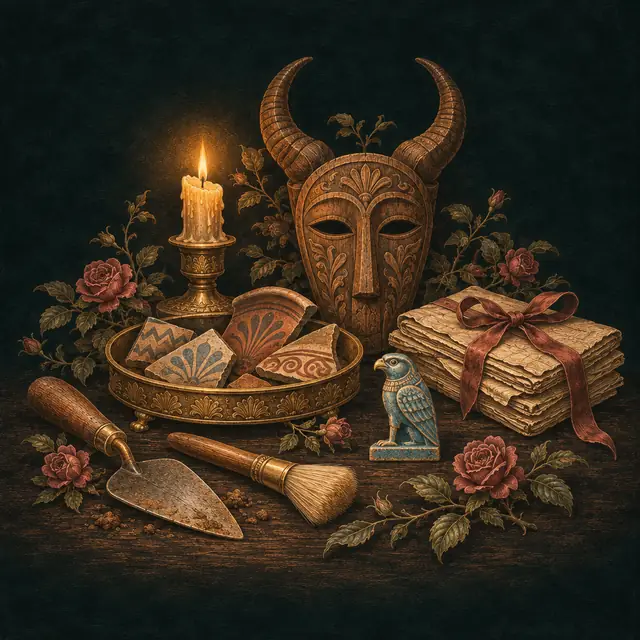
Who was Margaret Murray, and what is truly known of them?
What is known
British Egyptologist, born in Calcutta, who studied and then taught at University College London under Flinders Petrie from 1894 and excavated at Abydos, in Malta and at Petra. Her books for the general reader made ancient Egypt widely known. In The Witch-Cult in Western Europe (1921) and The God of the Witches (1931) she argued that the people tried as witches belonged to a pagan religion that had survived in secret. She wrote the entry on witchcraft in the Encyclopaedia Britannica that stood from 1929 to 1969, was president of the Folklore Society from 1953 to 1955, and published her memoir at a hundred.
The teaching
Taught from her own books, above all The Witch-Cult in Western Europe (1921) and The God of the Witches (1931).
Two kinds of witchcraft
Murray begins by dividing the subject in two. Operative witchcraft is every charm and spell, whether worked by a professed witch or a professed Christian, for good or ill, for killing or curing. It is found in every nation and religion, part of the common heritage of the human race, and so of no use for the study of any one cult. Ritual witchcraft, which she names the Dianic cult, is something else: the beliefs and ritual of the people called witches in the later Middle Ages. Her claim is that this was a religion, with its god, its rites and its organisation, which underlay Christianity, kept chiefly by the less educated and in the thinly settled country, and which ran back to pre-Christian times as the old religion of Western Europe.
The god of the witches
The god of this religion, she holds, was incarnate in a man, a woman or an animal, and the animal form came first: the god was often said to wear the skin or horns of a beast. There was also a god with two faces, like the Janus or Dianus of Italy. In The God of the Witches she traces the horned god from the masked figures painted in the caves of the Old Stone Age to the trials.
The Devil of the trial records, by her reading, was a human being, generally a man and sometimes a woman, the chief of a district. At the great assemblies he appeared disguised beyond recognition; at the small meetings, and when he visited a member or sought a convert, he came in the ordinary dress of the day, known by a gesture, a password or a token. The officers under him were also called devils or spirits.
Admission and the assemblies
A new member, in her account, was brought in by an introduction, renounced the former faith, made vows and a covenant, sometimes for a term of years and sometimes for life, was baptised into the religion and marked. The great assemblies, the sabbaths, were held on four days: May Eve and November Eve, Candlemas in February and Lammas at the start of August. These dates, she argues, belong to a herding people and follow the breeding seasons of the flocks; the solstices, Beltane and Yule, and Easter were added later, and the equinoxes were never kept in Britain.
Besides the sabbaths there were the esbats, a word she took from a French trial of 1567: local meetings, usually weekly, for business, for magic done for a client or against an enemy, and for simple enjoyment. Both ended in feasting and dancing, and her chapters on the rites describe the homage paid to the god, the ring dances, the music, the feast, the sacrament and the rites of fertility.
The covens
The word coven, she says, comes from convene and means a band set apart for the rites and the magic: in short, a kind of priesthood. It was made up of men and women of one district, bound to attend the weekly meeting, and ruled by an officer under the Grand Master, whom the recorders called the Devil. She holds that the persistence of the number thirteen in the covens, twelve members and their leader, is one of the details that torture and leading questions cannot explain away. The officer arranged the meetings, sent the notices, kept the record of work done and presented new members.
The fairies and the divine victim
Two further claims carry the thesis furthest. The fairies of the stories, she suggests, were the memory of a dwarf race that once lived in Europe, and their cult survived as witchcraft until less than three hundred years ago; the Devil was often called a fairy man and consorted with the Queen of Elfhame. And the god, or his voluntary substitute, was killed as a sacrifice for the people at the end of a set term, often seven years. She reads Joan of Arc in this light, as one whom the common people of France took for the god incarnate, and in The Divine King in England she extends the sacrifice to kings such as William Rufus, killed by an arrow in the New Forest.
What the records show
Her method was to set the confessions from many trials side by side and read their agreements as the outline of one religion. Read whole, the same records show accused people, mostly poor women, answering under pressure the questions their judges put to them; Joan of Arc's own answers at her trial are those of a devout Christian. The witch religion Murray described is a thesis about the past, and the trial records do not bear it out.
Orders and memberships
No order is documented. She wrote the introduction to Gerald Gardner’s Witchcraft Today in 1954, which lent the new witchcraft her name, but nothing shows that she joined a coven.
The legend
The witch-cult itself: an organised religion of a horned god, with covens of thirteen, running unbroken from the Stone Age to the trials. Historians who went back to the trial records, Norman Cohn and Keith Thomas among them, found that she had quoted them selectively, and the thesis is no longer accepted.
Their works
- The Witch-Cult in Western EuropeBook, 1921
Her book arguing that those tried as witches in early modern Europe belonged to an organised pagan religion of a horned god, with covens of thirteen. It was widely read and became a foundation for modern witchcraft. Historians who went back to the trial records found that she had quoted them selectively, and the thesis is no longer accepted.
Ask the Oracle about it - The God of the WitchesBook, 1931
A shorter book for general readers that set the horned god at the centre of her witch cult, tracing him from cave paintings to the trials. It reached a wider public than her first book and was reprinted many times. It carries the same thesis and the same faults.
Ask the Oracle about it - WitchcraftEssay, 1929
Her entry in the Encyclopaedia Britannica, which put her theory before general readers as settled fact and stood until 1969. For forty years it was what many people first read on the subject. It is a large part of why her views spread so widely.
Ask the Oracle about it - The Splendour That Was EgyptBook, 1949
A general survey of ancient Egyptian history, religion and daily life, written for the general reader. It drew on her long work as an Egyptologist under Flinders Petrie. It shows the sound scholarship on Egypt for which she was first known.
Ask the Oracle about it - The Divine King in EnglandBook, 1954
Her late book arguing that several English kings and other figures were ritually killed as sacrifices for the old religion. It carries her witch cult thesis to its furthest point. Historians have found no support for it.
Ask the Oracle about it - My First Hundred YearsBook, 1963
Her memoir, published in the year she turned a hundred and the year she died. It tells of her childhood in India, her years at University College London and her excavations. It is a lively record of a long working life in archaeology.
Ask the Oracle about it
How the house tells a life
This life is told from the record, with what is documented, what is legend and what was forged kept apart. A membership in an order is stated only where documents show it. A person’s chart explains none of their deeds.
The arts it feeds
Lives near it in time
Thinkers and teachers
Nikola TeslaÉmile CouéArthur Conan DoyleWallace WattlesWilliam Walker AtkinsonVivekanandaJames AllenW. B. YeatsGeorge GurdjieffCharles HaanelD. T. SuzukiWalter RussellThe whole tree

