
Vivekananda
1863 to 1902
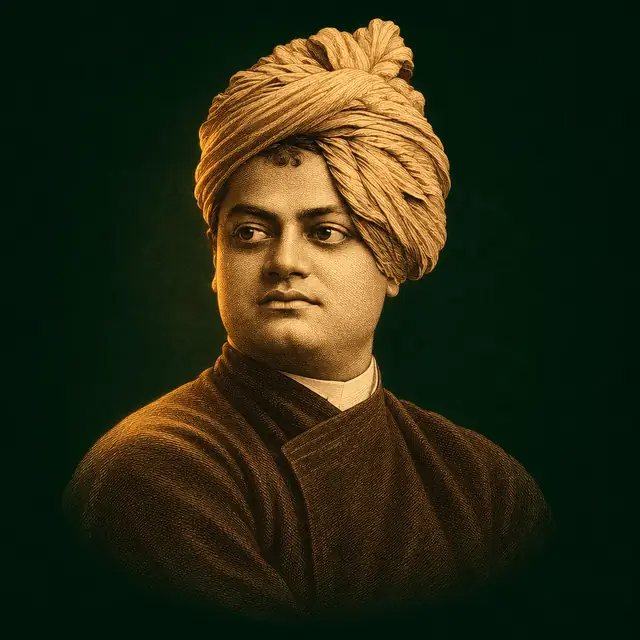
Who was Vivekananda, and what is truly known of them?
What is known
Indian monk, born Narendranath Datta in Calcutta and educated at its colleges. He came to Ramakrishna as a sceptical student in 1881, and after the master’s death in 1886 took monastic vows with a band of fellow disciples and walked the length of India. On 11 September 1893 he spoke for Hinduism at the World’s Parliament of Religions in Chicago, and for three years lectured in America and England, where his Raja Yoga (1896) gave many their first account of Patanjali’s yoga. He founded the Vedanta Society of New York in 1894 and the Ramakrishna Mission in 1897, with its monastery at Belur. He died there at thirty-nine.
The teaching
Taught from his own lectures and books, above all Raja Yoga (1896), Karma Yoga, Bhakti Yoga and the Chicago addresses of 1893.
The whole of religion
Raja Yoga gathers his teaching into a few lines. Each soul is potentially divine. The goal is to manifest this divinity within, by controlling nature, external and internal. Do this either by work, or worship, or psychic control, or philosophy, by one, or more, or all of these, and be free. This, he says, is the whole of religion; doctrines, dogmas, rituals, books, temples and forms are secondary details. The four ways are the four yogas: Karma Yoga, the way of work; Bhakti Yoga, the way of love and worship; Raja Yoga, the way of the mind's control; and Jnana Yoga, the way of knowledge. They are not rival sects, and a person may walk one, or several, or all at once.
Religion so understood is to be experienced, not believed on hearsay. People are asked to live on words, he says, and they cannot; they want to see the truth and feel it in their hearts. As astronomy needs a telescope and chemistry a laboratory, religion has its method of experiment, and Raja Yoga sets that method out.
Every path leads to the same sea
At Chicago he spoke for a faith that teaches not only universal toleration but the acceptance of all religions as true. He gave his hearers a hymn learned in childhood: as the different streams, rising in different places, all mingle their water in the sea, so the different paths that people take, crooked or straight as they appear, all lead to God; and the word of the Gita, that whoever comes to God through whatever form is reached by Him.
To show why the faiths quarrel he told the story of the frog in the well. A frog that had lived all its life in a small well met a frog from the sea, and asked whether the sea was as big as its well. When the sea frog laughed, the well frog called him a liar and had him turned out, for nothing could be bigger than its well. Each of us, he said, sits in a little well and thinks it is the whole world.
The steps of Raja Yoga
Raja Yoga has eight steps: the restraints, the observances, posture, the control of the vital force, the turning of the mind inward, concentration, meditation and absorption. The restraints and observances come first, and without them, he warns, no practice will bear fruit: not to injure anyone by thought, word or deed, and to let mercy reach beyond human beings to the whole world. The yogi avoids both luxury and austerity; he must not fast or torture the flesh, for, as the Gita says, neither the one who fasts nor the one who sleeps too much, neither the one who works too much nor the one who does nothing, can be a yogi.
The posture is simple: sit erect, holding the chest, neck and head in a straight line, with the weight of the body resting on the ribs, so that the spine is free. He leaves the feats of Hatha Yoga aside, as difficult and of no help to spiritual growth. The eight limbs as Patanjali gives them, which Raja Yoga translates and explains, are taught in full in the branch The eight limbs of Yoga, qigong, tai chi.
The breath and the sacred word
The first lesson of the breath is only to breathe in and out in a measured way, which harmonises the whole system. After practising it for a time, join to it the mental repetition of Om, or any other sacred word, letting the word flow in and out with the breath, rhythmically, until the body itself grows rhythmical and a person learns what rest is.
He goes on to stronger exercises, with the breath drawn through one nostril, held, and let out through the other, and he warns that the held breath must not be practised too much and must be increased only with great care, since it may injure. The house keeps to his first lesson: the measured breath and the sacred word, never held or forced, and the stronger work only under a teacher in person.
The yogis, he teaches, describe two currents in the spine, Ida and Pingala, and a channel between them, Sushumna, with the coiled power Kundalini asleep at its base; as it rises, layer after layer of the mind opens. He gives this as their language for the inner life, and he sets it after the moral training, not before.
The maddened monkey
How hard it is to control the mind, he says, and he likens it to a monkey: restless by nature, then made drunk with wine, then stung by a scorpion, and at last possessed by a demon. The mind is restless by its own nature; it is drunk with the wine of desire, stung by the scorpion of jealousy at others' success, and possessed by the demon of pride.
The first lesson, then, is to sit for some time and let the mind run on. Let the monkey jump as much as he can, and simply wait and watch: until you know what the mind is doing you cannot control it. Hideous thoughts may come, and you may be astonished that you could think them. But each day the mind's vagaries grow less violent; where at first it had a thousand thoughts, later it has seven hundred, then fewer, until at last it is under control. It must be practised patiently every day.
Work without attachment
Karma Yoga teaches work for work's sake, without attachment to its fruits. Work like a master and not as a slave. The ideal person, he says, is the one who in the midst of the greatest silence and solitude finds the intensest activity, and in the midst of the intensest activity finds the silence and solitude of the desert.
We help ourselves, he teaches, not the world. The world is like a dog's curly tail, which people have tried for ages to straighten, and which curls again the moment it is let go. It is a gymnasium in which we come to make ourselves strong. So the one who gives should be grateful to the one who receives, for the chance to do good, and should give without looking for return.
The triangle of love
Bhakti Yoga is the love of God for love's sake, and he draws its nature as a triangle. Love knows no bargaining: whoever loves God in order to get something is a shopkeeper in religion. Love knows no fear: love that fears punishment is not yet love. And love knows no rival, for in it the lover's highest ideal is always embodied. The devotee chooses a chosen ideal, an Ishta, the form of God their heart can love, without quarrelling with those who love another, and seeks a teacher who knows the spirit of the scriptures, is pure in life, and teaches with no motive of money or name.
The God in man
Jnana Yoga, the way of knowledge, is Vedanta. Maya, he says, is not a theory of illusion but a plain statement of the facts of the world: of life and death, good and evil, knowledge and ignorance always bound together in contradiction. Behind them the real nature of the human being is the infinite self, never born and never dying, one with the self of all.
From this he draws his most practical teaching. If God is in every being, the way to worship Him is to serve Him there, in the poor, the sick and the ignorant, and he founded his mission on the word of his master Ramakrishna, to serve human beings as God. Weakness, in his teaching, is to be thrown off as a sin: the knowledge that the self is divine is meant to make a person strong, fearless and useful.
Orders and memberships
The Ramakrishna Order of monks, which he organised and led. Masonic sources in India record his initiation in a Calcutta lodge in 1884, as a student, some years before he became a monk.
The legend
That he foretold he would not live to see forty, as disciples later recalled, and that Nikola Tesla drew his physics from him. The two did meet in New York in 1896, and Vivekananda wrote of his hope that Tesla would show force and matter to be one; Tesla never did; he later used the words akasha and prana in one essay, but his physics owes nothing to Vedanta.
Their works
- Raja YogaBook, 1896
Lectures given in New York and a translation with commentary of the Yoga Sutras of Patanjali. It presented yoga to Western readers as a discipline of the mind rather than of the body. It was one of the most influential books in bringing Indian thought to the West.
Ask the Oracle about it - Addresses at the Parliament of ReligionsLectures, 1893
The speeches he gave at the World’s Parliament of Religions in Chicago, beginning on 11 September 1893. He spoke for Hinduism as a religion of tolerance and universal acceptance, and was received with great warmth. They made him famous in America and began his years of teaching in the West.
Ask the Oracle about it - Karma YogaBook, 1896
Lectures on the yoga of action, given in New York in the winter of 1895 to 1896. They teach work done without attachment to its fruits, drawn from the Bhagavad Gita. The book became a guide for the service work of the Ramakrishna Mission.
Ask the Oracle about it - The Complete Works of Swami VivekanandaCollection, printed from 1907
The collected lectures, letters, poems and writings gathered after his death by the Advaita Ashrama at Mayavati. They fill many volumes and include the notes of hearers as well as his own texts. They are the main source for his teaching.
Ask the Oracle about it
How the house tells a life
This life is told from the record, with what is documented, what is legend and what was forged kept apart. A membership in an order is stated only where documents show it. A person’s chart explains none of their deeds.
The arts it feeds
Lives near it in time
Thinkers and teachers
Sri YukteswarNikola TeslaÉmile CouéArthur Conan DoyleWallace WattlesWilliam Walker AtkinsonMargaret MurrayJames AllenW. B. YeatsGeorge GurdjieffCharles HaanelD. T. SuzukiThe whole tree

