
Yoga
One limb of eight in the Indian tradition; most of today’s sequences are of the last century.
Where does yoga come from, and how do I begin it safely?
The practices that train attention through the body: yoga from India, qigong and tai chi from China, and prayer in motion. Their energy channels are the traditions’ own maps, not anatomy.
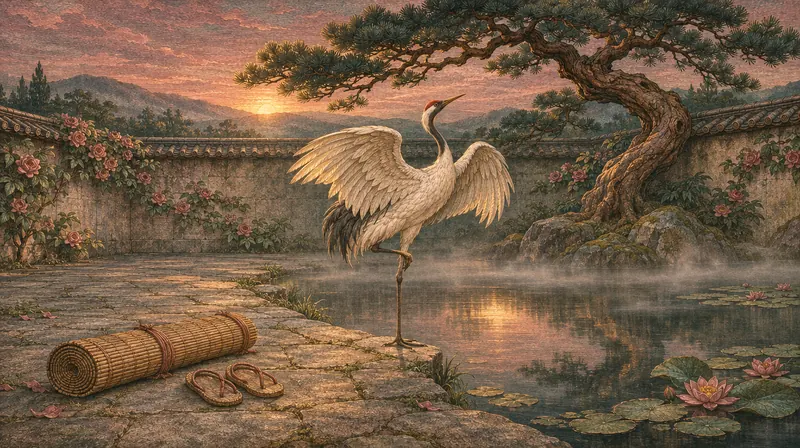
The body as the first instrument
Ask the OracleWhich practice of the body suits me, yoga, qigong or tai chi, and how do I begin safely?
These are the practices that train attention through the body. Yoga comes from India, where posture is one part of a much wider discipline. Qigong and tai chi come from China, the first out of exercises for health and long life, the second out of a martial art. Beside them stand the prayers that are done with the whole body: the turning of the Mevlevi dervishes, the slow walk of monks, the circling of a shrine.
Each tradition explains itself with its own map, prana and qi and channels that no anatomist has found, and the house reports those maps as maps. What can be said plainly is narrower: these are gentle, repeatable forms of movement, some of them now tested in trials for balance and for back pain. They are learned from a teacher who can see the body in front of them, and none of them is a treatment.
As the training of the body in yoga, qigong, tai chi and prayer teaches it.
None of these disciplines trains the body for its own sake. The Hatha Yoga Pradipika calls its whole practice a stairway for those who would climb to raja yoga, the yoga of the stilled mind, and Patanjali gives posture three short lines, as a seat for meditation. The Chinese teachers count qigong among the arts of nourishing life, yangsheng, and tai chi practises a martial art as stillness in movement. For the Mevlevi dervish the turning is the remembrance of God.
The body comes first because it is always present and because its shape governs the rest. A slumped body cramps the breath and invites drowsiness; a body upright and at ease lets the breath settle low and the attention gather. So every school begins where the student already is, in the body, and works inward from there.
The Chinese teachers give every set three tasks, the three regulations. Regulate the body, upright and relaxed. Regulate the breath, through the nose, natural at first and in time slow, fine and long without effort. Regulate the mind, quiet and resting in the body rather than in thought. Patanjali's limbs run in the same order: a steady seat, then the breath, then the inward turning of the senses and the mind.
The three are taught one after another but practised as one. When the posture is easy the breath deepens of itself, and a quiet breath quiets the mind. The breath is never strained to match a movement; in tai chi, with long practice, it comes to rise with the opening movements and sink with the closing ones of its own accord.
The prayers of the body have their own three: the posture of the body, the words of the mouth and the intention of the heart. Muslim prayer begins with niyya, the intention made in the heart, and Jewish prayer asks for kavanah, the heart directed to its words; a prayer without it, Jewish teachers say, is a body without a soul.
Patanjali's one rule for posture is that it be steady and easy, sthira and sukha, and he gives the way to it: relax the effort and let the mind rest on what has no bounds. The Chinese arts teach the same balance with the word song, loosened: the shoulders sink, the chest softens and the knees stay soft, but nothing collapses, while the crown lifts lightly as if hung from a thread. Tai chi puts it in one of its Ten Essentials: use the mind and not force.
The whole skill lies between strain and slackness. Too much effort hardens the body and catches the breath; too little lets it sag, and the attention sags with it. The student looks for the least effort that keeps the body upright and awake, and holds a posture only as long as the breath stays smooth.
The Indian and Chinese teachers draw the body as it is felt from inside. The Indian map has prana, the breath of life, moving in channels called nadis, with wheels, the chakras, strung along a central channel in the spine; it is taught in full under Chakras and the breath. The Chinese map has qi, breath and vital force, moving in its own channels, and three fields of cinnabar, the dantian, named after the elixir of the alchemists: the lower in the belly a little below the navel, the middle at the heart and the upper between the brows.
The Chinese teachers speak too of three treasures in a person: jing, the stored essence; qi, the moving force; and shen, the spirit. Beneath all of it lies the turning of yin and yang, the yielding and the firm, which the tai chi classics set at the root of their art: in motion the two divide, and in stillness they unite. So every movement has its pair. The hands rise and sink, the body opens and closes, and the weight is full in one leg and empty in the other.
For a beginner both maps say the same useful thing: where to put the attention. The Chinese arts keep it low, in the lower field, where the weight settles and the breath moves the belly; the yogis rest it on the breath and, once the mind is steady, on one place.
The yoga texts set not harming first among the restraints, and the mat is the first place it applies, to one's own body. The Bhagavad Gita asks for moderation in food, in sleep and in effort, and the Hatha Yoga Pradipika counts straining among the six things that ruin practice. The Chinese teachers have a name for what forcing the breath and the attention brings on, the fire running wild and the demons coming in, with heat, agitation and broken sleep. In every school the warning against force is part of the teaching itself.
The house's lines follow from it. Begin short and gentle, and learn postures from a teacher who can see you. Stop at pain. Never force a stretch, a deep backbend or an inversion such as a headstand. Ask a doctor first if you are pregnant, recovering from an injury, or have a heart, blood-pressure, eye, spine or joint condition. Dizziness, pain or breathlessness means stop and sit down.
Every school starts with the plainest postures: standing, sitting and lying at rest. The tai chi form opens from standing still, in the stillness the classics call the boundless, before the arms float up and the first movement begins. Many schools of qigong begin with standing too. A yoga class for beginners opens with sitting and breathing and ends lying flat in the corpse posture, shavasana, which teachers count a posture in its own right.
A reader can try the first step at home. Stand with the feet parallel and shoulder-width apart, the knees soft and not locked, the arms hanging loose, the crown lifted lightly and the chin a little drawn in. Breathe through the nose as the breath already goes. Rest the attention low in the belly, or in the soles of the feet where the weight meets the floor, for two or three minutes, and then sit down.
Short and often is the rule in all of these schools: a few minutes on most days, ten or fifteen at most at first, and a class with a teacher to learn the postures and the forms. Choose one discipline and give it some weeks before judging it.
The prayers made with the whole body have another aim. Patanjali's yoga aims at the stilling of the mind, and qigong at nourishing life; the bow and prostration of Muslim prayer, the steps and bows of the Jewish standing prayer, the pilgrim's circuits and the dervish's turning are worship, addressed to God, and carry the meaning their faith gives them. In them the movement is the prayer, not a preparation for it.
They are learned inside their own faith, from its own teachers, and the turning of the dervishes is left to those trained in it. For anyone, the gentle way in is a slow walk from one end of a short path to the other, the attention on the lifting and placing of each foot, which the page on prayer in motion gives with the labyrinth and the circling of shrines.
Yoga gives the word, the paths of the Gita, hatha yoga and the shape of the modern class. The eight limbs sets posture inside Patanjali's whole path, from the restraints to absorption, and shows why the mat is one part of eight. Qigong teaches the work of breath and qi: the three regulations, standing like a tree, the Eight Pieces of Brocade and the Five Animals.
Tai chi teaches the same principles in a martial form slowed down: the Ten Essentials, the thirteen postures, the form and pushing hands. Prayer in motion gives the worship of the body in the faiths. A beginner reads the page for the one discipline that suits them, and anyone drawn to yoga reads The eight limbs beside it, for the frame in which its postures stand.
Begin short and gentle, and learn postures from a teacher who can see you. Stop at pain and never force a stretch or an inversion. Ask your doctor first if you are pregnant, recovering from an injury, or have a heart, blood-pressure, eye, spine or joint condition. A practice is not a treatment.
Each one is a question you can ask.
One limb of eight in the Indian tradition; most of today’s sequences are of the last century.
Where does yoga come from, and how do I begin it safely?
Patanjali’s whole path, of which posture is the third.
What are the eight limbs of yoga?
Slow movement joined to the breath, from Chinese medicine.
What is qigong, and how do I begin?
A martial art slowed into a moving meditation.
What is tai chi, and what is it good for?
The turning of the dervishes, the walking of monks.
What are the sacred movement practices, like the whirling of the dervishes, and how do they compare with yoga?
Each opens its page in the dictionary.
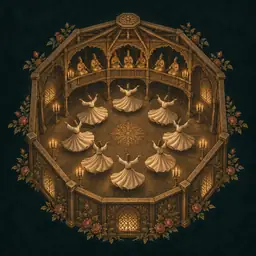 Sama
Indian yogi and astrologer of Bengal, teacher of Paramahansa Yogananda, who made him known in Autobiography of a Yogi (1946). His short book The Holy Science (1894) sets passages of the Bible beside Hindu scripture and gives his own reckoning of the world ages: a cycle of 24,000 years, which he tied to the precession of the equinoxes and to the Sun moving round a companion star.
The Tao Te Ching, some five thousand Chinese characters in eighty-one short chapters, is the founding text of Taoism: the Way that cannot be named, the strength of what yields, action without forcing. The oldest copies found, on bamboo slips from Guodian, date from about 300 BC.
PatanjaliKrishnamacharyaB. K. S. IyengarGeorge GurdjieffRumiVivekanandaBodhidharmaMircea Eliade
Make today specific
The same sky reaches everyone differently. Your birth details turn a general forecast into one theme, and one thing worth doing about it.
One instrument, one answer. Explore the preview; membership opens every tool.
Read more

