

Mystical systems
Sama
Direct answer
Sama: Sama, Arabic for listening, is the Sufi ceremony of music, poetry and remembrance of God, known in its Mevlevi form, the sema, for the turning of the dervishes.
$0 today, then $19/month after 7 days. Cancel anytime.
At a glance
- Also called
- sema ceremony, whirling dervishes, mevlevi sema, sufi whirling
- Found in
- Mystical Systems
- Related
- Sufism, Labyrinth, Contemplation
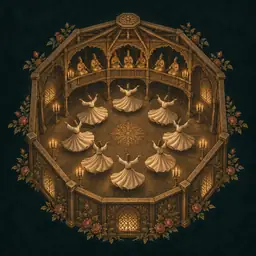

Sama, Arabic for listening, is the Sufi ceremony of music, poetry and remembrance of God, known in its Mevlevi form, the sema, for the turning of the dervishes.
A lineage map for books and systems; it avoids presenting symbolic traditions as literal fact.
Understand the chapter you are in.
Your life’s turning points, measured from your birth.
Walk through Alex’s whole example first


Prefer to explore first?
 The Road of AgesThe turning points of your whole life, from your own chart
Walk my road
What is sama?
Sama means listening or audition. In Sufism it names a gathering in which music and sung poetry are heard as an act of devotion, a way of remembering God. Some orders sit and listen; some sway or chant. In the Mevlevi order, founded by the followers of the poet Rumi, the listeners turn, and the ceremony is called by the Turkish form of the word, sema.
In the sema each dervish turns on the left foot with the right palm raised and the left palm turned to the ground. The order explains the hat as the tombstone of the self, the white skirt as its shroud, and the dropping of the black cloak as rising from the grave.
On the tree of the hidden arts: The mystics, Yoga, qigong, tai chi.
What sets Sama apart
Sama puts the ear at the centre of worship. The claim behind it is that a heart already turned toward God is moved further by sound, and that the movement of the body is a result and never the aim. The reed flute that opens a Mevlevi ceremony carries the meaning in Rumi's own image: a reed cut from the reed bed, crying to return. Other orders keep the listening and leave out the turning, as the Chishti do with the sung poetry called qawwali.
- Word: Arabic sama, listening or audition; sema in Turkish
- Mevlevi order: formed in Konya after the death of Rumi in 1273
- Shape of the sema: four periods of turning, each opened with a greeting
- Instrument: the ney, an end-blown reed flute
- Defender: al-Ghazali, died 1111, argued that listening may be lawful
- Annual gathering: Konya, each December, for the anniversary of Rumi's death
Often mistaken for something else: Dhikr is the remembrance of God by repeating his names, common to all Sufi orders; sama is remembrance through listening to music and poetry, which some orders practise and others avoid.
The story behind Sama
Muslim scholars long debated whether listening to music was allowed, and al-Ghazali, who died in 1111, wrote in its defence. The Mevlevi order took shape in Konya after Rumi's death in 1273 under his son Sultan Walad. Turkey closed the dervish lodges in 1925. Since the 1950s the sema has been performed in Konya each December, and UNESCO listed it as living heritage in 2008.
Why Sama matters
Sama is the clearest case of prayer made with the whole body, and the form in which most people outside Islam first meet Sufism.
How to read Sama
Writers on Sufism say sama for the practice of devotional listening in general, and sema for the Mevlevi ceremony in particular.
Sama in practice: an example
A visitor to Konya in December watches the sema not as a dance but as a prayer, and stays silent as at a service.
Where readings of Sama go wrong
Sama is an act of worship within Islam, taught inside an order; the turning is not an exercise to copy alone.
Sources and editorial method
This entry summarizes the tradition in the Almanac's own words; where no source is listed, it is an editorial summary rather than a primary text, and symbolic readings are named as the tradition's, not as fact.
- Source
- The Great Almanac Dictionary
- Category
- Mystical Systems
- Aliases
- sema ceremony, whirling dervishes, sama sufism, mevlevi sema, sufi whirling
- Last updated
- 2026-09-26
See Sama in your personal almanac
A definition tells you what it is; your own birth chart tells you what it means for you. The Oracle casts your real chart and answers for your love, your work, and your year ahead, in conversation. It opens with the 7-day Oracle trial.
Speak with the OracleRelated terms
More in Mystical Systems
From the reference page to your own chart
Every word here
is in your own chart.
- Your life’s turning points, measured from your birth
- A practical next step to consider
- It opens with 7 days free: the AI Oracle on thirty hidden arts, and your daily horoscope
$0 today, then $19/month after 7 days. Cancel anytime.
Common questions
What is sama?
It is the Sufi practice of listening to music and poetry as a way of remembering God. The Mevlevi form, called sema in Turkish, includes the turning of the dervishes.
Why do the dervishes whirl?
In the Mevlevi explanation the turning is a prayer: the raised right hand receives from God, the lowered left hand gives to the world, and the dervish turns from right to left, around the heart.
Is the sema a dance?
Those who perform it call it a ceremony of remembrance and not a dance. It follows a fixed order of music, greetings and four periods of turning.


