

Mystical systems
Dhikr
Direct answer
Dhikr: Dhikr, Arabic for remembrance, is the Islamic practice of repeating a name of God or a short sacred phrase, aloud or silently, to keep the heart turned toward God.
$0 today, then $19/month after 7 days. Cancel anytime.
At a glance
- Also called
- zikr, remembrance of god
- Found in
- Mystical Systems
- Related
- Sufism, Mantra, Hesychasm, Jesus Prayer
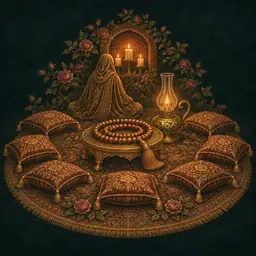

Dhikr, Arabic for remembrance, is the Islamic practice of repeating a name of God or a short sacred phrase, aloud or silently, to keep the heart turned toward God.
A lineage map for books and systems; it avoids presenting symbolic traditions as literal fact.
Understand the chapter you are in.
Your life’s turning points, measured from your birth.
Walk through Alex’s whole example first


Prefer to explore first?
 The Road of AgesThe turning points of your whole life, from your own chart
Walk my road
What does dhikr mean?
Dhikr means remembrance or mention. In its widest sense it is any act that brings God to mind, and many Muslims say short phrases of praise a set number of times after the daily prayers, often counting on a string of beads.
Among Sufis dhikr became a central discipline. A guide gives the disciple a formula, such as the statement that there is no god but God or one of the divine names, to be repeated with attention. Some orders chant it aloud together, sometimes with movement; others keep it silent in the heart. The tradition holds that constant remembrance polishes the heart.
On the tree of the hidden arts: Meditation, The mystics, Sound and mantra.
What sets Dhikr apart
Dhikr is counted and transmitted. The everyday form has numbers, three phrases of praise said thirty-three times each after prayer, and a string of beads to keep them. The Sufi form has a chain: a disciple receives a formula from a teacher who received it from his own, back, the orders say, to the Prophet. Orders are known by how they remember. The Naqshbandis are silent, the Qadiris chant aloud, the Mevlevis turn.
- Language: Arabic: remembrance, mention; also spelled zikr
- Quranic basis: hearts find rest in the remembrance of God (13:28)
- Common formula: la ilaha illa Allah, there is no god but God
- Beads: a string of thirty-three or ninety-nine
- Two manners: aloud, or silent in the heart
Often mistaken for something else: A mantra in the Indian traditions may be valued for its sound; dhikr is the naming and praising of God, and its meaning is the point.
The story behind Dhikr
The practice rests on the Quran, which tells believers to remember God often and says that hearts find rest in the remembrance of God. From the twelfth century Sufi orders formed around particular teachers, each with its own dhikr: the Qadiri order named for Abd al-Qadir al-Jilani, the Naqshbandi order known for silent remembrance, and the Mevlevi order of Rumi, whose turning ceremony is itself a form of it.
Why Dhikr matters
Dhikr is the nearest Islamic relative of the mantra and the Jesus Prayer, and shows the same method, one phrase repeated, serving a different end.
How to read Dhikr
The word covers both the everyday phrases of praise any Muslim may say and the formal sessions of a Sufi order led by its teacher.
Dhikr in practice: an example
A reader raised in the faith might return to it by saying one phrase of praise thirty-three times after the dawn prayer.
Where readings of Dhikr go wrong
Dhikr is an act of worship within Islam, and the orders hold that its formal practice is received from a teacher, not borrowed as a technique.
Sources and editorial method
This entry summarizes the tradition in the Almanac's own words; where no source is listed, it is an editorial summary rather than a primary text, and symbolic readings are named as the tradition's, not as fact.
- Source
- The Great Almanac Dictionary
- Category
- Mystical Systems
- Aliases
- zikr, dhikr meaning, sufi dhikr, remembrance of god, what is dhikr
- Last updated
- 2026-09-26
See Dhikr in your personal almanac
A definition tells you what it is; your own birth chart tells you what it means for you. The Oracle casts your real chart and answers for your love, your work, and your year ahead, in conversation. It opens with the 7-day Oracle trial.
Speak with the OracleRelated terms
More in Mystical Systems
From the reference page to your own chart
Every word here
is in your own chart.
- Your life’s turning points, measured from your birth
- A practical next step to consider
- It opens with 7 days free: the AI Oracle on thirty hidden arts, and your daily horoscope
$0 today, then $19/month after 7 days. Cancel anytime.
Common questions
What does dhikr mean?
It is Arabic for remembrance. It names the practice of repeating a name of God or a short phrase of praise so that God is kept in mind.
Is dhikr only for Sufis?
No. Remembrance of God is urged on all Muslims in the Quran, and short phrases of praise after prayer are widely said. Sufi orders developed it into a structured discipline under a guide.
Is dhikr a kind of meditation?
It resembles meditation in method, since attention rests on one repeated phrase. Muslims understand it as worship addressed to God, which is a different purpose from calm or insight.


