

At a glance
- Also called
- zen sitting meditation, shikantaza
- Found in
- Mystical Systems
- Related
- Zen, Kinhin, Vipassana, Mindfulness
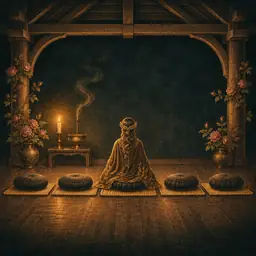

Zazen is the seated meditation of Zen Buddhism: sitting upright and still with the eyes half open, attending to the breath, to a koan, or simply to sitting itself.
A lineage map for books and systems; it avoids presenting symbolic traditions as literal fact.
Understand the chapter you are in.
Your life’s turning points, measured from your birth.
Walk through Alex’s whole example first


Prefer to explore first?
 The Road of AgesThe turning points of your whole life, from your own chart
Walk my road
What is zazen?
Zazen is Japanese for seated meditation. The sitter takes a stable posture on a cushion or chair, back straight, hands folded in the lap, eyes lowered and half open, and breathes naturally. Beginners are usually told to count the out-breaths from one to ten.
The two main Japanese schools then part ways. Soto Zen teaches shikantaza, just sitting, with no object and nothing to gain. Rinzai Zen gives the student a koan, a question that reasoning cannot solve, to hold during the sitting. Both schools treat the posture itself as the heart of the practice and not as a means to something else.
On the tree of the hidden arts: Meditation, The mystics.
What sets Zazen apart
What marks zazen out is its refusal of a goal. Dogen taught that sitting does not lead to awakening but expresses it, so a beginner's first sitting is already complete. The posture carries the teaching: eyes open and lowered, since the sitter is not withdrawing from the world, and hands laid in an oval in the lap. A teacher may walk the hall with a flat stick and, on request, strike a drowsy sitter's shoulders.
- Language: Japanese: za, sitting, and zen, from Sanskrit dhyana
- Key text: Dogen's short instruction for zazen, written in 1227
- Soto form: shikantaza, just sitting, usually facing a wall
- Rinzai form: sitting with a koan given by the teacher
- Beginner method: counting out-breaths from one to ten
- Hall and stick: the zendo, and the kyosaku carried by the monitor
Often mistaken for something else: Vipassana examines experience to gain insight; zazen in the Soto school has no object and seeks nothing, holding that the sitting is the point.
The story behind Zazen
The word zen comes through Chinese chan from the Sanskrit dhyana, meditation. Legend says Bodhidharma brought the practice to China and sat facing a wall for nine years. The Japanese monk Dogen (1200 to 1253) returned from China in 1227, wrote a short instruction for zazen and founded the Soto school, teaching that sitting is itself awakening. Teachers such as Shunryu Suzuki carried zazen to America in the 1960s.
Why Zazen matters
Zazen shows a view of meditation unlike the goal-seeking kind: the sitting is not for calm or insight later, it is the whole point now.
How to read Zazen
The word is used for a period of formal sitting, as in a round of zazen, and for the practice as a whole. A meditation hall is a zendo.
Zazen in practice: an example
A reader trying zazen at home might sit for ten minutes facing a blank wall and count breaths, starting again at one each time the count is lost.
Where readings of Zazen go wrong
The cross-legged postures strain knees and hips that are not used to them. A chair is a full and proper seat.
Sources and editorial method
This entry summarizes the tradition in the Almanac's own words; where no source is listed, it is an editorial summary rather than a primary text, and symbolic readings are named as the tradition's, not as fact.
- Source
- The Great Almanac Dictionary
- Category
- Mystical Systems
- Aliases
- zazen meditation, zen sitting meditation, shikantaza, what is zazen, how to sit zazen
- Last updated
- 2026-09-26
See Zazen in your personal almanac
A definition tells you what it is; your own birth chart tells you what it means for you. The Oracle casts your real chart and answers for your love, your work, and your year ahead, in conversation. It opens with the 7-day Oracle trial.
Speak with the OracleRelated terms
More in Mystical Systems
From the reference page to your own chart
Every word here
is in your own chart.
- Your life’s turning points, measured from your birth
- A practical next step to consider
- It opens with 7 days free: the AI Oracle on thirty hidden arts, and your daily horoscope
$0 today, then $19/month after 7 days. Cancel anytime.
Common questions
What is zazen?
Zazen is the sitting meditation of Zen. The sitter keeps an upright, still posture with the eyes half open and attends to the breath, to a koan, or to the bare fact of sitting.
What is shikantaza?
It is the Soto Zen form of zazen, usually translated as just sitting. There is no object to concentrate on and no state to reach; the sitter stays awake and lets thoughts come and go.
Do I have to sit in the lotus position for zazen?
No. The lotus is traditional, but a kneeling bench or an ordinary chair is accepted in Zen centres. What matters is a straight back and a posture that can be held still without pain.


