

Mystical systems
Psalmody
Direct answer
Psalmody is the singing of the psalms in worship, verse by verse on a simple reciting tone, most often by two sides of a choir answering one another.
$0 today, then $19/month after 7 days. Cancel anytime.
At a glance
- Also called
- psalm singing, chanting the psalms, psalm tones
- Found in
- Mystical Systems
- Related
- Plainsong, Gregorian chant, Lectio Divina, Jesus Prayer
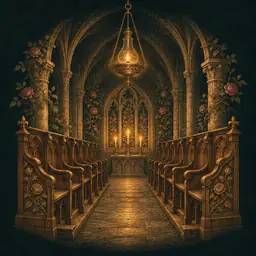

Psalmody is the singing of the psalms in worship, verse by verse on a simple reciting tone, most often by two sides of a choir answering one another.
A lineage map for books and systems; it avoids presenting symbolic traditions as literal fact.
Understand the chapter you are in.
Your life’s turning points, measured from your birth.
Walk through Alex’s whole example first


Prefer to explore first?
 The Road of AgesThe turning points of your whole life, from your own chart
Walk my road
What is psalmody?
Psalmody is the practice of singing the hundred and fifty psalms of the Bible as prayer. Each verse is sung on one repeated note, with a small rise at the start, a turn of melody at the middle and another at the end. The two halves of a verse are parted by a pause long enough to take a full breath, and the two sides of a choir sing alternate verses, so that each side rests while the other sings.
Psalmody is the oldest layer of Christian chant and the backbone of the monastic day. The Rule of Benedict spreads the psalms over the week so that all are sung every seven days, and Jewish worship, from which the practice comes, chants the same psalms in Hebrew to its own traditional melodies.
On the tree of the hidden arts: Sound and mantra.
What sets Psalmody apart
Psalmody is chant reduced to its working parts. The melody is almost nothing, a single note with a bend at each end, so that a verse of any length can be fitted to it and a community can sing for an hour without tiring. Its two inventions are the pause at the half verse and the division of the choir, which gives every singer a rest on alternate verses. The effect was felt long before it was measured: monastic rules of singing warn again and again against hurrying the pause.
- Text: the 150 psalms, with canticles such as the Magnificat
- Shape of a tone: opening rise, reciting note, middle turn, closing turn
- Antiphonal: two sides of the choir sing alternate verses
- Responsorial: a soloist sings the verses and all answer with a refrain
- Weekly round: all the psalms each week, by the Rule of Benedict, about 530
Often mistaken for something else: A hymn has a tune of its own and verses in metre; in psalmody the prose of the psalm is sung to a formula that fits any verse.
The story behind Psalmody
The psalms were sung in the Temple at Jerusalem and afterwards in the synagogue. Christian monks in the Egyptian desert in the fourth century recited the whole Psalter, some of them every day, and writers such as John Cassian carried their customs west. About 530 the Rule of Benedict set a weekly cycle in eight daily services. The eight psalm tones of the Latin church were fixed by the ninth century. Reformed churches after 1539 sang the psalms in rhymed verse, and the Anglican tradition developed its own harmonised chant in the seventeenth century.
Why Psalmody matters
Psalmody’s form explains its effect: one note, a fixed pause and alternating sides slow the breath and take away any need to perform.
How to read Psalmody
The term lets a reader name what monks are doing for most of their sung hours, as distinct from hymns and from the ornate chants of the Mass.
Psalmody in practice: an example
One side of the choir sings a verse on a single note, pauses at the middle for a breath, finishes, and the other side takes up the next.
Where readings of Psalmody go wrong
The psalms are scripture and prayer for Jews and Christians. Reading one aloud on a note is described here as a form, not as a substitute for that worship.
Sources and editorial method
This entry summarizes the tradition in the Almanac's own words; where no source is listed, it is an editorial summary rather than a primary text, and symbolic readings are named as the tradition's, not as fact.
- Source
- The Great Almanac Dictionary
- Category
- Mystical Systems
- Aliases
- psalm singing, chanting the psalms, antiphonal psalmody, psalm tones
- Last updated
- 2026-09-26
See Psalmody in your personal almanac
A definition tells you what it is; your own birth chart tells you what it means for you. The Oracle casts your real chart and answers for your love, your work, and your year ahead, in conversation. It opens with the 7-day Oracle trial.
Speak with the OracleRelated terms
More in Mystical Systems
From the reference page to your own chart
Every word here
is in your own chart.
- Your life’s turning points, measured from your birth
- A practical next step to consider
- It opens with 7 days free: the AI Oracle on thirty hidden arts, and your daily horoscope
$0 today, then $19/month after 7 days. Cancel anytime.
Common questions
What is psalmody?
Psalmody is the singing of the psalms in worship. Each verse is sung on a reciting note with short melodic turns, and two sides of a choir usually sing alternate verses.
What is a psalm tone?
A psalm tone is the simple melodic formula to which a psalm is sung: an opening rise, a reciting note, a turn at the middle of the verse and a closing turn. The Latin church has eight, one for each mode.
Why do monks pause in the middle of each verse?
The pause marks the two halves of the verse and gives time for a full breath. It keeps the pace unhurried and the breathing even, and it is one reason psalm-singing is felt as calming.


