

Mystical systems
Ghost
Direct answer
Ghost: A ghost is the spirit of a dead person believed to appear to the living, by being seen, heard or felt; the idea is found in almost every culture.
$0 today, then $19/month after 7 days. Cancel anytime.
At a glance
- Also called
- apparition, spectre, haunting
- Found in
- Mystical Systems
- Related
- Poltergeist, Seance, Ancestor Veneration, Necromancy
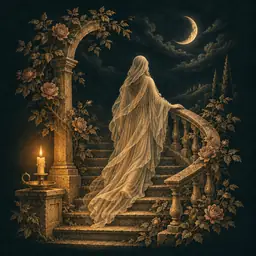

A ghost is the spirit of a dead person believed to appear to the living, by being seen, heard or felt; the idea is found in almost every culture.
A lineage map for books and systems; it avoids presenting symbolic traditions as literal fact.
Understand the chapter you are in.
Your life’s turning points, measured from your birth.
Walk through Alex’s whole example first


Prefer to explore first?
 The Road of AgesThe turning points of your whole life, from your own chart
Walk my road
What is a ghost?
The word is the old English one for spirit or breath, as in the Holy Ghost, and narrowed to its present sense in the Middle Ages. Most traditions explain a ghost by something left undone: a body unburied, a wrong unrighted, a death too sudden. The remedy is usually an act by the living, a burial, a prayer, a debt paid, after which the dead rest.
Beliefs differ sharply. Roman families fed and dismissed their dead at set festivals. Medieval Catholics held that souls in purgatory might ask for prayers. The Protestant reformers denied this and said such appearances were deceptions or fancies. Many East Asian cultures keep a month for the hungry dead.
On the tree of the hidden arts: The spirit realm.
What sets Ghost apart
Across cultures a ghost is less a kind of being than a relationship gone wrong. The dead person is owed something, a burial, a rite, justice, a remembered name, and appears until it is paid. That is why ghost beliefs come with instructions for the living, and why the classic story ends when the bones are buried or the debt is settled. The Reformation broke this pattern in Protestant lands by denying purgatory, which left reported apparitions with no agreed explanation and helped to make the ghost a puzzle to investigate.
- Word: Old English gast, spirit or breath
- Oldest picture: a Babylonian tablet of about 1500 BCE, British Museum
- Ancient haunted house tale: Pliny the Younger, Letters 7.27, about 100 CE
- Roman observance: the Lemuria in May, to quiet the restless dead
- Chinese observance: the Ghost Month, the seventh lunar month
- Large survey: the Census of Hallucinations, 1894
Often mistaken for something else: An ancestor is the remembered dead in good standing with the family; a ghost, in most traditions, is the dead for whom something was left undone.
The story behind Ghost
A Babylonian tablet of about 1500 BCE in the British Museum shows a ghost being led back to the underworld. Homer has Odysseus speak with the shades of the dead, and Pliny the Younger, about 100 CE, tells of a haunted house in Athens. A monk of Byland Abbey wrote down local ghost stories about 1400. The Society for Psychical Research, founded in 1882, collected first-hand reports and published a large survey in 1894.
Why Ghost matters
The ghost is the most widely held of all beliefs about spirits, and how a culture treats its ghosts shows what it thinks the living owe the dead.
How to read Ghost
Readers come to the word after a loss or a strange night, and the plain steps are to note what happened, look for an ordinary cause and tell someone steady.
Ghost in practice: an example
A widow who hears her husband's step on the stair in the months after his death is having an experience that surveys find to be common, and that most doctors regard as part of grief.
Where readings of Ghost go wrong
The house tells no reader that a place is haunted or that anyone is with them. An experience that frightens, commands or does not stop is for a doctor.
Sources and editorial method
This entry summarizes the tradition in the Almanac's own words; where no source is listed, it is an editorial summary rather than a primary text, and symbolic readings are named as the tradition's, not as fact.
- Source
- The Great Almanac Dictionary
- Category
- Mystical Systems
- Aliases
- ghosts, apparition, spectre, haunting, what is a ghost
- Last updated
- 2026-09-26
See Ghost in your personal almanac
A definition tells you what it is; your own birth chart tells you what it means for you. The Oracle casts your real chart and answers for your love, your work, and your year ahead, in conversation. It opens with the 7-day Oracle trial.
Speak with the OracleRelated terms
More in Mystical Systems
- Kabbalistic Tree of Life
- Mount Kailash
- Psalmody
- Shimon bar Yochai
- The Hanged Man
- Yonaguni Monument
- Banshee
- Devekut
From the reference page to your own chart
Every word here
is in your own chart.
- Your life’s turning points, measured from your birth
- A practical next step to consider
- It opens with 7 days free: the AI Oracle on thirty hidden arts, and your daily horoscope
$0 today, then $19/month after 7 days. Cancel anytime.
Common questions
What is a ghost?
A ghost is the spirit of a dead person believed to appear to the living. Most traditions say it is someone whose death or burial was not as it should have been.
Is it normal to sense someone who has died?
Yes. In surveys a large share of bereaved people report sensing, hearing or seeing the person they lost. Doctors regard it as an ordinary part of grief that usually fades.
Has a ghost ever been shown to exist?
No inquiry has produced evidence that others could check. Where haunted houses were examined closely, ordinary causes such as noises, draughts and suggestion were found.


