

Mystical systems
Poltergeist
Direct answer
Poltergeist: A poltergeist is a supposed spirit that makes itself known by noise and movement, such as knocks, thrown objects and shifted furniture, without being seen.
$0 today, then $19/month after 7 days. Cancel anytime.
At a glance
- Also called
- noisy ghost, knocking spirit
- Found in
- Mystical Systems
- Related
- Ghost, Seance, Spiritualism, Mediumship
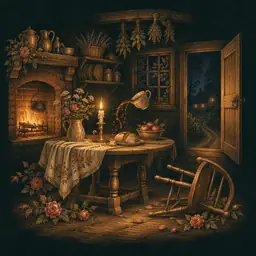

A poltergeist is a supposed spirit that makes itself known by noise and movement, such as knocks, thrown objects and shifted furniture, without being seen.
A lineage map for books and systems; it avoids presenting symbolic traditions as literal fact.
Understand the chapter you are in.
Your life’s turning points, measured from your birth.
Walk through Alex’s whole example first


Prefer to explore first?
 The Road of AgesThe turning points of your whole life, from your own chart
Walk my road
What does poltergeist mean?
Poltergeist is German for a rumbling or noisy spirit. The reports follow a pattern that differs from other ghost stories. Nothing is seen. Instead there are raps in walls, stones that fall on a roof, crockery that flies, beds that shake. The events last weeks or months and then stop, and they centre on one household and very often on one person in it, usually a child or an adolescent.
That last feature has shaped every explanation. Believers in spirits take the young person for a medium. Some psychical researchers proposed that distress in the person moves objects directly, an idea never demonstrated. Sceptics point out that in many cases, once watched closely, the young person was caught throwing things.
On the tree of the hidden arts: The spirit realm.
What sets Poltergeist apart
Three features make a poltergeist case recognisable. It is heard and felt and never seen. It runs its course in a few weeks or months and ends without any rite. And it gathers round a single person, called the focus by researchers, who is usually young and often under strain. Because the events happen in a house full of witnesses, these are the hauntings with the thickest files, and also the ones in which a hidden hand has most often been caught.
- Word: German poltern, to make a racket, and Geist, spirit
- Early user: Martin Luther, in the sixteenth century
- English case, 1660s: the Drummer of Tedworth
- Rectory case: Epworth, the Wesley family, 1716 to 1717
- Modern case: Enfield, London, from 1977; some events admitted as faked
- Usual length: weeks or months, and then it stops
Often mistaken for something else: A haunting is tied to a place and may go on for generations; a poltergeist is tied to a person, moves with them, and is over within months.
The story behind Poltergeist
The word is found in German from the sixteenth century, and Martin Luther used it. Reports of the type are far older. Famous cases include the Drummer of Tedworth in England in the 1660s, the rappings at the Wesley family's rectory at Epworth in 1716 and 1717, and the Enfield case in London from 1977, where investigators recorded the events and two girls admitted faking some of them. The word reached English in the nineteenth century.
Why Poltergeist matters
Poltergeist is the kind of haunting most often investigated on the spot, so it shows clearly how testimony, trickery and expectation mix.
How to read Poltergeist
Readers who meet the word in a film or a news story can check a case against the pattern, and ask who was present each time and who was watching.
Poltergeist in practice: an example
A family that reports knocking in the walls every evening for a month, always in the room where their twelve-year-old sleeps, is describing the classic pattern.
Where readings of Poltergeist go wrong
Where a child is at the centre of such reports, the child needs care and calm, not an audience. The house tells no reader that a spirit is in their home.
Sources and editorial method
This entry summarizes the tradition in the Almanac's own words; where no source is listed, it is an editorial summary rather than a primary text, and symbolic readings are named as the tradition's, not as fact.
- Source
- The Great Almanac Dictionary
- Category
- Mystical Systems
- Aliases
- poltergeists, poltergeist activity, noisy ghost, poltergeist meaning, knocking spirit
- Last updated
- 2026-09-26
See Poltergeist in your personal almanac
A definition tells you what it is; your own birth chart tells you what it means for you. The Oracle casts your real chart and answers for your love, your work, and your year ahead, in conversation. It opens with the 7-day Oracle trial.
Speak with the OracleRelated terms
More in Mystical Systems
- Seven Hermetic Principles
- Tetramorph
- World Soul
- Avalon
- Cross of Saint Peter
- Frankenstein
- Japa
- Middle Pillar
From the reference page to your own chart
Every word here
is in your own chart.
- Your life’s turning points, measured from your birth
- A practical next step to consider
- It opens with 7 days free: the AI Oracle on thirty hidden arts, and your daily horoscope
$0 today, then $19/month after 7 days. Cancel anytime.
Common questions
What does poltergeist mean?
It is German for a noisy or rumbling spirit, from poltern, to make a racket, and Geist, a spirit. The word has been used in German since the sixteenth century.
How is a poltergeist different from a ghost?
A ghost is seen or sensed as a person. A poltergeist is not seen at all: it is known only by knocks, moving objects and disturbances around one household.
What causes poltergeist reports?
No single cause is agreed. In many investigated cases a young person in the house was found to be producing the events; in others no cause was established.


