

Mystical systems
Ancestor Veneration
Direct answer
Ancestor Veneration: Ancestor veneration is the practice of honouring dead family members with remembrance, offerings and set observances, in the belief that the bond between the living and the dead continues.
$0 today, then $19/month after 7 days. Cancel anytime.
At a glance
- Also called
- ancestor worship, honouring the ancestors, ancestor reverence, veneration of the dead
- Found in
- Mystical Systems
- Related
- Necromancy, Daimon, Guardian Angel
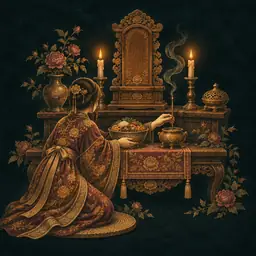

Ancestor veneration is the practice of honouring dead family members with remembrance, offerings and set observances, in the belief that the bond between the living and the dead continues.
A lineage map for books and systems; it avoids presenting symbolic traditions as literal fact.
Understand the chapter you are in.
Your life’s turning points, measured from your birth.
Walk through Alex’s whole example first


Prefer to explore first?
 The Road of AgesThe turning points of your whole life, from your own chart
Walk my road
What is ancestor veneration?
Ancestor veneration means treating the family dead as still belonging to the family. The living keep their names, tend their graves, set out food, drink, light or incense on certain days, and in many places tell them the household's news. It is found in most of the world's cultures and is central in China, Korea, Japan, Vietnam and much of Africa.
The older English term is ancestor worship, which scholars now mostly avoid, because in most traditions the dead are honoured and asked for help but are not treated as gods. What the rites express is debt and continuity: the living owe their existence to those who came before.
On the tree of the hidden arts: The spirit realm.
What sets Ancestor Veneration apart
The practice rests on exchange. The living feed, name and remember the dead, and the dead are held to bless, warn or simply remain present, so that the family is one body across the generations. Who counts as an ancestor is usually defined: in Confucian rites the father's line for a set number of generations, in much of West Africa those who lived well and died a good death. The anthropologist Meyer Fortes showed that among the Tallensi of Ghana the rites mirror the authority parents held in life.
- Oldest record: Shang oracle bones, China, about 1250 to 1050 BCE
- Chinese festival: Qingming, the sweeping of graves, in early April
- Roman festival: Parentalia, 13 to 21 February
- Japanese festival: Obon, in July or August, when the dead are welcomed home
- Catholic ruling: Chinese family rites banned in 1704, the ban confirmed in 1742, lifted in 1939
- Usual offerings: food, drink, incense, light, and the spoken name
Often mistaken for something else: Necromancy tries to call up the dead to get information; ancestor veneration honours them and asks no performance of them.
The story behind Ancestor Veneration
Shang dynasty oracle bones, more than three thousand years old, record questions put to royal ancestors. Confucius taught ritual respect for parents in life and after death. Rome honoured its dead at the Parentalia in February. In the seventeenth and eighteenth centuries the Catholic Church argued for decades over whether Chinese converts could keep the family rites, banned them in 1704 and finally in 1742, and allowed them again in 1939.
Why Ancestor Veneration matters
Ancestor Veneration is probably the most widespread religious practice there is, and it frames the dead as kin to be thanked, which changes how grief and family are understood.
How to read Ancestor Veneration
Readers draw on it to make a plain act of remembrance: a name, a date, a light and a few words of thanks, in their own faith or in none.
Ancestor Veneration in practice: an example
A family that lights a candle beside a grandmother's photograph on her birthday and cooks her recipe is practising a simple form of it.
Where readings of Ancestor Veneration go wrong
The house does not speak for the dead and passes on no messages. Remembrance asks nothing back, and anyone selling contact with a dead relative deserves doubt.
Sources and editorial method
This entry summarizes the tradition in the Almanac's own words; where no source is listed, it is an editorial summary rather than a primary text, and symbolic readings are named as the tradition's, not as fact.
- Source
- The Great Almanac Dictionary
- Category
- Mystical Systems
- Aliases
- ancestor worship, honouring the ancestors, ancestor reverence, veneration of the dead, ancestor altar
- Last updated
- 2026-09-26
See Ancestor Veneration in your personal almanac
A definition tells you what it is; your own birth chart tells you what it means for you. The Oracle casts your real chart and answers for your love, your work, and your year ahead, in conversation. It opens with the 7-day Oracle trial.
Speak with the OracleRelated terms
More in Mystical Systems
From the reference page to your own chart
Every word here
is in your own chart.
- Your life’s turning points, measured from your birth
- A practical next step to consider
- It opens with 7 days free: the AI Oracle on thirty hidden arts, and your daily horoscope
$0 today, then $19/month after 7 days. Cancel anytime.
Common questions
What is ancestor veneration?
It is the honouring of dead relatives through remembrance, grave care, offerings and festivals. The dead are treated as members of the family whose bond with the living goes on.
Is ancestor veneration the same as ancestor worship?
Ancestor worship is the older term. Most scholars prefer veneration, since in most traditions the ancestors are respected and asked for help, not worshipped as gods.
Which festivals honour the ancestors?
Qingming in China, Chuseok in Korea, Obon in Japan, the Day of the Dead in Mexico and All Souls' Day in the Catholic calendar are among the best known.


