

Mystical systems
Daimon
Direct answer
Daimon: A daimon, in Greek religion and philosophy, is a being between gods and mortals; from Plato onward the word also names the guiding spirit allotted to each soul.
$0 today, then $19/month after 7 days. Cancel anytime.
At a glance
- Also called
- daemon, guiding spirit
- Found in
- Mystical Systems
- Related
- Guardian Angel, Jinn, Theurgy, Elementals
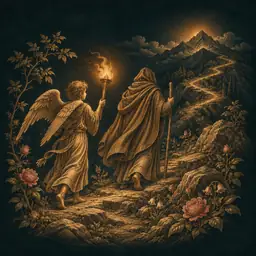

A daimon, in Greek religion and philosophy, is a being between gods and mortals; from Plato onward the word also names the guiding spirit allotted to each soul.
A lineage map for books and systems; it avoids presenting symbolic traditions as literal fact.
Understand the chapter you are in.
Your life’s turning points, measured from your birth.
Walk through Alex’s whole example first


Prefer to explore first?
 The Road of AgesThe turning points of your whole life, from your own chart
Walk my road
What is a daimon?
Daimon is a Greek word for a divine power that is less than a god. In Homer it can mean a god's unseen action, and in Hesiod the souls of a past golden race watch over mortals as daimones. Plato gave the word its lasting sense. In the Symposium daimons carry prayers up and commands down, and in the Republic each soul receives a daimon to guide the life it has chosen.
Socrates spoke of a daimonion, a sign that held him back from error. The Latin equivalent is genius. Christian writers used the same word for evil spirits, which is how daimon became demon, though the Greek term did not of itself mean that.
On the tree of the hidden arts: The spirit realm.
What sets Daimon apart
Plato's daimon is defined by its position: it fills the gap between gods and mortals so that the two can deal with each other, and every later doctrine of intermediaries borrows that logic. The personal daimon adds a second idea, that the guide is tied to a chosen lot. In the myth of Er the soul picks its life first and the daimon is then assigned to see the choice through, which makes it closer to a destiny than to a protector.
- Word: Greek daimon; Socrates says daimonion, a divine something
- Earliest guardian sense: Hesiod, Works and Days: the golden race become watchers over mortals
- As messenger: Plato, Symposium 202e: 'everything daimonic is between god and mortal'
- As personal guide: Plato, Republic, book 10, the myth of Er
- Latin equivalent: genius, the spirit born with each person
- Modern reading: James Hillman, The Soul's Code, 1996
Often mistaken for something else: A guardian angel in Christian teaching is a servant of God sent to protect; Plato's daimon is bound to the life a soul chose and sees that lot fulfilled.
The story behind Daimon
Hesiod, about 700 BCE, calls the dead of the golden age guardian daimones. Plato wrote in the fourth century BCE. Plutarch and Apuleius composed essays on the daimon of Socrates, and Plotinus wrote a treatise on the daimon allotted to us. The Greek Bible, and Christian authors after it, used daimonion for hostile spirits, and that sense prevailed.
Why Daimon matters
Daimon is the source of later ideas of a guardian spirit, a genius and a calling, and it explains where the word demon came from.
How to read Daimon
Readers take it as a figure for vocation and for the inner check that warns, asking what their own life seems shaped to do.
Daimon in practice: an example
A reader who feels a steady pull toward one kind of work, and a quiet no before certain choices, is describing what the Greeks would have called their daimon.
Where readings of Daimon go wrong
The daimon is a philosophical idea. No guide is assigned to anyone here, and a voice that commands or frightens is a matter for a doctor.
Sources and editorial method
This entry summarizes the tradition in the Almanac's own words; where no source is listed, it is an editorial summary rather than a primary text, and symbolic readings are named as the tradition's, not as fact.
- Source
- The Great Almanac Dictionary
- Category
- Mystical Systems
- Aliases
- daemon, daimonion, personal daimon, daimon of socrates, guiding spirit
- Last updated
- 2026-09-26
See Daimon in your personal almanac
A definition tells you what it is; your own birth chart tells you what it means for you. The Oracle casts your real chart and answers for your love, your work, and your year ahead, in conversation. It opens with the 7-day Oracle trial.
Speak with the OracleRelated terms
More in Mystical Systems
From the reference page to your own chart
Every word here
is in your own chart.
- Your life’s turning points, measured from your birth
- A practical next step to consider
- It opens with 7 days free: the AI Oracle on thirty hidden arts, and your daily horoscope
$0 today, then $19/month after 7 days. Cancel anytime.
Common questions
What is a daimon?
In Greek thought it is a being between gods and humans. Plato describes daimons as messengers between the two, and as the personal guide each soul is given for its life.
What was the daimonion of Socrates?
Socrates said a divine sign had come to him since childhood. It never told him what to do; it only held him back when he was about to act wrongly.
Is a daimon a demon?
The words are the same, but the meanings differ. A Greek daimon could be good, neutral or harmful. Early Christian writers applied the word to evil spirits, and demon kept that sense.


