

Mystical systems
Jinn
Direct answer
Jinn are, in Islamic teaching, unseen beings created from smokeless fire, who live alongside humans, have free will and are held to account for what they do.
$0 today, then $19/month after 7 days. Cancel anytime.
At a glance
- Found in
- Mystical Systems
- Related
- Angel, Daimon, Elementals, Guardian Angel
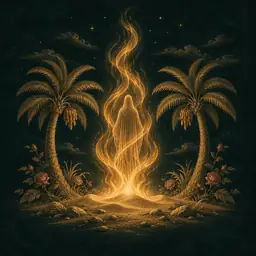

Jinn are, in Islamic teaching, unseen beings created from smokeless fire, who live alongside humans, have free will and are held to account for what they do.
A lineage map for books and systems; it avoids presenting symbolic traditions as literal fact.
Understand the chapter you are in.
Your life’s turning points, measured from your birth.
Walk through Alex’s whole example first


Prefer to explore first?
 The Road of AgesThe turning points of your whole life, from your own chart
Walk my road
What are jinn in Islam?
Jinn is the Arabic name for a class of beings that the Qur'an sets beside angels and humans. It says they were created from smokeless fire, and tradition adds that they are usually invisible and that they eat, marry, have children and die. Like humans they can choose: the Qur'an speaks of jinn who heard its recitation and believed, and of others who refuse. One of them is a jinni; the plural is jinn.
The root of the word means hidden or covered. Folklore across the Muslim world adds many details that the Qur'an does not give, including kinds such as the ghul. The ifrit it names once, in the story of Solomon. The English word genie comes from the French translation of the Thousand and One Nights.
On the tree of the hidden arts: The spirit realm.
What sets Jinn apart
Three things set the jinn apart from the spirits of other traditions. They are held to be creatures with bodies of a kind, made of a named substance, so they are not ghosts or pure minds. They are morally free, which angels in Islam are not. And they are addressed by revelation: the Qur'an speaks to jinn and humans together as the two accountable peoples. Classical jurists even discussed whether a contract or a marriage with a jinni could be valid, a sign of how concretely they were imagined.
- Word: Arabic root j-n-n, to hide or cover; singular jinni
- Made from: smokeless fire, in the Qur'an 55:15
- Named chapter: Surah 72, al-Jinn
- Their purpose: created, with humankind, to worship God: Qur'an 51:56
- Iblis: called one of the jinn in Qur'an 18:50
- Kinds in folklore: ghul, ifrit and marid, mostly from later storytelling
Often mistaken for something else: Angels in Islam are made of light and do not disobey; jinn are made of fire and choose, so some are faithful and some are not.
The story behind Jinn
Arabs before Islam believed that jinn lived in wild places and inspired poets. The Qur'an, in the seventh century, affirmed the beings and placed them under God, naming its seventy-second chapter after them. Medieval scholars debated their bodies and their law. Antoine Galland's French version of the Nights, published from 1704, turned jinni into génie and gave Europe the spirit of the lamp.
Why Jinn matters
The jinn show that Islam has a third kind of being that fits neither the angel nor the demon of Christian thought, and much confusion comes from forcing it into either.
How to read Jinn
Readers meet the word in the Qur'an, in folklore and in fantasy; knowing the first keeps the other two in proportion.
Jinn in practice: an example
A reader who hears that a house has jinn can ask what the Qur'an itself says of them, and find that it describes neighbours with lives of their own, not haunters.
Where readings of Jinn go wrong
The house cannot tell anyone that a jinni is near them. Islamic teaching itself discourages seeking jinn out, and lasting fear or voices are for a doctor.
Sources and editorial method
This entry summarizes the tradition in the Almanac's own words; where no source is listed, it is an editorial summary rather than a primary text, and symbolic readings are named as the tradition's, not as fact.
- Source
- The Great Almanac Dictionary
- Category
- Mystical Systems
- Aliases
- djinn, jinni, genie meaning, jinn in islam, what are jinn
- Last updated
- 2026-09-26
See Jinn in your personal almanac
A definition tells you what it is; your own birth chart tells you what it means for you. The Oracle casts your real chart and answers for your love, your work, and your year ahead, in conversation. It opens with the 7-day Oracle trial.
Speak with the OracleRelated terms
More in Mystical Systems
From the reference page to your own chart
Every word here
is in your own chart.
- Your life’s turning points, measured from your birth
- A practical next step to consider
- It opens with 7 days free: the AI Oracle on thirty hidden arts, and your daily horoscope
$0 today, then $19/month after 7 days. Cancel anytime.
Common questions
What are jinn in Islam?
They are beings made from smokeless fire, unseen by humans in the ordinary way. They have free will, live in communities and are held to account by God, as people are.
Are jinn the same as demons?
No. Jinn can be good or bad, believers or unbelievers. The rebellious ones are called shayatin, and Iblis, the tempter, is described in the Qur'an as one of the jinn.
Is a genie a jinni?
The word genie is the French rendering of jinni in the Thousand and One Nights. The wish-granting servant of a lamp belongs to those tales and to later films, not to Islamic teaching.


