

Mystical systems
Shamanism
Direct answer
Shamanism is a name for traditions in which a specialist, the shaman, is believed to enter a changed state and deal with spirits on behalf of a community.
$0 today, then $19/month after 7 days. Cancel anytime.
At a glance
- Also called
- shamans, shamanic journey, what is a shaman
- Found in
- Mystical Systems
- Related
- Spiritualism, Daimon, Ancestor Veneration, Mediumship
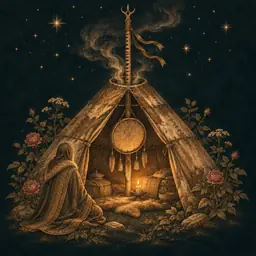

Shamanism is a name for traditions in which a specialist, the shaman, is believed to enter a changed state and deal with spirits on behalf of a community.
A lineage map for books and systems; it avoids presenting symbolic traditions as literal fact.
Understand the chapter you are in.
Your life’s turning points, measured from your birth.
Walk through Alex’s whole example first


Prefer to explore first?
 The Road of AgesThe turning points of your whole life, from your own chart
Walk my road
Where does the word shaman come from?
Shamanism is a scholar's word built on a Siberian one. Among the Evenki and other Tungus-speaking peoples a shaman is the person who can travel in spirit, or be entered by spirits, in order to find a lost soul, guide the dead, bring game or learn the cause of an illness. The work is done in public, with a drum, song and costume, and the shaman is usually chosen by an illness or a calling that cannot be refused.
Writers then applied the word to roles that looked similar in the Arctic, the Americas, Korea, Central Asia and elsewhere. How far these belong together is disputed. Many peoples have their own names for their practitioners and do not use the word shaman at all.
On the tree of the hidden arts: The spirit realm.
What sets Shamanism apart
Two things define the shaman in the Siberian sources. The first is mastery: the shaman is not simply entered by spirits but deals with them, with helpers who were first tormentors. The second is the calling, which comes as a long illness that ends only when the person accepts the role; nobody applies for it. Eliade added a third, the flight of the soul up and down a world tree, and made it the test of true shamanism, which is the part of his theory that later fieldwork has most often failed to find.
- Word: Tungus saman, recorded by Russians in the 1600s
- Early use of the word: the exiled priest Avvakum, 1670s
- Chief instrument: the frame drum, in places called the horse of the shaman
- Classic study: Mircea Eliade, Shamanism, 1951
- Western method: Michael Harner, The Way of the Shaman, 1980
- Under Soviet rule: shamans persecuted from the 1920s
Often mistaken for something else: A medium is said to be spoken through by the dead and to remember little; a shaman is said to travel, to bargain with the spirits, and to return with an account.
The story behind Shamanism
Russian accounts of Siberia from the 1670s onward brought the word west, and it was in German and English by about 1700. In 1951 Mircea Eliade defined shamanism by ecstatic flight and made it a general type of religion. Michael Harner's book of 1980 taught a method drawn from it to Western students, a movement often called neo-shamanism. Soviet policy suppressed Siberian shamans for decades, and their practice has revived since the 1990s.
Why Shamanism matters
The word is used for a huge range of practices, and knowing its Siberian origin and its disputed stretch keeps a reader from treating them as one thing.
How to read Shamanism
Readers meet it in anthropology, in museums and in advertisements for courses, and it helps to ask each time which people and which tradition is meant.
Shamanism in practice: an example
A museum label that calls a Sami drum, a Korean rite and an Amazonian chant all shamanism is using the broad sense that many scholars now question.
Where readings of Shamanism go wrong
A shaman's work belongs to a community and its training. The house offers no journey and no rite, and courses built round a plant brew carry real risks.
Sources and editorial method
This entry summarizes the tradition in the Almanac's own words; where no source is listed, it is an editorial summary rather than a primary text, and symbolic readings are named as the tradition's, not as fact.
- Source
- The Great Almanac Dictionary
- Category
- Mystical Systems
- Aliases
- shaman, shamans, shamanic journey, what is a shaman, siberian shamanism
- Last updated
- 2026-09-26
See Shamanism in your personal almanac
A definition tells you what it is; your own birth chart tells you what it means for you. The Oracle casts your real chart and answers for your love, your work, and your year ahead, in conversation. It opens with the 7-day Oracle trial.
Speak with the OracleRelated terms
More in Mystical Systems
- The Devil Tarot
- Yarrow Stalk Method
- Baal Shem Tov
- Dantian
- Galvanism
- Jinn
- Mithraic Mysteries
- Principle of Polarity
From the reference page to your own chart
Every word here
is in your own chart.
- Your life’s turning points, measured from your birth
- A practical next step to consider
- It opens with 7 days free: the AI Oracle on thirty hidden arts, and your daily horoscope
$0 today, then $19/month after 7 days. Cancel anytime.
Common questions
Where does the word shaman come from?
From the Tungus languages of Siberia, where saman names the specialist who deals with spirits. Russian travellers recorded it in the seventeenth century.
What does a shaman do?
In the traditions that have them, a shaman enters a changed state, usually with drumming and song, to seek a lost soul, guide the dead or ask the spirits about an illness.
Is shamanism one religion?
No. It is a comparative label that scholars placed on many separate traditions. Mircea Eliade argued in 1951 for a single pattern, and that view is now widely disputed.


