

Mystical systems
Lemuria
Direct answer
Lemuria is a sunken land in the Indian Ocean proposed by the zoologist Philip Sclater in 1864. Science gave the idea up; occult writers kept the name for a lost continent.
$0 today, then $19/month after 7 days. Cancel anytime.
At a glance
- Found in
- Mystical Systems
- Related
- The Land of Mu, Atlantis, Root Races, Theosophy
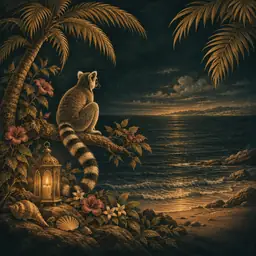

Lemuria is a sunken land in the Indian Ocean proposed by the zoologist Philip Sclater in 1864. Science gave the idea up; occult writers kept the name for a lost continent.
A lineage map for books and systems; it avoids presenting symbolic traditions as literal fact.
Understand the chapter you are in.
Your life’s turning points, measured from your birth.
Walk through Alex’s whole example first


Prefer to explore first?
 The Road of AgesThe turning points of your whole life, from your own chart
Walk my road
Was Lemuria a real continent?
Lemuria began as a scientific hypothesis. Lemurs live in Madagascar, and their living kin, the lorises, in India, with ocean in between. In 1864 Philip Sclater suggested that a strip of land had once joined the two and had since sunk, and he named it after the animals. Other naturalists of the day proposed similar bridges elsewhere.
The hypothesis was dropped when geologists showed that continents move and that India was once joined to Madagascar. By then the name had a second life. Helena Blavatsky made Lemuria the home of an early race in 1888, and later writers moved it to the Pacific and filled it with temples and sages.
On the tree of the hidden arts: Lost worlds.
What sets Lemuria apart
Lemuria is the rare lost continent that began in a scientific journal. Sclater reasoned as naturalists of his day did: animals cannot cross deep water, so land must once have joined the places where they live. Sunken land bridges were proposed across several oceans before the movement of continents was understood. Its occult life owes nothing to that reasoning beyond the name, which Blavatsky took over within twenty-five years.
- Named by: Philip Sclater, zoologist, 1864
- Puzzle it answered: lemurs in Madagascar and their living kin in India
- Scientific fate: dropped once the movement of continents was accepted
- Occult adoption: The Secret Doctrine, 1888, as home of the third root race
- American legend: survivors placed under Mount Shasta, California
Often mistaken for something else: The land of Mu comes from a misread Maya book; Lemuria comes from a zoologist's hypothesis, and only later writers merged the two.
The story behind Lemuria
Sclater published the idea in The Quarterly Journal of Science in 1864. The German biologist Ernst Haeckel took it further and suggested Lemuria as the cradle of humankind. Blavatsky's The Secret Doctrine of 1888 turned it into the continent of her third root race, a ranking of peoples the house rejects. In the twentieth century Tamil writers joined it to Kumari Kandam, a drowned land of old Tamil poetry, and American occult groups placed Lemurian survivors under Mount Shasta in California.
Why Lemuria matters
Lemuria shows a sound scientific guess outliving its evidence, and how a retired idea can be reborn as a legend under the same name.
How to read Lemuria
Readers bring it up as a clear case for asking who named a lost land first, and what that person was trying to explain.
Lemuria in practice: an example
A reader who meets Lemurian crystals in a shop can trace the word back to a naturalist puzzling over where lemurs live.
Where readings of Lemuria go wrong
No ancient people spoke of Lemuria; its supposed history comes from books written after 1864.
Sources and editorial method
This entry summarizes the tradition in the Almanac's own words; where no source is listed, it is an editorial summary rather than a primary text, and symbolic readings are named as the tradition's, not as fact.
- Source
- The Great Almanac Dictionary
- Category
- Mystical Systems
- Aliases
- lemuria lost continent, lemuria meaning, lemurians, sclater lemuria
- Last updated
- 2026-09-26
See Lemuria in your personal almanac
A definition tells you what it is; your own birth chart tells you what it means for you. The Oracle casts your real chart and answers for your love, your work, and your year ahead, in conversation. It opens with the 7-day Oracle trial.
Speak with the OracleRelated terms
More in Mystical Systems
From the reference page to your own chart
Every word here
is in your own chart.
- Your life’s turning points, measured from your birth
- A practical next step to consider
- It opens with 7 days free: the AI Oracle on thirty hidden arts, and your daily horoscope
$0 today, then $19/month after 7 days. Cancel anytime.
Common questions
Was Lemuria a real continent?
No. It was a proposed land bridge that turned out not to be needed, because India and Madagascar were once joined and moved apart. The ocean floor shows no sunken continent there.
Why is it called Lemuria?
After lemurs. Philip Sclater coined the name in 1864 for a land he thought must once have linked Madagascar, where lemurs live, with India, where their kin the lorises live.
How did Lemuria become part of occult teaching?
Helena Blavatsky adopted the name in The Secret Doctrine in 1888 for the home of one of her root races. Later authors added details of their own, moving it to the Pacific and to Mount Shasta in California.


