

Mystical systems
Newgrange
Direct answer
Newgrange is a passage tomb in the Boyne valley of Ireland, built about 3200 BCE so that the rising Sun at midwinter shines down its passage into the inner chamber.
$0 today, then $19/month after 7 days. Cancel anytime.
At a glance
- Also called
- bru na boinne, boyne valley tomb
- Found in
- Mystical Systems
- Related
- Megalith, Stonehenge, December Solstice, Solstice
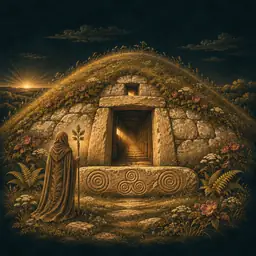

Newgrange is a passage tomb in the Boyne valley of Ireland, built about 3200 BCE so that the rising Sun at midwinter shines down its passage into the inner chamber.
A lineage map for books and systems; it avoids presenting symbolic traditions as literal fact.
Understand the chapter you are in.
Your life’s turning points, measured from your birth.
Walk through Alex’s whole example first


Prefer to explore first?
 The Road of AgesThe turning points of your whole life, from your own chart
Walk my road
How old is Newgrange?
Newgrange is a round mound some eighty-five metres across, ringed by ninety-seven great kerbstones, several of them carved with spirals and lozenges. A stone-lined passage nineteen metres long leads to a chamber with three recesses, roofed with overlapping slabs that have kept it dry for five thousand years. Burnt and unburnt human bone was found in the recesses.
Above the doorway is an opening the excavators called the roof-box. For a few mornings around the winter solstice the rising Sun sends a beam through it and along the passage floor, lighting the chamber for about seventeen minutes.
On the tree of the hidden arts: Sacred places.
What sets Newgrange apart
The roof-box is what makes Newgrange singular. It is a slot built over the doorway, with a stone that could be slid aside, so that light could reach the chamber even when the door was blocked. The passage rises as it goes in, and the floor of the chamber lies level with the box, which is why only a low Sun can send its beam the whole length. The builders had to plan this before the mound was raised over it.
- Built: about 3200 BCE
- Mound: some 85 metres across and 13 metres high
- Passage: 19 metres long
- Midwinter light: about 17 minutes at sunrise, on the days around 21 December
- Excavated: 1962 to 1975 by Michael O'Kelly, who first recorded the beam in 1967
Often mistaken for something else: Stonehenge is an open ring aligned on the solstices for those standing in it; Newgrange is a closed tomb into which the midwinter Sun is let for a few minutes.
The story behind Newgrange
The tomb was built by farming people about 3200 BCE, some centuries before the great stones of Stonehenge and before the pyramids of Egypt. Its entrance was rediscovered in 1699. Michael O'Kelly excavated and restored it from 1962 to 1975, and in December 1967 he stood in the chamber and saw the beam arrive, as local tradition had said it did. Irish legend made the mound the house of the god called the Dagda and his son Aengus. The white quartz wall of the front is O'Kelly's reconstruction, and not all archaeologists accept it.
Why Newgrange matters
Newgrange is the oldest building known that was plainly designed to catch the Sun on one day of the year, and it still works.
How to read Newgrange
Guides at the Boyne valley sites show the beam with a lamp on ordinary days, since the chamber is too small for crowds at midwinter.
Newgrange in practice: an example
Each year a lottery chooses a few dozen people to stand in the chamber at dawn on the days around 21 December.
Where readings of Newgrange go wrong
Entry is by guided tour from the visitor centre only, and the passage is low and narrow, which some people find hard to bear.
Sources and editorial method
This entry summarizes the tradition in the Almanac's own words; where no source is listed, it is an editorial summary rather than a primary text, and symbolic readings are named as the tradition's, not as fact.
- Source
- The Great Almanac Dictionary
- Category
- Mystical Systems
- Aliases
- newgrange passage tomb, bru na boinne, newgrange winter solstice, newgrange ireland, boyne valley tomb
- Last updated
- 2026-09-26
See Newgrange in your personal almanac
A definition tells you what it is; your own birth chart tells you what it means for you. The Oracle casts your real chart and answers for your love, your work, and your year ahead, in conversation. It opens with the 7-day Oracle trial.
Speak with the OracleRelated terms
More in Mystical Systems
From the reference page to your own chart
Every word here
is in your own chart.
- Your life’s turning points, measured from your birth
- A practical next step to consider
- It opens with 7 days free: the AI Oracle on thirty hidden arts, and your daily horoscope
$0 today, then $19/month after 7 days. Cancel anytime.
Common questions
How old is Newgrange?
About 5,200 years. It was built around 3200 BCE, which makes it older than the great stone ring at Stonehenge and older than the pyramids at Giza.
What happens at Newgrange on the winter solstice?
At sunrise on the mornings around 21 December a beam of sunlight enters through an opening above the door, runs up the passage and lights the inner chamber for about seventeen minutes.
Was Newgrange a tomb or a temple?
Human remains were found in it, so it was a burial place. Its size, its carvings and its midwinter light suggest it was also a place of ceremony for the living.


