

Mystical systems
Sri Yantra
Direct answer
Sri Yantra: The Sri Yantra is a Hindu ritual diagram of nine interlocking triangles round a central point, set within two rings of lotus petals and a square with four gates.
$0 today, then $19/month after 7 days. Cancel anytime.
At a glance
- Also called
- shri yantra, sri chakra, shri chakra, nine triangles yantra
- Found in
- Mystical Systems
- Related
- Yantra, Mandala, Sacred Geometry, Flower of Life
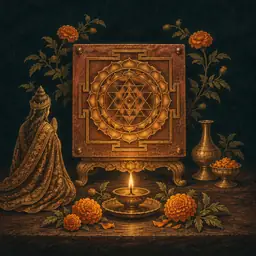

The Sri Yantra is a Hindu ritual diagram of nine interlocking triangles round a central point, set within two rings of lotus petals and a square with four gates.
A lineage map for books and systems; it avoids presenting symbolic traditions as literal fact.
Understand the chapter you are in.
Your life’s turning points, measured from your birth.
Walk through Alex’s whole example first


Prefer to explore first?
 The Road of AgesThe turning points of your whole life, from your own chart
Walk my road
What do the nine triangles of the Sri Yantra mean?
The Sri Yantra, also called the Sri Chakra, is the chief diagram of the Shri Vidya tradition of Hindu goddess worship. Four triangles point upward and five downward, and where they cross they make forty-three smaller triangles round a central point, the bindu. Round these are a ring of eight lotus petals, a ring of sixteen, and a square enclosure with a gate on each side.
The tradition holds that the upward triangles are Shiva and the downward ones Shakti, and that the whole is the form of the goddess Tripura Sundari. Worship moves from the outer square inward to the point, in nine stages, and is taught by a guru. The figure is now widely printed and sold as an ornament with promises of wealth. Those promises are the sellers' own and are no part of the worship.
On the tree of the hidden arts: Sacred geometry.
What sets Sri Yantra apart
Its difficulty is its mark. Nine triangles of different sizes must be placed so that their lines pass through one another's crossing points at many places at once, and a freehand copy almost never manages it. Traditional craftsmen follow fixed proportions handed down in the texts, and published analyses since the late 1970s have shown that an exact solution is a serious problem in geometry. The same figure raised into three dimensions, as a stepped mound, is called the Meru form.
- Triangles: nine: four pointing up, five pointing down
- Smaller triangles: forty-three, formed where the nine cross
- Lotus rings: eight petals inside, sixteen outside
- Centre: the bindu, a single point
- Tradition: Shri Vidya, the worship of Tripura Sundari
- Raised form: the Meru, the same plan built up as a mound
Often mistaken for something else: Other yantras belong to other deities and are far simpler; the Sri Yantra is the one figure of nine interlocking triangles.
The story behind Sri Yantra
The diagram is described in Sanskrit tantric texts from about the tenth century CE onward, and the hymn Saundarya Lahari, traditionally attributed to Shankara, praises the goddess through it. Temples such as Sringeri keep it in stone or metal. From the late 1970s mathematicians began publishing studies of how its nine triangles can be drawn so that every crossing meets exactly, which is harder than it looks.
Why Sri Yantra matters
Sri Yantra is the best known yantra and a living object of worship, so it tests whether a figure is being described or merely borrowed.
How to read Sri Yantra
Devotees of Shri Vidya worship the goddess through it under a teacher; geometers study the exact meeting of its lines.
Sri Yantra in practice: an example
In a household shrine it may be a small copper plate set before the image and touched with red powder during the daily worship.
Where readings of Sri Yantra go wrong
Sri Yantra is sacred to a living tradition. A printed copy sold with promises of money or luck is trade, not the rite.
Sources and editorial method
This entry summarizes the tradition in the Almanac's own words; where no source is listed, it is an editorial summary rather than a primary text, and symbolic readings are named as the tradition's, not as fact.
- Source
- The Great Almanac Dictionary
- Category
- Mystical Systems
- Aliases
- shri yantra, sri chakra, shri chakra, sri yantra meaning, nine triangles yantra
- Last updated
- 2026-09-26
See Sri Yantra in your personal almanac
A definition tells you what it is; your own birth chart tells you what it means for you. The Oracle casts your real chart and answers for your love, your work, and your year ahead, in conversation. It opens with the 7-day Oracle trial.
Speak with the OracleRelated terms
More in Mystical Systems
From the reference page to your own chart
Every word here
is in your own chart.
- Your life’s turning points, measured from your birth
- A practical next step to consider
- It opens with 7 days free: the AI Oracle on thirty hidden arts, and your daily horoscope
$0 today, then $19/month after 7 days. Cancel anytime.
Common questions
What do the nine triangles of the Sri Yantra mean?
In the Shri Vidya tradition the four that point up are Shiva and the five that point down are Shakti. Their crossing is read as the union from which the world unfolds.
How many triangles are in the Sri Yantra?
Nine large ones interlock. Where they cross they form forty-three smaller triangles, arranged in rings round the central point.
Can anyone use a Sri Yantra?
Anyone may look at one, or draw one as a study in geometry. Its ritual worship belongs to a tradition and is taught by a teacher of that tradition.


