
The golden ratio
A real number, about 1.618, and the temples, shells and faces it is said to rule.
What is the golden ratio, and where is it truly found?
Sacred geometry is the old habit of reading meaning into figures: circles, ratios, stars and solids. The mathematics of the figures is true and can be checked. What they are held to mean is a tradition with authors and dates, many popular claims do not survive a ruler, and no figure has a power of its own.
The figures, their mathematics, and what is claimed for them
Ask the OracleWhat is sacred geometry, and what is true of the figures it reveres?
Sacred geometry is a modern name for an old habit: finding meaning in figures. The followers of Pythagoras taught in the sixth century BCE that number lies under all things, Plato gave the elements the shapes of regular solids, and the masons of the medieval cathedrals set out their plans with compasses and cord. The figures themselves are mathematics. The golden ratio, the five Platonic solids and the vesica piscis are defined exactly, and what is proved of them can be checked by anyone with a pencil.
What the figures are held to mean is another matter, and the house keeps the two apart. Meanings are a tradition: they have authors and dates, and many of the best known are recent. The flower of life got its name in the 1980s and 1990s, and most claims that the golden ratio governs temples, shells and faces do not survive a ruler. No figure mends, protects or attracts anything. What is left is real enough: drawing a figure with care is a practice of attention, and the proofs are among the oldest beautiful things people have made.
As Euclid's geometry with the Pythagorean and Platonic lore of number teaches it.
The art begins where Euclid's Elements begin, with the first things. “A point is that which has no part.” “A line is breadthless length.” A circle is a figure bounded by one line, such that every straight line drawn to it from one point within, its centre, is equal to every other. The art draws nothing that cannot be built from these three.
The tradition reads the first things as the first numbers. The point is one, the monad, which has no size and from which all else comes. Two points make a line, the dyad; three make the first surface, the triangle; four make the first solid, the tetrahedron. The Pythagoreans set these in their emblem, the tetractys, ten points in four rows of one, two, three and four, which climbs from the point to the solid, and they swore by it as the fount and root of ever-flowing nature.
The circle is the figure of the whole. It is drawn from one centre with one opening of the compass, and every point of its rim stands at the same distance from the centre, with no beginning and no end. The tradition gives it to heaven and to unity, as it gives the square, steady on four equal sides, to the earth.
The geometer of this tradition works with two tools. The compass draws a circle about any centre and through any point; the straight edge, which carries no marks, draws a line through any two points and carries it on as far as is needed. Euclid's first three postulates grant exactly these acts. Nothing is measured with a ruler: every length is made, and every figure is reached by construction from what is already on the page.
The builders add the cord, pegged at one end to strike a circle on the ground. Knotted into twelve equal lengths and pegged out as a triangle with sides of three, four and five, a cord gives a true right angle, because three squared and four squared, nine and sixteen, make five squared, twenty-five: the theorem that bears Pythagoras' name, which Euclid proves with its converse at the end of his first book.
The limits of the tools are part of the teaching. Some things can never be done with them, the squaring of the circle among them, and a figure counts as truly drawn only when every step of it can be shown.
The first construction of all is two circles of one opening, each drawn through the other's centre. Between them lies the almond called the vesica piscis, and from it the first figures come. Join the two centres to a point where the circles cross, and the triangle has three equal sides: this is the first proposition of the Elements. Join the two crossing points, and the line cuts the line of centres in half and at right angles, which gives the middle of a line, the right angle, and from the right angle the square.
Keep the same opening and step it round one circle: it fits exactly six times. Joining the steps gives the hexagon; joining every other step gives the triangle again; drawing a circle on each step gives six circles round one, the rosette now called the seed of life. The pentagon asks for one more step, the line cut in extreme and mean ratio, which is found from a square and the middle of its side, and so the art's figure of five is also the door to its most famous number.
The heart of the art is less the single figure than the relation between figures. A ratio is the relation of two magnitudes of one kind, as of one length to another. A proportion is an equality of ratios, when the first is to the second as the third is to the fourth. The finest proportion, in Plato's Timaeus, joins three terms by a single mean, so that the first is to the middle as the middle is to the last, and the maker binds the elements of the world together in this way, because two things cannot be joined well without a third between them, and a proportion makes the terms and itself into one.
The Pythagoreans name three such means. In the arithmetic mean the middle exceeds the first by as much as the last exceeds the middle, as in 6, 9 and 12. In the geometric mean the ratio is kept, as in 1, 2 and 4. In the harmonic mean the middle exceeds the first, and falls short of the last, by the same fraction of each, as in 6, 8 and 12. Set 6, 8, 9 and 12 side by side and the ratios of music appear: six to twelve is the octave, six to nine and eight to twelve the fifth, six to eight and nine to twelve the fourth, and eight to nine the tone.
The golden cut is a continued proportion made from one line: cut so that the whole is to the longer part as the longer part is to the shorter, a single line holds all three terms. Its number, its pentagon and its spiral are taught on their own page.
Under the figures lies number, and the art treats the two as one study seen from two sides. The medieval schools divided that study into four arts, the quadrivium: arithmetic is number in itself, music is number in relation to number, geometry is magnitude at rest, and astronomy is magnitude in motion. The first proof the tradition gives that number orders things is heard on a single string, where half its length sounds the octave, two thirds the fifth and three quarters the fourth.
Each number of the decad has its nature in the Pythagorean teaching: one the source, two division, three the first whole, with a beginning, a middle and an end, four the square and justice, and so on up to ten, which holds them all. The figures take their meanings from their numbers: the triangle from three, the square from four, the pentagon and its star from five, the hexagon from six. The ten numbers are taught one by one on the page of Pythagoras and number.
The art prizes the regular figure, with every side equal and every angle equal, as the figure in which nothing is out of place. On a flat surface there is one for every number of sides from three upward, and of them only three, the triangle, the square and the hexagon, can cover a floor without leaving gaps. In space the rule is far stricter. A solid whose faces are all one regular figure, with the same number of faces meeting at every corner, can be made in five ways only, and the Elements end by proving it. Plato gives four of the five to fire, air, water and earth, and the fifth to the whole.
The same love of order passes into arithmetic in the magic square, where every row, every column and both long diagonals add to one sum. The smallest holds the numbers one to nine with five at its heart, and in China it is the Lo Shu, the writing from the river Luo.
The sacred diagrams of India and Tibet use the same first figures to another end. A yantra is built outward from the point, the bindu at its heart, through triangles, circles and rings of lotus petals to a square with four gates round all; a mandala is the palace of a deity seen from above, its square courts and gates set within rings. Both are read from the outside in, the worshipper passing the gates toward the centre, and in their own traditions they are made and used under a teacher, with rites of their own.
The art is learned with the hand. The student needs compasses that hold their opening, a hard and sharp pencil, a straight edge with no marks and good paper, and draws one figure at a time: a circle; two circles, each through the other's centre; the equilateral triangle; a line halved at right angles and the square raised on it; the opening stepped six times round the circle; six circles round one. Nothing is measured and everything is constructed, and each figure checks itself: if the circles miss their crossings by a hair, the opening has slipped or a point was set off true.
Beside the drawing goes the reading. Euclid's first book is read a proposition at a time with the figure drawn alongside, until the student can say not only that the triangle's sides are equal but why. Then come the golden cut and the pentagon, the five solids folded from card, and the ratios heard on a string. The traditional meanings are learned as they come, each with its source, and a figure that closes exactly, every circle meeting at its crossing, is the art's own test of a steady hand.
The branches stand in the order the figures themselves suggest. Pythagoras and number is the ground: the tetractys, the numbers of the decad and the ratios of the string. The vesica piscis is the first figure, the two circles and everything raised from them, down to the pointed arch of the cathedral masons. The flower of life carries the six circles round one outward across the plane. The golden ratio is the cut that the pentagon needs, with its star and its spiral.
The Platonic solids take the regular figure into space, and magic squares take the same order into arithmetic, from the Lo Shu to the tables of the planets. Mandala and yantra show the first figures as the traditions of India and Tibet use them, as seats of a deity and maps of the way to the centre. Read in this order, each figure is met after the figures it is built from.
The mathematics of these figures is true and can be checked. What they are held to mean is a tradition, and many popular claims of the golden ratio in buildings, bodies and paintings do not survive measurement. A figure heals, protects and attracts nothing by itself.
Each one is a question you can ask.
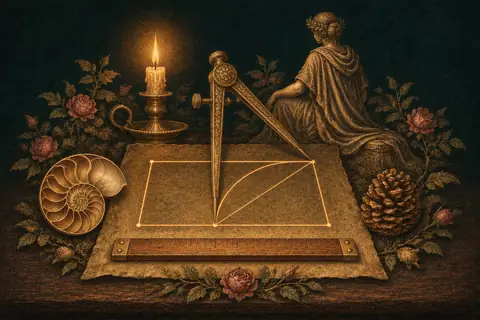
A real number, about 1.618, and the temples, shells and faces it is said to rule.
What is the golden ratio, and where is it truly found?
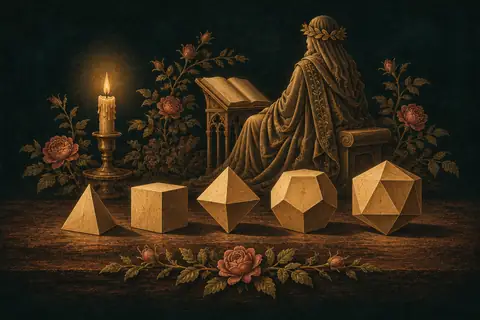
The five regular solids, proved to be the only ones, and what Plato made of them.
What are the five Platonic solids, and why can there be only five?
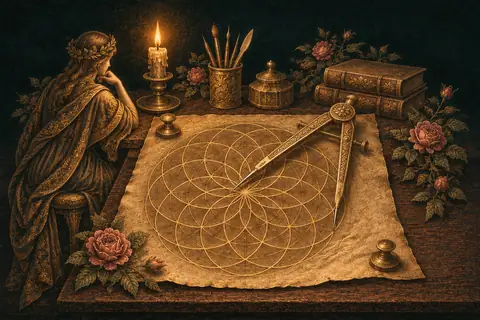
An ancient rosette of overlapping circles, and the modern name and claims it carries.
What is the flower of life, and how old is the figure really?
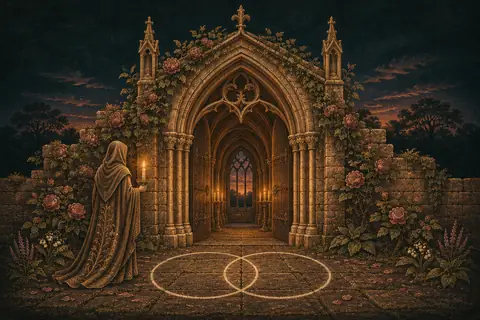
Two circles through each other’s centres: the almond the cathedral masons drew from.
What is the vesica piscis, and what did the cathedral masons draw with it?
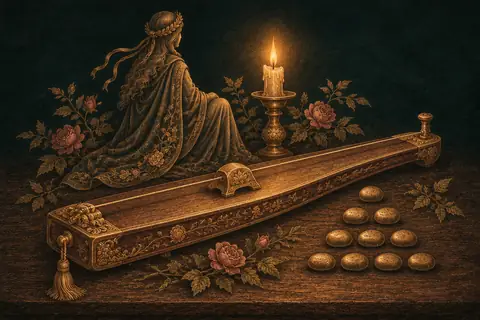
The tetractys, the ratios of music, and the teaching that all things are number.
What did the Pythagoreans teach about sacred number and the tetractys?
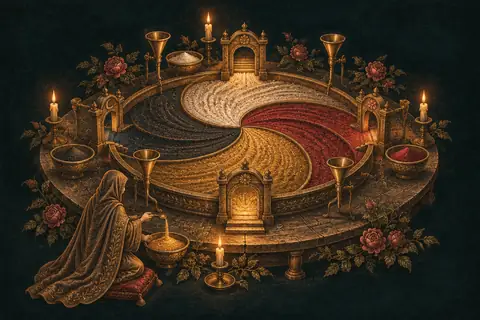
The circle diagrams of India and Tibet, as their own traditions describe them.
What are mandalas and yantras, and how do their own traditions regard them?
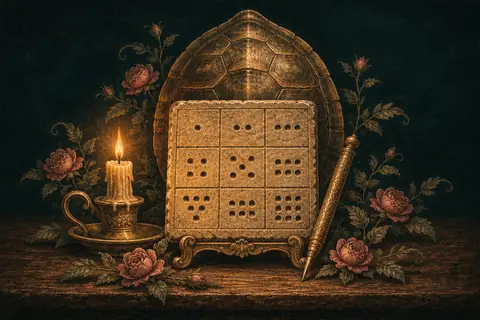
Grids whose every row, column and diagonal add to one sum, from the Lo Shu to Dürer.
What is a magic square, and why were magic squares given to the planets?
Each opens its page in the dictionary.
 Golden Ratio
 Fibonacci Sequence
 Platonic Solids
 Timaeus
 Flower of Life
 Seed of Life
 Metatron's Cube
 Vesica Piscis
 Squaring the Circle
 Tetractys
 Monochord
 Quadrivium
 Mandala
 Yantra
 Sri Yantra
 Magic Square
Greek teacher from Samos who founded a community at Croton in southern Italy. He left no writings; what is known comes from authors writing generations and centuries later. His school taught that number and harmony order the world, and that souls pass from life to life.
Athenian philosopher, pupil of Socrates and teacher of Aristotle, who founded the Academy about 387 BC and wrote in dialogues. The Timaeus describes the cosmos as a living being with a soul, ordered by number; the Republic gives the cave and the three parts of the soul; the Symposium gives the tale of humans split in two who seek their other half. Later Platonists, Plotinus above all, built on him the philosophy the Hermetic and astrological traditions lean on.
Florentine priest, physician and scholar, head of the circle the Medici gathered at Careggi. He put all of Plato into Latin and, before it, the Corpus Hermeticum, which he believed as old as Moses. His Three Books on Life (1489) teach how to temper the planets within oneself by music, scent, food and image, and are the first book of what is now called psychological astrology. He gave the West the phrase “Platonic love” and the idea of one ancient theology running from Hermes to Plato.
ProclusHypatiaJohannes KeplerPtolemyIamblichusTheseus and the MinotaurHiram Abiff
Past lives and karmaAstral projectionThe Tree of LifeThe Hermetic principlesHerbs, oils and stonesFasting and disciplineDeath and what followsSound and mantraLost worlds
Make today specific
The same sky reaches everyone differently. Your birth details turn a general forecast into one theme, and one thing worth doing about it.
One instrument, one answer. Explore the preview; membership opens every tool.
Read more

