
Magic squares
Grids whose every row, column and diagonal add to one sum, from the Lo Shu to Dürer.
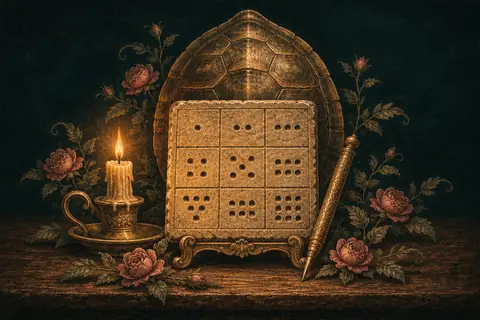
What is a magic square, and why were magic squares given to the planets?
What it is
A magic square is a square grid of different whole numbers arranged so that every row, every column and both long diagonals add to the same sum. The smallest has three cells a side and holds the numbers one to nine, with five at the centre and fifteen as the sum; apart from turning it round or reflecting it, there is only one. With four cells a side there are 880. The squares are arithmetic and nothing else, and methods for building one of any size have been known for centuries.
The teaching
As the lore of the grid from the Lo Shu to Agrippa teaches it.
The rule of the square
A magic square of order n holds the numbers from 1 to n squared, each once, so that every row, every column and both long diagonals add to the same sum. Since all the numbers together make n squared times n squared plus one, halved, each of the n rows must take an equal share, and the sum of a line is n times n squared plus one, halved: 15 for a square of three, 34 for four, 65 for five, 111 for six, 175 for seven, 260 for eight and 369 for nine.
In the square of three the middle cell must hold five, and every pair of cells on opposite sides of the middle adds to ten.
The Lo Shu
The oldest is the Lo Shu, the writing from the river Luo. Its rows read 4, 9, 2 at the top, 3, 5, 7 across the middle and 8, 1, 6 at the bottom. Legend says it was seen on the shell of a turtle that rose from the river in the days of Yu the Great, who tamed the floods. The odd numbers, which are yang, stand on the cross through the centre; the even numbers, which are yin, stand at the corners; and five, at the centre, is the pivot of all.
Chinese teaching lays it out as the nine palaces, with south at the top as on old Chinese maps. Nine is the south and fire, one the north and water, three the east and thunder, seven the west and the lake; four is the south-east and wind, two the south-west and earth, eight the north-east and the mountain, six the north-west and heaven. So the square joins the numbers to the eight trigrams of the Book of Changes and the eight directions, and the art of feng shui moves the numbers through the palaces year by year as the flying stars.
Building the even squares
Odd squares are built by a stepping rule; even ones need others. For a square of four, write the numbers 1 to 16 in order, row by row, then replace each number on the two long diagonals by its partner, the number that adds to it to make 17. The rows then read 16, 2, 3, 13; 5, 11, 10, 8; 9, 7, 6, 12; 4, 14, 15, 1, and every line adds to 34. For a square of eight the same is done on the diagonals of each of its four smaller squares, with partners that make 65.
Squares of six, ten and the other even orders not divisible by four are the hardest: they are made by joining four odd squares and swapping certain cells between them.
Dürer's square
Dürer set a square of four in his engraving Melencolia I: 16, 3, 2, 13; 5, 10, 11, 8; 9, 6, 7, 12; 4, 15, 14, 1. Every row, column and long diagonal adds to 34, and so do the four corners, the four middle cells and each of its four quarters, while every pair of cells set opposite each other through the centre adds to 17. The two middle cells of the bottom row give the year, 1514.
Agrippa's tables of the planets
Agrippa gives a square to each of the seven planets, in the old order from the slowest to the swiftest, and the size of the square rises with it. Saturn has the square of three, with lines of 15 and a total of 45; Jupiter four, 34 and 136; Mars five, 65 and 325; the Sun six, 111 and 666; Venus seven, 175 and 1225; Mercury eight, 260 and 2080; the Moon nine, 369 and 3321. Each was to be engraved on a plate of metal at a fortunate hour, lead for Saturn, gold for the Sun, silver for the Moon.
With each square come names whose letters, counted as numbers in Hebrew, give the square's own numbers: for Saturn the intelligence Agiel and the spirit Zazel both count 45, and for the Sun the spirit Sorath counts 666. The square of the Sun is thus the square of the number that Revelation gives the beast: Here is wisdom. Let him that hath understanding count the number of the beast: for it is the number of a man; and his number is Six hundred threescore and six.
Seals traced on the squares
Agrippa draws for each planet a seal made from the lines of its square. Later magicians, the Golden Dawn among them, made a sigil for any name the same way: turn each letter of the name into its number, find the numbers in turn on the planet's square, and join them with one line, beginning with a small circle and ending with a short bar. The line, lifted off the square, is the sigil of that name on that planet's table.
How it is practised
Build the three by three square from one fact held in memory, that five sits in the middle and the even numbers take the corners, and check all eight lines. Then try the old method for any odd size: start with one in the middle of the top row, move up and to the right for each next number, wrap round at the edges, and drop down one cell when the way is blocked. It is a puzzle and a pleasure. Agrippa's planetary squares are part of the history of magic and are told as that; a magic square on paper attracts nothing and wards off nothing.
Where it comes from
The three by three square is told in China as the Lo Shu, a pattern said in legend to have been seen on the shell of a turtle rising from the River Luo; texts describing it survive from about two thousand years ago. Arabic mathematicians of the ninth and tenth centuries built larger ones. In 1533 Heinrich Cornelius Agrippa printed seven squares, with three to nine cells a side, and gave one to each planet from Saturn to the Moon, for cutting on talismans. Albrecht Dürer set a four by four square in his engraving Melencolia I, with the year 1514 in its bottom row.
What is known, and what is not
The counts are proved: one square with three cells a side, 880 with four, and 275,305,224 with five, found by computer in 1973. The place of the Lo Shu in Chinese thought is documented, and so is Agrippa's table. That a square of numbers carries the influence of a planet is a claim of Renaissance magic with nothing to support it. Numbers drawn from a birth date and set in a grid, as some modern systems do, describe the method and not the person.
Its words
 Magic Square
- A square grid of different numbers whose rows, columns and long diagonals all add to one sum. Pure arithmetic, later given to the planets by Renaissance magicians.
- Melencolia I
- Albrecht Dürer's engraving of 1514: a brooding winged figure among idle tools of geometry, under a four by four magic square that holds the date.
Ask the Oracle further
How do I build a magic square of any odd size?Why did Agrippa give a magic square to each planet?
Before you practise
The mathematics of these figures is true and can be checked. What they are held to mean is a tradition, and many popular claims of the golden ratio in buildings, bodies and paintings do not survive measurement. A figure heals, protects and attracts nothing by itself.
Its other branches
The golden ratioThe Platonic solidsThe flower of lifeThe vesica piscisPythagoras and numberMandala and yantraThe whole artSearch the tree

