

Mystical systems
Magic Square
Direct answer
Magic Square: A magic square is a square grid of different numbers in which every row, every column and both long diagonals add up to the same total.
$0 today, then $19/month after 7 days. Cancel anytime.
At a glance
- Also called
- kamea, planetary squares, lo shu square
- Found in
- Mystical Systems
- Related
- Lo Shu Grid, Sacred Geometry, Tetractys, Pythagorean Numerology
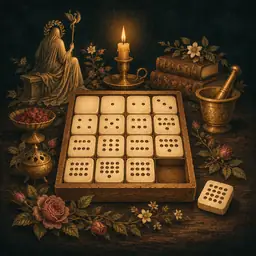

A magic square is a square grid of different numbers in which every row, every column and both long diagonals add up to the same total.
A lineage map for books and systems; it avoids presenting symbolic traditions as literal fact.
Understand the chapter you are in.
Your life’s turning points, measured from your birth.
Walk through Alex’s whole example first


Prefer to explore first?
 The Road of AgesThe turning points of your whole life, from your own chart
Walk my road
What is the magic number of a three by three magic square?
A magic square of order three holds the numbers one to nine in a three by three grid so that each line of three adds to fifteen. Five must sit in the centre and the even numbers in the corners, and apart from turning and mirroring there is only one such square. Order four, with the numbers one to sixteen and a sum of thirty-four, has 880. Rules for building squares of any size are old and exact.
Because the squares looked like a marvel they were given meanings. In China the order three square, the Lo Shu, was tied to the plan of the nine halls. Renaissance magicians assigned the squares of order three to nine to the seven planets and cut them on talismans, and from each square they drew a seal by joining its numbers in order. The arithmetic is true. The planetary powers are a claim of the magicians.
On the tree of the hidden arts: Sacred geometry.
What sets Magic Square apart
The sum is forced before a single number is placed. The numbers from one upward have a fixed total and the rows share it equally, so every line must add to fifteen when there are three cells a side, thirty-four when there are four and sixty-five when there are five. What is free is the arrangement, and the count of arrangements explodes: one square, then 880, then more than 275 million. No square with two cells a side exists at all.
- Order three: one square, sum 15, with 5 at the centre
- Order four: 880 squares, sum 34
- Order five: 275,305,224 squares, sum 65
- Chinese form: the Lo Shu, with the legend of the turtle of the River Luo
- Planetary set: orders three to nine, Saturn to the Moon, in Agrippa, 1533
- Dürer's square: order four, in Melencolia I, 1514
Often mistaken for something else: A Latin square repeats the same few symbols once in each row and column, as a sudoku does; a magic square holds different numbers and is defined by its sums.
The story behind Magic Square
The Lo Shu is described in Chinese texts of about two thousand years ago. Squares of higher order were worked out by Arabic mathematicians from the ninth century and appear in the encyclopedia of the Brethren of Purity. Agrippa printed the seven planetary squares in 1533, and Dürer engraved an order four square in 1514. The count of 880 squares of order four was found by Bernard Frénicle de Bessy and published in 1693.
Why Magic Square matters
Magic Square is a clean case of arithmetic that needs no mystery, beside a long history of people giving it one.
How to read Magic Square
Puzzle makers and teachers build them for their own sake; the old magicians cut them on metal as planetary talismans.
Magic Square in practice: an example
In Dürer's Melencolia I the middle cells of the bottom row read 15 and 14, the year the print was made.
Where readings of Magic Square go wrong
A grid of numbers has no influence on events, whatever planet or birth date it is tied to.
Sources and editorial method
This entry summarizes the tradition in the Almanac's own words; where no source is listed, it is an editorial summary rather than a primary text, and symbolic readings are named as the tradition's, not as fact.
- Source
- The Great Almanac Dictionary
- Category
- Mystical Systems
- Aliases
- magic squares, kamea, planetary squares, lo shu square, magic square meaning
- Last updated
- 2026-09-26
See Magic Square in your personal almanac
A definition tells you what it is; your own birth chart tells you what it means for you. The Oracle casts your real chart and answers for your love, your work, and your year ahead, in conversation. It opens with the 7-day Oracle trial.
Speak with the OracleRelated terms
More in Mystical Systems
From the reference page to your own chart
Every word here
is in your own chart.
- Your life’s turning points, measured from your birth
- A practical next step to consider
- It opens with 7 days free: the AI Oracle on thirty hidden arts, and your daily horoscope
$0 today, then $19/month after 7 days. Cancel anytime.
Common questions
What is the magic number of a three by three magic square?
Fifteen. The numbers one to nine total forty-five, and the three rows share that total equally, so each row, column and long diagonal adds to fifteen.
What is a planetary magic square?
It is one of seven squares, with three to nine cells a side, that Renaissance writers such as Agrippa gave to Saturn, Jupiter, Mars, the Sun, Venus, Mercury and the Moon in that order.
What is the Lo Shu?
It is the three by three magic square as told in China, where legend says its pattern of dots was seen on the shell of a turtle that came out of the River Luo.


