

Mystical systems
Feng Shui
Direct answer
Feng Shui: Feng shui is the Chinese art of choosing and arranging a site so that a house, a grave or a city sits well in its land; the name means wind and water.
$0 today, then $19/month after 7 days. Cancel anytime.
At a glance
- Also called
- fengshui, chinese geomancy, wind and water
- Found in
- Mystical Systems
- Related
- Bagua, Vastu Shastra, Qi (Chi), I Ching
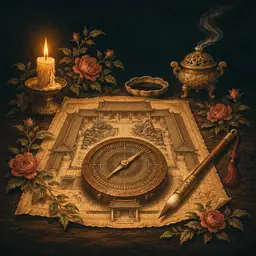

Feng shui is the Chinese art of choosing and arranging a site so that a house, a grave or a city sits well in its land; the name means wind and water.
A lineage map for books and systems; it avoids presenting symbolic traditions as literal fact.
Understand the chapter you are in.
Your life’s turning points, measured from your birth.
Walk through Alex’s whole example first


Prefer to explore first?
 The Road of AgesThe turning points of your whole life, from your own chart
Walk my road
What does feng shui mean?
Feng shui began as the art of siting graves and houses. Its older school, the school of forms, reads the land: high ground behind, lower hills to left and right, open ground and curving water in front. The four sides are named for four animals, the black tortoise, the green dragon, the white tiger and the red bird.
The later compass school works by direction and time. Its tool is the luopan, a compass ringed with the eight trigrams and other signs, and it reckons a house from its facing and the year it was built. Both schools speak of qi, the breath of the land, which a good site gathers and holds.
On the tree of the hidden arts: Sacred places.
What sets Feng Shui apart
Feng shui began with the dead. Its founding book is about burial, and the belief behind it is that the bones of ancestors, well placed, send good to their descendants. Houses came second. The form school is at bottom a description of a sheltered site: a hill at the back against the north wind, low spurs at the sides, water and sunlight in front. Much of what is sold under the name in the West, with colours and corners for wealth, is of the last fifty years.
- Name: Chinese: wind and water
- Founding text: the Book of Burial, credited to Guo Pu, who died in 324 CE
- Two schools: forms, which reads the land; compass, which reckons by direction
- Instrument: the luopan, a ringed compass
- Four animals: black tortoise behind, red bird in front, dragon and tiger at the sides
Often mistaken for something else: Vastu shastra lays a building on a fixed square grid; feng shui has no grid, and starts from the lie of the land around the site.
The story behind Feng Shui
The name comes from the Book of Burial, credited to Guo Pu, who died in 324 CE. The school of forms is traced to Yang Yunsong in the ninth century and the compass school grew up after it. The art shaped imperial tombs, villages and the plan of Beijing. It was condemned as superstition in China after 1949 and was kept up in Hong Kong, Taiwan and among Chinese abroad. A simplified version, which lays a map of eight life areas over a floor plan from the front door, was taught in California from the 1980s.
Why Feng Shui matters
Feng Shui is the best known tradition of asking what a place does to the people in it, and much advice sold in its name is recent.
How to read Feng Shui
In Chinese tradition a master is called in before a grave is dug or a house is built; in the West it is mostly applied to rooms and furniture.
Feng Shui in practice: an example
A consultant of the school of forms praises a house that backs on a wooded slope and looks out over a pond that curves toward it.
Where readings of Feng Shui go wrong
No study shows that it changes luck, health or wealth. Costly remedies are not part of the classical art, and no school asks anyone to leave a safe home.
Sources and editorial method
This entry summarizes the tradition in the Almanac's own words; where no source is listed, it is an editorial summary rather than a primary text, and symbolic readings are named as the tradition's, not as fact.
- Source
- The Great Almanac Dictionary
- Category
- Mystical Systems
- Aliases
- fengshui, feng shui meaning, chinese geomancy, wind and water, feng shui house
- Last updated
- 2026-09-26
See Feng Shui in your personal almanac
A definition tells you what it is; your own birth chart tells you what it means for you. The Oracle casts your real chart and answers for your love, your work, and your year ahead, in conversation. It opens with the 7-day Oracle trial.
Speak with the OracleRelated terms
More in Mystical Systems
From the reference page to your own chart
Every word here
is in your own chart.
- Your life’s turning points, measured from your birth
- A practical next step to consider
- It opens with 7 days free: the AI Oracle on thirty hidden arts, and your daily horoscope
$0 today, then $19/month after 7 days. Cancel anytime.
Common questions
What does feng shui mean?
It means wind and water. The words come from an old Chinese book on burial, which says that the breath of the land is scattered by wind and held where there is water.
Does feng shui work?
No controlled study shows an effect on fortune or health. Some of its advice, such as good light, clear entrances and a seat that faces the door, makes rooms pleasanter for ordinary reasons.
What is the difference between the form school and the compass school?
The form school reads the shape of the land and of the building. The compass school reckons by directions and dates with a special compass. Many practitioners combine the two.


