

Mystical systems
Vastu Shastra
Direct answer
Vastu Shastra: Vastu shastra is India's traditional teaching on building: how to choose a plot, face a door and lay out rooms on a square grid set to the four directions.
$0 today, then $19/month after 7 days. Cancel anytime.
At a glance
- Also called
- vaastu, indian architecture tradition, vastu for home
- Found in
- Mystical Systems
- Related
- Feng Shui, Bagua, Temple, Mandala
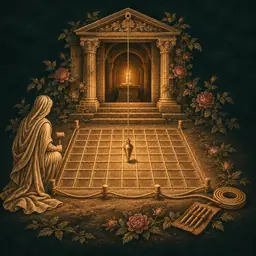

Vastu shastra is India's traditional teaching on building: how to choose a plot, face a door and lay out rooms on a square grid set to the four directions.
A lineage map for books and systems; it avoids presenting symbolic traditions as literal fact.
Understand the chapter you are in.
Your life’s turning points, measured from your birth.
Walk through Alex’s whole example first


Prefer to explore first?
 The Road of AgesThe turning points of your whole life, from your own chart
Walk my road
What is vastu shastra?
Vastu means a dwelling or its site, and shastra a body of teaching. The texts treat the testing of soil, the proportions of a building and the placing of its parts. At their centre is a diagram, a square divided into smaller squares, usually sixty-four for a temple and eighty-one for a house. A cosmic figure is pictured lying in it, and each square belongs to a deity, with Brahma at the middle, which is left open.
The building is set square to the directions, and each quarter has its proper use. Popular rules today put the kitchen in the south-east, the quarter of fire, and prefer a door to the east or north.
On the tree of the hidden arts: Sacred places.
What sets Vastu Shastra apart
Vastu starts from a diagram and not from the landscape. The square grid is drawn on the cleared ground before building, and a figure is imagined pinned face down within it, with the gods holding his limbs; the walls and rooms then respect where he lies. The centre is kept free. The old texts spend most of their length on measures and proportions, which makes them closer to a builder's handbook than to a book of omens.
- Name: Sanskrit: vastu, a dwelling or site; shastra, a teaching
- Grid: 64 squares for a temple, 81 for a house
- Centre: the place of Brahma, left open
- Early source: Varahamihira, sixth century CE
- Later manuals: the Manasara and the Mayamata
Often mistaken for something else: Feng shui reads hills, water and compass bearings; vastu shastra sets every building on the same square diagram turned to the four directions.
The story behind Vastu Shastra
Rules for houses and temples are found in a sixth-century work of the astronomer Varahamihira and in builders' manuals of the following centuries, among them the Manasara and the Mayamata, whose dates are uncertain. They guided temples and palaces above all. The city of Jaipur, laid out from 1727, is often named as a town planned on the nine-part square. Vastu for ordinary flats and offices is largely a revival of the late twentieth century, and it is stricter than the old books.
Why Vastu Shastra matters
Vastu Shastra carries a whole view of how a building should sit among the directions, and it still shapes how many Indian homes are bought.
How to read Vastu Shastra
Builders and buyers in India consult it for the facing of a plot and the placing of rooms, much as others consult a surveyor.
Vastu Shastra in practice: an example
A family choosing between two flats is told by a consultant that the one with the east-facing door is better, and asks why.
Where readings of Vastu Shastra go wrong
No study shows that a layout changes fortune or health, and advice to rebuild or sell at a loss should be weighed as belief.
Sources and editorial method
This entry summarizes the tradition in the Almanac's own words; where no source is listed, it is an editorial summary rather than a primary text, and symbolic readings are named as the tradition's, not as fact.
- Source
- The Great Almanac Dictionary
- Category
- Mystical Systems
- Aliases
- vastu, vaastu, vastu shastra meaning, indian architecture tradition, vastu for home
- Last updated
- 2026-09-26
See Vastu Shastra in your personal almanac
A definition tells you what it is; your own birth chart tells you what it means for you. The Oracle casts your real chart and answers for your love, your work, and your year ahead, in conversation. It opens with the 7-day Oracle trial.
Speak with the OracleRelated terms
More in Mystical Systems
From the reference page to your own chart
Every word here
is in your own chart.
- Your life’s turning points, measured from your birth
- A practical next step to consider
- It opens with 7 days free: the AI Oracle on thirty hidden arts, and your daily horoscope
$0 today, then $19/month after 7 days. Cancel anytime.
Common questions
What is vastu shastra?
It is the traditional Indian teaching on architecture: how to choose a site and how to orient and lay out a building. It was written down in Sanskrit texts from about the sixth century.
Is vastu the same as feng shui?
No. They are separate traditions, Indian and Chinese. Both set a building by the directions, but vastu works from a fixed square grid while feng shui reads the land and uses a compass.
Is there evidence that vastu works?
No controlled study shows an effect on luck, wealth or health. Its insistence on light, air and a clear centre agrees with ordinary good design.


