

Mystical systems
Bagua
Direct answer
Bagua: The bagua is the set of eight trigrams of the I Ching arranged in a ring, each made of three whole or broken lines and each tied to a direction.
$0 today, then $19/month after 7 days. Cancel anytime.
At a glance
- Also called
- ba gua, pa kua, eight trigrams
- Found in
- Mystical Systems
- Related
- Feng Shui, I Ching, Vastu Shastra, Qi (Chi)
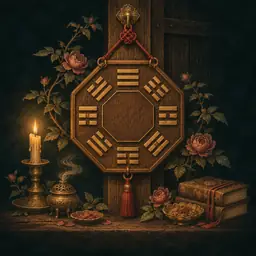

The bagua is the set of eight trigrams of the I Ching arranged in a ring, each made of three whole or broken lines and each tied to a direction.
A lineage map for books and systems; it avoids presenting symbolic traditions as literal fact.
Understand the chapter you are in.
Your life’s turning points, measured from your birth.
Walk through Alex’s whole example first


Prefer to explore first?
 The Road of AgesThe turning points of your whole life, from your own chart
Walk my road
What are the eight trigrams?
Bagua means eight signs. Each sign, or trigram, is a stack of three lines, and each line is either whole or broken in two. Three lines of two kinds give eight figures, named heaven, earth, thunder, wind, water, fire, mountain and lake. Set one above another in pairs they make the sixty-four hexagrams of the I Ching.
Arranged in a ring, the eight are matched to the eight directions. Chinese tradition knows two such rings, an earlier one credited to the sage Fuxi and a later one credited to King Wen. The compass school of feng shui uses the later ring to read the quarters of a house.
On the tree of the hidden arts: Sacred places.
What sets Bagua apart
The bagua is a counting scheme before it is a symbol: every way of stacking three lines of two kinds. That makes it complete, which is what let Chinese thinkers hang directions, seasons, family members, animals and parts of the body on the same eight pegs. The ring exists in two orders that put different trigrams at the south, and a plaque shows which by what sits at the top. About 1700 Leibniz saw in the lines a likeness to his arithmetic of ones and noughts.
- Name: Chinese: eight signs
- Each trigram: three lines, each whole or broken
- The eight: heaven, earth, thunder, wind, water, fire, mountain, lake
- Two rings: the earlier, credited to Fuxi, and the later, credited to King Wen
- Doubled: into the 64 hexagrams of the I Ching
Often mistaken for something else: A hexagram has six lines and is what an I Ching reading yields; a trigram has three, and the bagua is the set of all eight.
The story behind Bagua
The trigrams belong to the oldest layer of the I Ching, which took shape in the first millennium BCE; legend gives them to Fuxi. The later ring follows a passage in the old commentaries of the I Ching itself; the earlier ring was first drawn by scholars of the Song dynasty, about a thousand years ago. Eight-sided plaques bearing the bagua, often with a mirror at the centre, are hung over doors in Chinese folk custom. The map of eight life areas, with a corner for wealth and one for love, comes from a Western school of the 1980s.
Why Bagua matters
The same eight figures underlie Chinese divination, medicine, martial arts and the laying out of houses, so they repay knowing once.
How to read Bagua
A compass practitioner lays the ring over a floor plan to name each quarter by its trigram and reads the house from there.
Bagua in practice: an example
A reader sees an eight-sided plaque above a shop door in a Chinese quarter and can now name the bars on it.
Where readings of Bagua go wrong
A plaque or mirror over a door is a folk custom, and nothing shows that it turns anything away or draws anything in.
Sources and editorial method
This entry summarizes the tradition in the Almanac's own words; where no source is listed, it is an editorial summary rather than a primary text, and symbolic readings are named as the tradition's, not as fact.
- Source
- The Great Almanac Dictionary
- Category
- Mystical Systems
- Aliases
- ba gua, pa kua, eight trigrams, bagua map, bagua mirror
- Last updated
- 2026-09-26
See Bagua in your personal almanac
A definition tells you what it is; your own birth chart tells you what it means for you. The Oracle casts your real chart and answers for your love, your work, and your year ahead, in conversation. It opens with the 7-day Oracle trial.
Speak with the OracleRelated terms
More in Mystical Systems
From the reference page to your own chart
Every word here
is in your own chart.
- Your life’s turning points, measured from your birth
- A practical next step to consider
- It opens with 7 days free: the AI Oracle on thirty hidden arts, and your daily horoscope
$0 today, then $19/month after 7 days. Cancel anytime.
Common questions
What are the eight trigrams?
They are eight figures of three lines each, whole or broken: heaven, earth, thunder, wind, water, fire, mountain and lake. They are the building blocks of the I Ching.
What is the bagua map in feng shui?
In the classical compass school it is the ring of trigrams laid over a house by compass direction. The popular map of life areas fixed to the front door is a Western version of the 1980s.
What is the difference between the two bagua arrangements?
The earlier ring sets opposite trigrams across from each other, heaven facing earth. The later ring follows the seasons round the year and is the one used with the compass.


