

Mystical systems
Gehenna
Direct answer
Gehenna is a name for a place of punishment after death, taken from the Valley of Hinnom on the south side of ancient Jerusalem.
$0 today, then $19/month after 7 days. Cancel anytime.
At a glance
- Also called
- Valley of Hinnom, Gehinnom, Ge Hinnom
- Found in
- Mystical Systems
- Related
- Sheol, Hades, Purgatory, Final Judgment
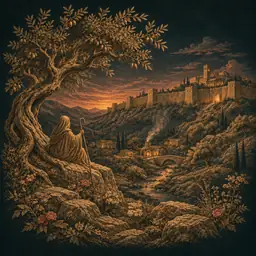

Gehenna is a name for a place of punishment after death, taken from the Valley of Hinnom on the south side of ancient Jerusalem.
A lineage map for books and systems; it avoids presenting symbolic traditions as literal fact.
Understand the chapter you are in.
Your life’s turning points, measured from your birth.
Walk through Alex’s whole example first


Prefer to explore first?
 The Road of AgesThe turning points of your whole life, from your own chart
Walk my road
What does Gehenna mean?
Gehenna comes from the Hebrew Ge Hinnom, the Valley of Hinnom, which runs along the south and west of the old city of Jerusalem. The books of Kings and Jeremiah say that children were burned there in sacrifice at a place called Topheth, and that King Josiah defiled the site to end it. Jeremiah said that it would be called the Valley of Slaughter.
By the first century CE the name of the valley stood for a place of fire where the wicked are punished. It is used that way in rabbinic writings, where the stay is usually limited to twelve months, and in the Gospels, where it appears eleven times in the words of Jesus. The Arabic Jahannam is the same word.
On the tree of the hidden arts: Death and what follows.
What sets Gehenna apart
Gehenna is the rare name for the other world that can be found on a map. The valley is still there below the walls of the old city of Jerusalem. Its meaning comes from memory more than from landscape: the prophets tied it to the burning of children, and later teachers made the place of that crime the image of its punishment. In Jewish teaching the punishment is usually bounded; the usual Christian reading made it lasting.
- Hebrew: Ge Hinnom, Valley of Hinnom; also Valley of the Son of Hinnom
- Where: south and west of the old city of Jerusalem
- Biblical memory: child sacrifice at Topheth, ended by King Josiah
- In the New Testament: twelve times: eleven in the Gospels, once in the Letter of James
- Rabbinic limit: twelve months, in the Mishnah
- Arabic cognate: Jahannam
Often mistaken for something else: In the New Testament Hades is usually the realm of the dead before the judgement, and Gehenna the place of punishment after it.
The story behind Gehenna
The valley is named in the Book of Joshua as a boundary. Its association with child sacrifice dates to the last centuries of the kingdom of Judah. The often repeated statement that it was an ever-burning rubbish tip in the time of Jesus is first found in the commentary of Rabbi David Kimhi, about 1200 CE, and excavation has not confirmed it.
Why Gehenna matters
Gehenna shows how a real place with a terrible memory became an image, and why English Bibles that print hell for it lose that history.
How to read Gehenna
Scholars keep the word to distinguish it from Sheol and Hades, which older English Bibles also translated as hell.
Gehenna in practice: an example
A visitor to Jerusalem walks through a green valley with a park in it and learns that this is the Gehenna of the Gospels.
Where readings of Gehenna go wrong
What it teaches about punishment belongs to the faiths that use it. The house does not say that anyone is there.
Sources and editorial method
This entry summarizes the tradition in the Almanac's own words; where no source is listed, it is an editorial summary rather than a primary text, and symbolic readings are named as the tradition's, not as fact.
- Source
- The Great Almanac Dictionary
- Category
- Mystical Systems
- Aliases
- Valley of Hinnom, Gehinnom, Ge Hinnom, Gehenna meaning
- Last updated
- 2026-09-26
See Gehenna in your personal almanac
A definition tells you what it is; your own birth chart tells you what it means for you. The Oracle casts your real chart and answers for your love, your work, and your year ahead, in conversation. It opens with the 7-day Oracle trial.
Speak with the OracleRelated terms
More in Mystical Systems
From the reference page to your own chart
Every word here
is in your own chart.
- Your life’s turning points, measured from your birth
- A practical next step to consider
- It opens with 7 days free: the AI Oracle on thirty hidden arts, and your daily horoscope
$0 today, then $19/month after 7 days. Cancel anytime.
Common questions
What does Gehenna mean?
It comes from the Hebrew for Valley of Hinnom, a valley beside ancient Jerusalem. In later Jewish and Christian use it names a place of punishment after death.
Was Gehenna a burning rubbish dump?
That is often said, but the earliest source for it is a commentary written about 1200 CE, and archaeologists have found no evidence of such a dump from the time of Jesus.
Is Gehenna eternal in Jewish teaching?
Usually not. The Mishnah gives twelve months as the length of the judgement of the wicked in Gehenna, and many rabbis understood it as a cleansing with an end.


