

Mystical systems
Shatkona
Direct answer
Shatkona: The shatkona is the six-pointed figure of Hindu sacred diagrams: an upward and a downward triangle interlaced, read as the union of Shiva and Shakti.
$0 today, then $19/month after 7 days. Cancel anytime.
At a glance
- Also called
- satkona, hindu hexagram, six pointed star hinduism
- Found in
- Mystical Systems
- Related
- Hexagram, Star of David, Yantra, Chakra
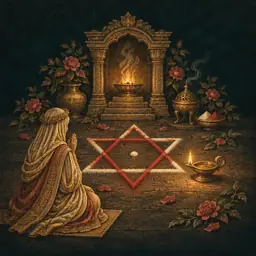

The shatkona is the six-pointed figure of Hindu sacred diagrams: an upward and a downward triangle interlaced, read as the union of Shiva and Shakti.
A lineage map for books and systems; it avoids presenting symbolic traditions as literal fact.
Understand the chapter you are in.
Your life’s turning points, measured from your birth.
Walk through Alex’s whole example first


Prefer to explore first?
 The Road of AgesThe turning points of your whole life, from your own chart
Walk my road
What does the shatkona mean?
Shatkona is Sanskrit for six-cornered. The figure is made of two equal triangles laid over each other, one with its point up and one with its point down, so that a six-pointed star appears with a six-sided space at its centre. In Hindu teaching the upward triangle is the masculine principle, named as Shiva or as purusha, pure awareness, and the downward triangle is the feminine principle, Shakti or prakriti, the power that brings things forth. Their meeting is the world.
The shatkona is drawn inside yantras, the diagrams used in worship, often with a dot at the centre, and it stands in the picture of the heart centre in the system of the chakras. It is also found in Buddhist and Jain diagrams. It shares its outline with the Star of David and has a separate history.
On the tree of the hidden arts: Symbols.
What sets Shatkona apart
The shatkona differs from the other six-pointed stars in that every part of it is assigned: the upward triangle to Shiva or to awareness, the downward to Shakti or to the power that brings forth, and the point often drawn at the centre to the place where the two are not yet divided. It is rarely seen alone. It sits inside a yantra, ringed by lotus petals and a square enclosure with four gates, and is meant to be looked at in worship, not worn.
- Meaning of the name: Sanskrit shat, six, and kona, corner or angle
- Upward triangle: Shiva, or purusha, the masculine principle
- Downward triangle: Shakti, or prakriti, the feminine principle
- Among the chakras: drawn within the twelve-petalled lotus of the heart centre
Often mistaken for something else: The Jewish emblem has the same outline and a separate history in Europe; no borrowing between it and the shatkona has been shown.
The story behind Shatkona
Interlaced triangles belong to the ritual diagrams described in the tantric texts of the first millennium CE and after, and the figure is carved on temples across India. In South India it is tied to the god Murugan, whose six faces it is said to show. European visitors of the nineteenth century noticed the likeness to the Jewish emblem, and the Theosophical Society, founded in 1875, set the interlaced triangles in its own seal beside signs from other traditions. No borrowing in either direction has been shown.
Why Shatkona matters
Shatkona shows that the six-pointed star has more than one home, so that the figure is read by its setting and not assumed to be a single sign.
How to read Shatkona
Worshippers draw it within a yantra as a seat for the deity, and teachers of the chakras show it inside the lotus of the heart centre.
Shatkona in practice: an example
A visitor who sees the six-pointed figure on the floor of a South Indian temple is looking at a shatkona, drawn for worship there.
Where readings of Shatkona go wrong
Shatkona is a sacred figure of living religions and is drawn by their own rules; it is not a charm that works by being worn.
Sources and editorial method
This entry summarizes the tradition in the Almanac's own words; where no source is listed, it is an editorial summary rather than a primary text, and symbolic readings are named as the tradition's, not as fact.
- Source
- The Great Almanac Dictionary
- Category
- Mystical Systems
- Aliases
- satkona, shatkona meaning, hindu hexagram, six pointed star hinduism
- Last updated
- 2026-09-26
See Shatkona in your personal almanac
A definition tells you what it is; your own birth chart tells you what it means for you. The Oracle casts your real chart and answers for your love, your work, and your year ahead, in conversation. It opens with the 7-day Oracle trial.
Speak with the OracleRelated terms
More in Mystical Systems
From the reference page to your own chart
Every word here
is in your own chart.
- Your life’s turning points, measured from your birth
- A practical next step to consider
- It opens with 7 days free: the AI Oracle on thirty hidden arts, and your daily horoscope
$0 today, then $19/month after 7 days. Cancel anytime.
Common questions
What does the shatkona mean?
It pictures the union of two principles: the upward triangle for Shiva, or pure awareness, and the downward triangle for Shakti, the creative power. Their interlacing stands for the world that arises from both.
Is the shatkona the same as the Star of David?
The outline is the same and the histories are separate. The shatkona belongs to Hindu, Buddhist and Jain sacred diagrams; the Star of David became the emblem of the Jewish people in Europe from the seventeenth century.
Where is the shatkona used?
Inside yantras drawn for worship, in the picture of the heart centre among the chakras, on temple floors and walls, and in South India in the worship of Murugan.


