
The pentagram
A Greek sign of health, a Christian sign of five wounds, and only since the 1850s a star to fear.
Where does the pentagram come from, and when did people begin to fear it?
A symbol is a mark that people have filled with meaning, and the meanings change. The house tells each sign’s history in order, with whose reading each was, and says plainly what is modern. Seeing a sign proves no membership and no plot, and no sign protects, attracts or harms by being worn or drawn.
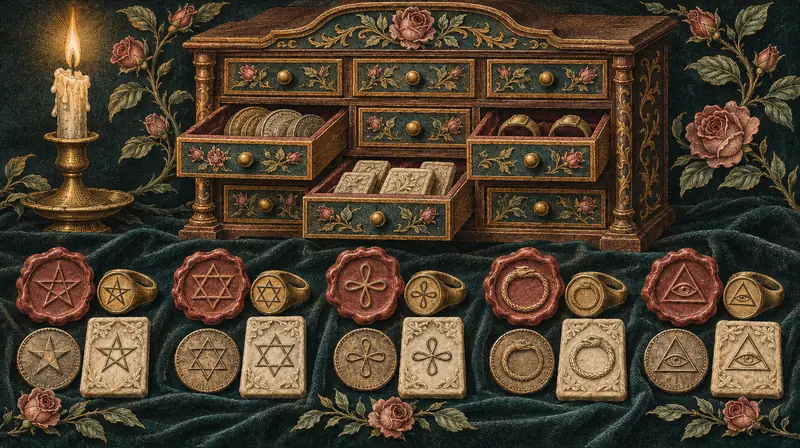
Where each sign comes from, and what it has meant
Ask the OracleWhere do the great esoteric symbols come from, and what have they meant?
A symbol is a mark that people have agreed to fill with meaning, and the agreement changes. The pentagram has stood for health, for the five wounds of Christ and for a goat's head. The hexagram has been an ornament, a magician's seal and the Star of David. No sign carries one true meaning from the beginning. What can be told is its history: where it is first found, who read it in which way, and when each reading began.
The house tells that history in order and says what is modern, since much that is called ancient is not. The point-down pentagram as a sign of evil dates from the 1850s, the picture of Baphomet from 1856, and the eye on the dollar bill from 1935. A sign held sacred by a living faith is told with respect. Seeing a symbol proves no membership and no plot, and none protects, attracts or harms by being worn or drawn.
As the craft of reading a sign by its form, its setting and its history teaches it.
The Greek word symbolon first meant a token broken in two. Two friends, or the two parties to a bargain, each kept one half, and when the halves were brought together again and fitted, each knew the other for who they were. A symbol in that first sense is half of a thing, and it is made whole only when it meets its other half.
So it is with every sign this art studies. The mark is one half; the other half is the knowledge of the people who made it, and the mark speaks fully only to those who carry that knowledge. A serpent on a staff meant healing to a Greek at the shrine of Asclepius; a serpent with its tail in its mouth is, in the Greek books of alchemy, the one matter from which all things come; a serpent in a garden is the tempter to a reader of Genesis. Each reader is right within their own world, and to read a sign is first to find out whose half it is.
Readers of signs keep a few words apart. A sign in the narrow sense points to one thing by plain agreement, as a letter stands for a sound, or the ankh in Egyptian writing for the word life. A symbol gathers many meanings at once and opens onto more than it can say, as the ring of the serpent opens onto the year, time and a world that renews itself. A monogram joins letters into one figure, as the chi-rho joins the first two letters of Christ in Greek. An attribute is the object by which a figure in art is known: the keys of Peter, the herald's wand of Hermes, the single-snaked staff of Asclepius.
An emblem stands for a person, a people, an office or a teaching. In the emblem books of the Renaissance, which gave the word its sense, an emblem has three parts, a motto, a picture and a short verse that unfolds them, and it is read as a riddle is solved. A seal is a mark of authority or ownership, pressed in wax or cut in a ring, as the Great Seal of a state or the legendary signet of Solomon. An amulet is a thing worn or hung in the belief that it turns harm aside, as the hamsa is hung by a door, and a talisman a thing made in the belief that it draws some good to its owner, as the pentacles of the old books of ritual were cut on metal or parchment. The words overlap, and one sign can be several of these in turn, but they help to ask the first question of any mark: what was it for?
Beneath the famous signs lie a few plain figures, and each carries readings that recur in many lands. The point is the centre and the source: in a Hindu yantra the dot at the heart, the bindu, is the deity before it takes form, and astrologers and alchemists set a point within a circle for the sun and for gold. The circle, with no beginning and no end, is the whole and the unending, and it has long stood for heaven, as the square, steady on its four equal sides, has stood for earth; Chinese teaching speaks of a round heaven and a square earth.
The cross is the meeting of two ways. It is read as the four quarters of the horizon and, in many systems, the four elements; for Christians it is the cross of Christ, its long foot making the Latin form and its four equal arms the Greek. The triangle is three: in Christian art the Trinity, framing the eye of Providence; in the alchemists' books fire when it points up and water when it points down, with air and earth drawn as the same two triangles crossed by a bar. Stars are counted by their points, five for the pentagram and six for the hexagram, and the reading of any star begins with the count.
Readers of signs look closely, because a small change of form makes a different sign. One snake on a rough staff is the rod of Asclepius, the healer; two snakes on a winged wand are the caduceus of Hermes, the herald. A serpent lifted on a pole is the serpent of brass that Moses set up; a serpent bent into a ring with its tail in its mouth is the ouroboros. A cross with a loop above is the ankh, two Greek letters laid one over the other make the chi-rho, and a cross whose arms are bent is the swastika.
Direction is read too, though each rule has its own maker. Lévi taught that a pentagram with one point up is spirit ruling the elements and with two points up the goat, and the rule is his; Hindu teachers read the right-turning swastika by the sun's course across the sky and give the left-turning form to the night. Doubling is read as union or balance: the two triangles of the hexagram, the two snakes brought to accord about one rod, the dark and the bright of yin and yang, each holding a seed of the other. A single figure returning into itself, as the ouroboros does, is read as a whole that needs nothing outside it.
Many of the great signs are built to be read like a sentence, part by part, and their makers left the reading. The poet of Sir Gawain stops his story to explain the five points of the star on his hero's shield. Lévi explains every part of his Baphomet, from the torch between its horns to the words written on its two arms. Charles Thomson explained the reverse of the Great Seal to Congress: the unfinished pyramid, the eye, the mottoes and the date. The Jain emblem, read from the foot upward, gives the whole teaching of that faith, from the round of births through the path to release.
Where its makers left such a reading, it comes first, before any later reader's. A reader who explains a sign without asking what its own makers said of it is writing a new meaning, which may be worth having, but should be called new.
A form travels between peoples, and each fills it anew. The six-pointed star stands on synagogues as the Star of David, in Hindu diagrams as the shatkona of Shiva and Shakti, and on rings in the old books of ritual as the Seal of Solomon: one figure, three histories, and the setting tells which is meant. The ankh passed from the hands of Egypt's gods into the Coptic church as the cross with a handle, and its meaning moved with it, from the life the gods give to the life to come.
A form can also be seized. The swastika is a sign of well-being in Hindu, Buddhist and Jain use to this day, and in modern times it was taken as the badge of the Nazi party. The second history does not erase the first, and the reader holds both, each in its own setting. A sign that a living faith holds sacred is read first in that faith's own words.
Most sacred signs, in the words of the faiths that use them, are reminders. The eye of Providence reminds the faithful of a care that watches over them; the square and compasses remind the mason to square his actions and keep within due bounds; the scallop shell marks the pilgrim of Santiago and the road behind them. The traditions of the amulet and the talisman go further and hold that a sign worn or drawn turns harm aside or draws good, and the art teaches that belief as the belief of the people who hold it, alongside their sign.
A sign is also evidence, of a narrow kind. It shows who drew it, where and when, and what they wished to say, and it shows nothing more. An eye on a seal shows that its designers knew a common church sign of Providence; it does not show who rules. The charges built on signs, from the idol the Templars were said to adore to the hoax that the lodges worship Baphomet, fall away when each sign is traced back to its makers.
The first practice is looking, with a pencil in hand. The student chooses one sign and finds it in as many places as possible, in a museum, a church, a temple, an old book, on a coin, a gravestone or a banknote, and draws each example small on the page with its place and date beneath. Copying a sign teaches its form as nothing else does: how many points or strokes, which way it turns, what is joined to it and what frames it.
Then of each example the student asks three questions: when was it made, who made it, and what did such a mark mean to those people then. The answers go down in order of date, each with whose reading it was, and whatever cannot be traced is marked as unknown rather than filled in. Done for a handful of signs, the habit soon sorts the old from the recent at a glance, and an old figure stops being frightening.
The branches of this art are single signs, each traced through all its houses. Three are figures drawn in lines: the pentagram, the six-pointed star, and the crosses with the ankh, from Egypt's sign for life to the chi-rho. Two are serpents: the ouroboros, with yin and yang beside it, and the two staffs of Hermes and of Asclepius. One is the eye, in its Egyptian, Mediterranean and Christian forms. Two are lessons in what can be done to a sign: the swastika, an old blessing taken for a party's badge, and Baphomet, a name from a charge made under torture and a drawing made long afterwards.
The pentagram is the best place to start, since it is the simplest figure with the longest line of readers. The six-pointed star follows, for the lesson that one figure can carry three histories, and then the serpents and the crosses. The eye, the swastika and Baphomet come last, once the habit of tracing a sign to its makers is firm.
A symbol has the meanings people have given it over time, and the Oracle tells them in order, with whose they were. Seeing a symbol proves no secret membership and no hidden hand. No sign protects, attracts or harms by being worn or drawn.
Each one is a question you can ask.
A Greek sign of health, a Christian sign of five wounds, and only since the 1850s a star to fear.
Where does the pentagram come from, and when did people begin to fear it?
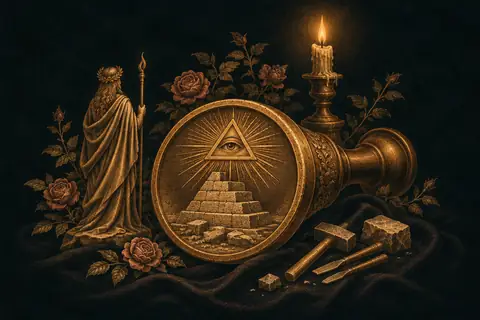
A church sign of Providence that reached a seal in 1782 and a banknote in 1935.
What is the all-seeing eye, and how did the Eye of Providence come onto the dollar bill?
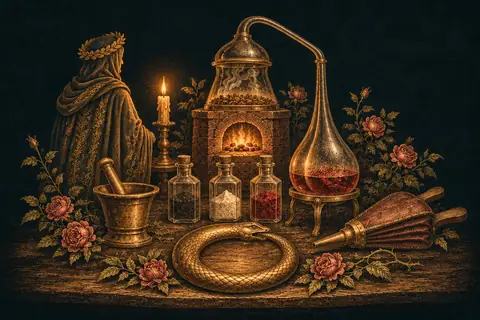
The serpent with its tail in its mouth, from a pharaoh’s shrine to a chemist’s daydream.
What has the ouroboros meant, from ancient Egypt to the present?
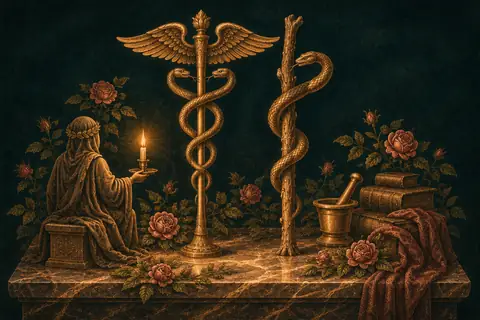
Two snakes for the herald Hermes, one for the physician Asclepius, and how they were mixed up.
What is the difference between the caduceus and the rod of Asclepius?
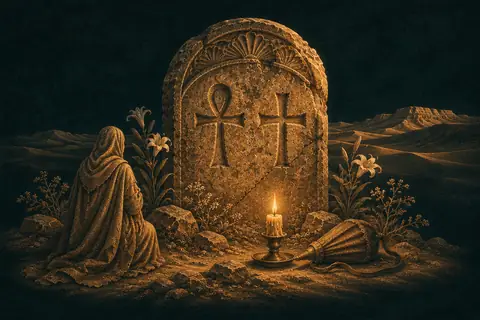
Egypt’s sign for life, the Coptic cross that kept its loop, and the chi-rho of Constantine.
What did the ankh mean in Egypt, and how is it tied to the chi-rho and the cross?
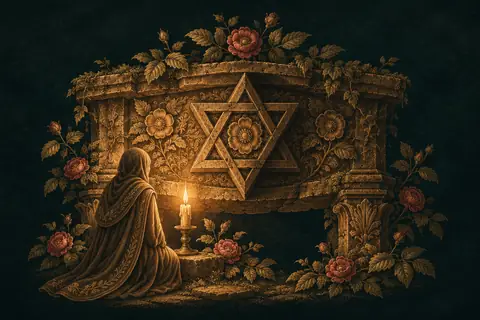
Star of David, Seal of Solomon and the Hindu shatkona: one figure with three histories.
Where does the hexagram come from, as the Star of David and as the Seal of Solomon?
An old sign of good fortune across Asia, and from 1920 the badge of a murderous party.
What is the history of the swastika, in Asia and in twentieth-century Europe?
A name from a trial under torture in 1307, and a drawing made in 1856.
What is Baphomet, and where do the name and the image come from?
Each opens its page in the dictionary.
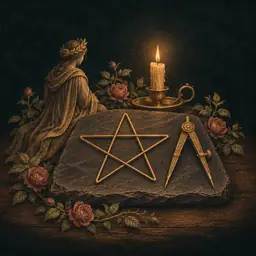 Pentagram
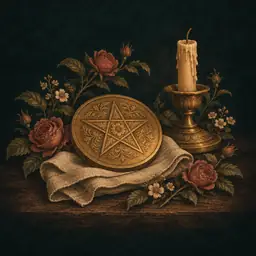 Pentacle
 Hexagram
 Star of David
 Seal of Solomon
 Shatkona
 Ouroboros
 Yin and Yang
 Eye of Providence
 Eye of Horus
 Hamsa
 Square and Compasses
 Caduceus
 Rod of Asclepius
 Ankh
 Chi-rho
 Swastika
 Baphomet
French writer, born Alphonse-Louis Constant, who trained for the Catholic priesthood and left before ordination. His Dogme et Rituel de la Haute Magie (1854 to 1856) shaped modern occultism: he tied the twenty-two tarot trumps to the Hebrew letters and drew the goat-headed figure of Baphomet as an emblem of balanced opposites.
American lawyer, writer and Confederate brigadier general. From 1859 until his death he led the Scottish Rite of Freemasonry’s Southern Jurisdiction, whose degrees he rewrote. His Morals and Dogma (1871) is a long commentary on those degrees, much of it taken from the French occultist Éliphas Lévi.
A legendary sage, the Greek Hermes joined to the Egyptian Thoth, under whose name the Hermetica were written in Roman Egypt. The Renaissance believed him older than Moses: in 1463 Marsilio Ficino set Plato aside to translate the Corpus Hermeticum first. In 1614 the scholar Isaac Casaubon showed from their language that the texts belong to the early Christian centuries.
Athanasius KircherJoachim of FioreRamon LlullCourt de GébelinEtteillaCharles-François DupuisJoséphin PéladanPamela Colman SmithAustin Osman SpareRené GuénonFulcanelliNarcissusTheseus and the MinotaurThe PhoenixHiram AbiffDorian GrayGeorge WashingtonWilliam BlakeGodfrey HigginsStanislas de GuaitaAnton LaVeyJoseph CampbellThothMithrasSolomon and the demonsThe Holy GrailMichael MaierGeorge Gurdjieff
Magic and protectionTarot, runes, I ChingThe Tree of LifeThe Hermetic principlesOrders and mystery schoolsConspiracies, examinedSacred places
Make today specific
The same sky reaches everyone differently. Your birth details turn a general forecast into one theme, and one thing worth doing about it.
One instrument, one answer. Explore the preview; membership opens every tool.
Read more

