
Baphomet
A name from a trial under torture in 1307, and a drawing made in 1856.

What is Baphomet, and where do the name and the image come from?
What it is
Baphomet is a name with two separate lives. In 1307 the king of France had the Knights Templar arrested, and among the charges was that they adored an idol. Some brothers, questioned under torture, gave it the name Baphomet and described it in ways that do not agree: a head, a head with three faces, a cat. No such object was ever produced. Five and a half centuries later the French writer Éliphas Lévi drew a winged, goat-headed figure, seated, with a torch between its horns and a pentagram on its brow, and gave it the old name. That drawing is the Baphomet people picture today. It began as a charge and a drawing, not as a being anyone is known to have worshipped.
The teaching
As the story of the name from the charge of 1308 to Lévi teaches it.
What the charge alleged
The name enters history in a charge. The articles drawn up against the Knights Templar in 1308 alleged that in every province the order kept idols, heads, some with three faces and some with one, some a human skull; that the brothers adored them in their chapters as God and saviour; that they said the head could make them rich, make the trees flower and the land bring forth; and that they bound themselves with cords that had touched it. In a few confessions taken under torture the idol was given the name Baphomet.
The charge is taught as what it was. No such head was ever found, the descriptions given under torture do not agree, and in 1312 the pope dissolved the order without judging it guilty of heresy.
Lévi's figure, part by part
In 1856 Éliphas Lévi drew a figure, gave it the old name and explained every part of it. It is a goat with wings, seated, with a woman's breasts. Between its horns burns a torch: the flame of intelligence, the magic light of the universal balance, the soul raised above matter, as a flame, though tied to its wick, shines above it. On its brow is the pentagram with one point up, which makes it a sign of light.
Its hands make the sign of the hidden art: one points up to the white moon of Chesed and the other down to the black moon of Geburah, the perfect harmony of mercy with justice. One arm is a woman's and one a man's, like the androgyne of Khunrath, and on them are written SOLVE and COAGULA, dissolve and bind, the two works of the alchemists. In place of the sex stands a rod with two snakes, the caduceus, for eternal life; the belly is covered with scales, for water; above it a half circle stands for the air, and the feathers above that for what is volatile.
The breasts and the arms of both sexes stand for humanity, and the beast's head for the horror of the sinner, whose material part alone must bear the punishment, since the soul suffers only when it binds itself to matter.
What Lévi meant by it
Lévi called the figure the sphinx of the occult sciences. It is a picture of the Absolute in symbols: all the opposites of his system, male and female, mercy and justice, light and matter, above and below, held in balance in one body. He also read the name backwards, as the Kabbalists read words, and found in it the initials of a Latin phrase, templi omnium hominum pacis abbas, the father of the temple of peace of all men.
He called it the goat of Mendes as well, after the city in the Egyptian delta where, as Herodotus tells, goats were held sacred and the god was pictured with a goat's face and legs, and he gathered into his one figure the horned images that others had feared.
The goat in the reversed star
In 1897 Stanislas de Guaita drew a goat's head inside a pentagram with two points up, the horns in the upper points, the ears at the sides and the beard below, as Lévi had described it, with the Hebrew letters of Leviathan at the five points and the names Samael and Lilith in the ring round it: the sign of matter ruling spirit. The Church of Satan took this drawing for its emblem, keeping the Hebrew letters, and named it the Sigil of Baphomet; for that church it stands for the flesh and the material world.
Waite's deck gave Lévi's goat to the Devil card, standing on an altar with bat's wings, a reversed pentagram on its brow and a torch turned to the earth, with a chained man and woman below. The Satanic Temple's bronze of 2015 seats the winged goat with two children looking up at it, made to stand in public beside monuments of the Ten Commandments as a claim to an equal place for minority beliefs.
The charge against the lodges
In the 1890s the writer Léo Taxil claimed that the highest Freemasons worshipped Baphomet in secret rites, and put Lévi's drawing on the cover of his exposé. The claim was his own invention, and in 1897 he confessed in public that the whole story was a hoax. No lodge has any rite of Baphomet, and the charge, still repeated in tracts, rests on nothing but that hoax.
How it is practised
Set the two sources side by side. Read a modern historian's account of the trial of 1307 and list what each witness said the idol looked like; the list does not add up to one object. Then find Lévi's drawing in a library copy of his book (the house does not print it) and name its parts: the torch, the pentagram, the two arms pointing up and down, the wand with two snakes. Each part is a statement about balance in his own system. Seeing how the picture was built is the surest way to stop taking it for the likeness of anything.
Where it comes from
The word is most likely an Old French form of Mahomet, the medieval European name for Muhammad: the Templars were accused, in effect, of having gone over to the faith of their enemy, which medieval Christians wrongly pictured as the worship of an idol. The order was dissolved in 1312. In 1818 the orientalist Joseph von Hammer-Purgstall claimed to have found Templar idols; his objects were not what he said. Lévi's drawing appeared in 1856 as a picture of opposites held in balance, male and female, above and below. In the 1890s the hoaxer Léo Taxil pretended that Freemasons worshipped it, and confessed the fraud in 1897. The Church of Satan and later the Satanic Temple took the goat as an emblem, the latter casting it in bronze in 2015.
What is known, and what is not
The trial records survive and have been studied closely; historians agree that the confessions were forced and that no idol existed. The derivation of the name from Mahomet is the common view, though it is not proven. Lévi's authorship of the image is certain. Taxil's confession of 1897 is documented, yet the charge he invented, that lodges worship Baphomet, is still repeated. Modern groups that use the figure describe it as an emblem of dissent and not as a god. The Leviathan cross that sometimes goes with it is an alchemist's sign for sulphur, given that use in 1969.
Its words
 Baphomet
- A name from the charges against the Templars in 1307, given in 1856 to a goat-headed figure drawn by Éliphas Lévi.
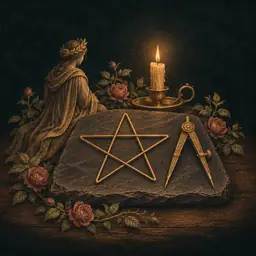 Pentagram
- A five-pointed star drawn with five strokes in one unbroken line: a sign of health to the Pythagoreans, and of many other things since.
- Leviathan Cross
- A cross with two bars standing on a sideways figure of eight: an alchemist’s mark for sulphur, taken up by the Church of Satan in 1969.
Ask the Oracle further
Did the knights arrested in 1307 really worship Baphomet?What do the parts of the drawing of Baphomet made in 1856 stand for?
Before you practise
A symbol has the meanings people have given it over time, and the Oracle tells them in order, with whose they were. Seeing a symbol proves no secret membership and no hidden hand. No sign protects, attracts or harms by being worn or drawn.
Its other branches
The pentagramThe all-seeing eyeThe ouroborosThe caduceus and the rodThe ankh and the crossThe six-pointed starThe swastika, in two partsThe whole artSearch the tree

