
The caduceus and the rod
Two snakes for the herald Hermes, one for the physician Asclepius, and how they were mixed up.
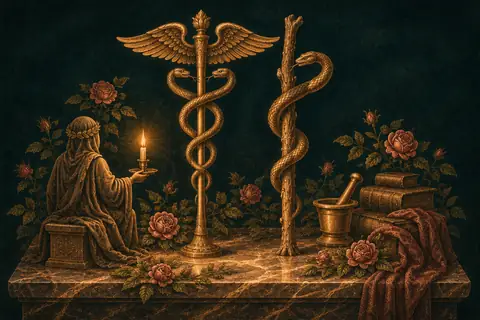
What is the difference between the caduceus and the rod of Asclepius?
What it is
Two staffs with snakes are constantly taken for one another. The caduceus is the wand of Hermes, the Greek messenger god: a short staff with two snakes twined around it and, in later art, a pair of wings. It was the badge of heralds and envoys, and so of safe passage, trade and bargaining. The rod of Asclepius is the rough staff of the Greek god of medicine, with a single snake and no wings. One belongs to messengers and merchants, the other to physicians. In much of the world the medical sign is still the rod; in the United States the caduceus is often used in its place.
The teaching
As the Greek lore of Hermes and of Asclepius teaches it.
The herald's wand
The caduceus is the Latin name of the Greek kerykeion, the herald's staff, from keryx, a herald. A herald who carried it could not be harmed: he passed between enemies to carry words, to ask for a truce, to make a bargain. So the wand means safe passage, peace, negotiation and exchange, and it became the sign of Hermes, the messenger of the gods, and of Mercury, the Roman god of trade, whose envoys came to sue for peace under its protection.
How Hermes came by it
The Homeric hymn to Hermes tells it. On the day he was born Hermes stole the cattle of his brother Apollo and made the first lyre from a tortoise shell; when Apollo came in anger, Hermes played, and gave him the lyre. Apollo in return gave him a golden staff of wealth and good fortune and made him keeper of herds. A later story says that Hermes found two snakes fighting and laid the staff between them, and they wound about it in peace: that is why the staff carries two snakes.
Homer gives the wand a further power: with it Hermes lulls to sleep the eyes of whom he will and wakes others from sleep, and with it he leads the souls of the dead down to the house of Hades. The messenger goes between waking and sleep and between the living and the dead, as well as between enemies.
Staff, snakes and wings
Each part of the caduceus is read in turn. The staff is the herald's authority, the right to go where others may not. The two snakes are opposites brought into accord, the two sides of a quarrel or a bargain wound about one rod. The wings are the speed of the messenger. Drawn small, the wand became the sign of the planet Mercury, and through it the sign of the metal, the quicksilver of the alchemists, whose whole art is called Hermetic after the god.
The occultists kept the wand. Lévi set it in the lap of his Baphomet as the sign of eternal life, and in Waite's deck the caduceus rises between the cups of the two lovers on the Two of Cups, crowned with a lion's head between its wings.
Asclepius and his staff
Asclepius, son of Apollo and the mortal Coronis, was taught the art of healing by the centaur Chiron, and grew so skilled that he raised the dead, for which Zeus struck him down with a thunderbolt; afterwards he was honoured as the god of healing. His staff is a plain, rough stick, a traveller's staff, with one snake coiled about it and no wings. The snake was his own creature, kept in his temples, and the old readers saw in it renewal, since a snake sheds its skin and is new.
Sleep in the god's house
At Epidaurus and the other houses of Asclepius the sick came to sleep in the god's presence. They bathed, made an offering and lay down for the night in a hall set apart, where tame snakes moved freely among the sleepers. They hoped the god would come to them in a dream, to touch them or to tell them what to do, and in the morning the priests heard their dreams. Tablets set up in the sanctuary told of cures that sleepers said they had received.
Ovid tells that when a plague struck Rome the city sent to Epidaurus for the god, and he came in the form of a great serpent, boarded the Roman ship and, at Rome, swam ashore to the island in the Tiber where his temple was then built.
Moses' serpent of brass
A third staff stands beside these in the Bible. When the people in the wilderness were bitten by fiery serpents, Moses was told to set a serpent on a pole: And Moses made a serpent of brass, and put it upon a pole, and it came to pass, that if a serpent had bitten any man, when he beheld the serpent of brass, he lived. Centuries later King Hezekiah broke it in pieces, because the people burned incense to it, and called it Nehushtan.
The Gospel of John reads it as a figure of the cross: as Moses lifted up the serpent in the wilderness, even so must the Son of man be lifted up. The likeness of this pole to the staff of Asclepius helped the single snake become the sign of medicine in Christian Europe.
Which staff is which
One snake on a rough staff, without wings, is Asclepius, and belongs to medicine. Two snakes on a slender wand, usually winged, are the caduceus of Hermes, and belong to heralds, trade, eloquence and the planet and metal Mercury. Moses' serpent hangs alone on a pole, the sign of a healing asked of God.
How it is practised
Count the snakes. One snake on a plain staff is the rod of Asclepius and means medicine; two snakes, usually with wings, are the caduceus and mean a messenger. Look at the signs on an ambulance, a pharmacy, a hospital's notepaper and a medical school, and note which each has chosen. Then look for the caduceus where it first belonged: on coins and statues of Hermes and Mercury, and on the emblems of customs houses and trading companies. It is a small habit of looking that settles a common confusion for good.
Where it comes from
Heralds carry the two-snaked staff on Greek vases from the sixth century BCE, and the Romans gave it to Mercury, their god of commerce. Asclepius and his serpent staff were honoured at Epidaurus from the fifth century BCE, where the sick slept in the temple hoping for a dream. Printers of the Renaissance used the caduceus as a trademark, and some medical publishers followed them. The lasting mix-up dates from 1902, when the United States Army Medical Corps put the caduceus on its uniform. The World Health Organization, founded in 1948, chose the rod of Asclepius.
What is known, and what is not
The two staffs and their gods are clearly distinct in ancient art and texts. The American adoption of 1902 is documented in army records, and historians of medicine generally call it a mistake. A survey of American health organisations published in 1992 found professional bodies mostly using the rod and commercial ones mostly the caduceus. Older emblems are harder to read: what the labrys, the double axe of Bronze Age Crete, meant there is lost. Why Asclepius has a snake is not known for certain; the explanations offered, from the shedding of skin to a parasitic worm wound on a stick, are guesses.
Its words
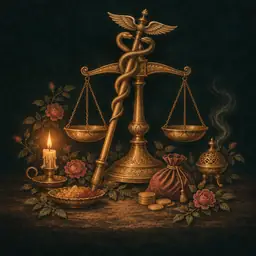 Caduceus
- The staff of Hermes, with two snakes and often wings: the badge of heralds and trade, often mistaken for a medical sign.
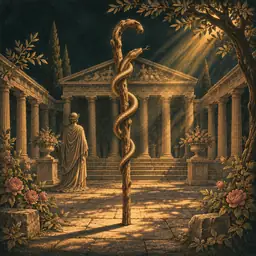 Rod of Asclepius
- A rough staff with a single snake, carried by the Greek god of medicine: the true sign of physicians.
- Labrys
- An axe with two blades on one shaft, the sacred emblem of Bronze Age Crete, whose meaning there is lost; a women’s emblem since the 1970s.
Ask the Oracle further
Why do American hospitals use the caduceus if it belongs to Hermes?What does the single snake on the rod of Asclepius stand for?
Before you practise
A symbol has the meanings people have given it over time, and the Oracle tells them in order, with whose they were. Seeing a symbol proves no secret membership and no hidden hand. No sign protects, attracts or harms by being worn or drawn.
Its other branches
The pentagramThe all-seeing eyeThe ouroborosThe ankh and the crossThe six-pointed starThe swastika, in two partsBaphometThe whole artSearch the tree

