
The ouroboros
The serpent with its tail in its mouth, from a pharaoh’s shrine to a chemist’s daydream.
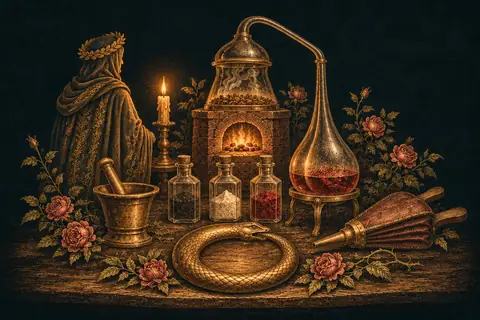
What has the ouroboros meant, from ancient Egypt to the present?
What it is
The ouroboros is a serpent or dragon bent into a ring with its tail in its mouth. The name is Greek and means tail-eater. It has been read as the year that returns to its start, as time, as a world that feeds on itself and renews itself, and, in the alchemists' books, as the one matter from which everything comes and to which it goes back. A different sign for a related thought is the Chinese pair of yin and yang, the dark and the bright, each holding a seed of the other. The two are often set side by side. They come from separate worlds and are better read apart. So are the Norse signs: Mjolnir, the hammer of Thor, who fights the serpent that rings the world, and the valknut of three locked triangles.
The teaching
As the lore of the serpent and of yin and yang teaches it.
The serpent that eats its tail
The ouroboros is a serpent or a dragon bent into a ring with its tail in its mouth; the Greek name means tail eater. It is the figure of what returns into itself: an end that is also a beginning, a whole that needs nothing outside it, a life that feeds on itself and is renewed. Plato gives the thought without the snake in the Timaeus, where the maker shapes the cosmos complete and alone, needing neither food nor anything beyond itself, its own waste becoming its food.
In Egypt
Its oldest picture is in a book of the netherworld on a shrine of Tutankhamun, where two serpents with their tails in their mouths ring the head and the feet of a great figure of the god in the depths. There the sun goes down each night to be joined with Osiris and is born again at dawn, and the serpents enclose that renewal.
A late Greek book on the hieroglyphs, under the name of Horapollo, says that to write the universe the Egyptians drew a serpent devouring its own tail, its speckled scales standing for the stars, and that the serpent fits the year, since each year it puts off its old age with its skin.
The alchemists' one matter
In the Greek books of alchemy the serpent rings the words hen to pan, the All is One, in the drawing called the Gold-making of Cleopatra. The teaching is that the Work begins and ends in one matter. The serpent devours itself and is dissolved and changed, dies and is born again; what rises in the sealed vessel falls back to be raised again, round and round, until the matter is made perfect.
Later alchemists drew the same thought as two dragons, one winged and one without wings, often biting each other's tails in a ring: the winged for what flies off in the fire, the wingless for what stays, the volatile and the fixed, which the art must join into one.
The Gnostic and the Norse serpents
In the Gnostic book Pistis Sophia the outer darkness is a great dragon with its tail in its mouth, lying outside the whole world and holding twelve chambers of punishment. Here the ring is the outer bound, the limit beyond which there is no light.
In Norse myth Jörmungandr, a child of Loki, is cast by Odin into the sea, where he grows until he lies round all the lands and bites his own tail: the Midgard serpent, the bound of the world of men. At Ragnarök he rises from the sea, and Thor kills him and falls dead of his venom nine steps away.
Yin and yang
The Chinese pair is something else: not one thing returning into itself but two that make a whole by turning into each other. The words first meant the shady and the sunny side of a hill. Yin is the dark, the cool, the yielding, the inward and the receptive: earth, the moon, water, the female. Yang is the bright, the warm, the firm, the outward and the active: heaven, the sun, fire, the male. Neither is good or evil, and neither is ever found alone.
The Great Commentary on the Book of Changes says it in a line: one yin, one yang, that is the Way. In the book itself they are the broken and the whole lines, and every figure is a mixture of the two.
How each becomes the other
The Song master Zhou Dunyi taught it in his Explanation of the Diagram of the Supreme Ultimate. The Supreme Ultimate moves and gives rise to yang; movement at its limit becomes stillness, and stillness gives rise to yin; stillness at its limit becomes movement again. Each is the root of the other. From their play come the five phases, water, fire, wood, metal and earth, and from these the ten thousand things.
Reading the swirled disc
The familiar disc draws the teaching. The circle is the whole, the Supreme Ultimate. The curve between dark and light shows that neither stands still: as one swells to its broadest the other is born at its narrow tail, as summer turns toward winter at its height. The dot of light in the dark and of dark in the light is the seed of each within the other, the reason why any extreme, at its limit, turns into its opposite. The Book of Changes reads its old lines the same way: a line at its extreme changes.
So the two signs are read apart. The ouroboros is one thing returning into itself; yin and yang are two that make one by giving way to each other in turn.
How it is practised
Follow one sign through its houses. Find the ouroboros on the Egyptian shrine in a museum catalogue, then in a plate from an alchemical book, then in a modern trademark, and write beside each what the people who drew it said it meant. Do the same for the swirled disc of yin and yang, beginning with Chinese sources and not with a poster. The point is to see that a ring-shaped serpent is not one message sent down the ages but a shape that many peoples found worth filling.
Where it comes from
The oldest known picture is on a gilded shrine from the tomb of Tutankhamun, of the fourteenth century BCE, where serpents with their tails in their mouths ring the head and feet of a great figure. Greek magical papyri and Gnostic texts of Roman Egypt use the sign, and a Greek alchemical manuscript draws it around a short motto meaning that all is one. In Norse myth the Midgard serpent lies in the sea around the world holding its own tail. The chemist August Kekulé said in 1890 that a daydream of a snake seizing its tail had shown him the ring of benzene. Yin and yang are named as a pair in Chinese texts by about the third century BCE; the familiar swirled disc is far younger.
What is known, and what is not
The Egyptian, Greek and Norse examples are documented in objects and manuscripts. That they share one hidden teaching is an idea of modern writers, Carl Jung among them, who called the ouroboros an archetype; it is a reading and cannot be tested. Historians of chemistry doubt Kekulé's story, which he told twenty-five years after the discovery. The swirled diagram of yin and yang is first found in Chinese books of the Ming dynasty, more than a thousand years after the idea.
Its words
 Ouroboros
- A serpent bent into a ring with its tail in its mouth, first drawn in Egypt and taken up by Greek alchemists and many after them.
 Yin and Yang
- The Chinese pair of the dark and the bright, two phases that turn into each other; their swirled disc is a later drawing.
- Mjolnir
- The hammer of the Norse god Thor, and the small metal hammers that people of the Viking Age wore on a cord, as modern Heathens do again.
- Valknut
- Three triangles locked together, carved on Viking Age stones beside scenes of death. The name is modern, and no Norse writing says what the figure meant.
Ask the Oracle further
Where is the oldest ouroboros found, and what did it mean there?Are the ouroboros and yin and yang saying the same thing?
Before you practise
A symbol has the meanings people have given it over time, and the Oracle tells them in order, with whose they were. Seeing a symbol proves no secret membership and no hidden hand. No sign protects, attracts or harms by being worn or drawn.
Its other branches
The pentagramThe all-seeing eyeThe caduceus and the rodThe ankh and the crossThe six-pointed starThe swastika, in two partsBaphometThe whole artSearch the tree

