

The inner life
Archetype
Direct answer
Archetype: An archetype, in the psychology of Carl Jung, is an inherited pattern of the psyche that shapes images and feelings found alike in dreams, myths and religions across cultures.
$0 today, then $19/month after 7 days. Cancel anytime.
At a glance
- Also called
- archetypal image
- Found in
- Consciousness & Spiritual Psychology
- Related
- Collective Unconscious, Individuation, Shadow Work, Active Imagination
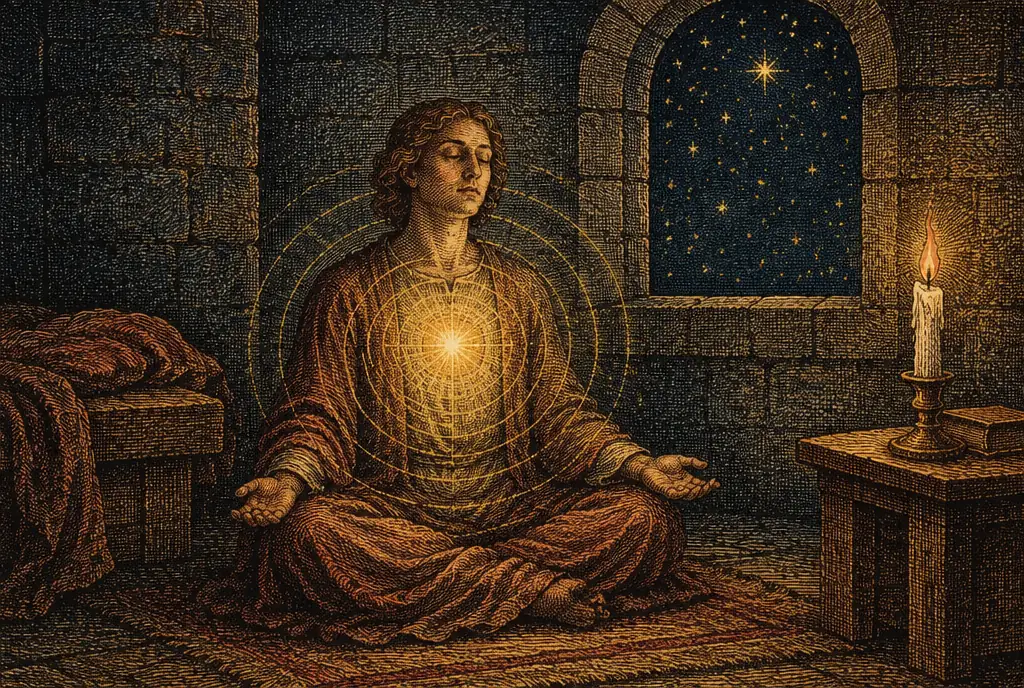
An archetype, in the psychology of Carl Jung, is an inherited pattern of the psyche that shapes images and feelings found alike in dreams, myths and religions across cultures.
A plain educational schematic; it does not diagnose a condition or replace professional care.
Understand the chapter you are in.
Your life’s turning points, measured from your birth.
Walk through Alex’s whole example first


Prefer to explore first?
 The Road of AgesThe turning points of your whole life, from your own chart
Walk my road
What is an archetype?
Jung used archetype for what he took to be the common moulds of human imagination. He noticed that certain figures and situations recur in his patients' dreams and in myths from peoples who had no contact: the mother, the child, the trickster, the wise old man, the shadow, the journey, death and rebirth.
He distinguished the archetype itself, an empty form that cannot be seen, from the archetypal image, which a culture and a person fill in. The idea has been very influential in the study of literature and myth and in astrology, where planets are often called archetypes. In scientific psychology it remains unproven.
On the tree of the hidden arts: Dreams.
What sets Archetype apart
Jung's own comparison is the clearest: an archetype is like the axis system of a crystal, which fixes the shape a crystal can take while having no substance of its own. So there is no picture of the mother archetype, only countless mothers in dreams and stories that share a form. He counted it as the psychic side of instinct. The word then escaped psychology, and in everyday use it now means little more than a typical example.
- Language: Greek arche, first or origin, and typos, pattern or stamp
- Jung adopts the term: 1919, replacing his earlier primordial image
- His main figures: shadow, anima and animus, wise old man, great mother, child, Self
- Key distinction: the archetype as such against the archetypal image
- In myth study: Joseph Campbell, The Hero with a Thousand Faces, 1949
- Standing: influential in the humanities; unproven as inherited psychology
Often mistaken for something else: A stereotype is a fixed social image learned from a culture; an archetype, in Jung's theory, is an inborn form that each culture fills differently.
The story behind Archetype
The Greek word means first pattern and was used by ancient philosophers and theologians for the original forms of things. Jung at first spoke of primordial images and adopted the term archetype in 1919. Joseph Campbell applied the idea to hero myths in 1949, and the critic Northrop Frye to literature in 1957. Critics reply that recurring motifs can be explained by shared human experience and by stories travelling between peoples.
Why Archetype matters
Archetype is the key term of Jung's way with dreams, and the reason a Jungian reader sets a dream beside myths as well as beside the dreamer's life.
How to read Archetype
In dream reading it names a figure that feels larger than any person the dreamer knows, and invites a look at the stories in which such a figure appears.
Archetype in practice: an example
A reader who dreams again and again of a calm old woman who gives directions might, in Jung's terms, be meeting an archetype of wisdom.
Where readings of Archetype go wrong
Naming an archetype explains nothing by itself, and no test can show which one a dream figure is. The dreamer's own associations come first.
Sources and editorial method
This entry summarizes the tradition in the Almanac's own words; where no source is listed, it is an editorial summary rather than a primary text, and symbolic readings are named as the tradition's, not as fact.
- Source
- The Great Almanac Dictionary
- Category
- Consciousness & Spiritual Psychology
- Aliases
- jungian archetype, archetypes meaning, what is an archetype, jung archetypes, archetypal image
- Last updated
- 2026-09-26
See Archetype in your personal almanac
A definition tells you what it is; your own birth chart tells you what it means for you. The Oracle casts your real chart and answers for your love, your work, and your year ahead, in conversation. It opens with the 7-day Oracle trial.
Speak with the OracleRelated terms
More in Consciousness & Spiritual Psychology
- COINTELPRO
- Ego Death
- Highly Sensitive Person
- Loving-Kindness
- Peak Experience
- Samatha
- Sound Bath
- Twin Flame
From the reference page to your own chart
Every word here
is in your own chart.
- Your life’s turning points, measured from your birth
- A practical next step to consider
- It opens with 7 days free: the AI Oracle on thirty hidden arts, and your daily horoscope
$0 today, then $19/month after 7 days. Cancel anytime.
Common questions
What is an archetype?
In Jung's psychology it is an inherited pattern that shapes how people imagine and feel, showing itself in figures such as the mother, the hero or the trickster in dreams and myths.
What are the main Jungian archetypes?
Jung wrote most about the shadow, the anima and animus, the wise old man, the great mother, the child, the trickster and the Self. He did not give a fixed list and held that there are many.
Is there scientific evidence for archetypes?
Not of the kind a laboratory gives. The idea that such patterns are inherited has not been demonstrated, and academic psychology does not generally accept it. It remains a widely used way of interpreting stories and dreams.


