

The inner life
Collective Unconscious
Direct answer
Collective Unconscious: The collective unconscious is Carl Jung's term for a layer of the psyche that he held to be shared by all human beings and inherited, not formed from personal experience.
$0 today, then $19/month after 7 days. Cancel anytime.
At a glance
- Also called
- objective psyche
- Found in
- Consciousness & Spiritual Psychology
- Related
- Archetype, Individuation, Active Imagination, Shadow Work
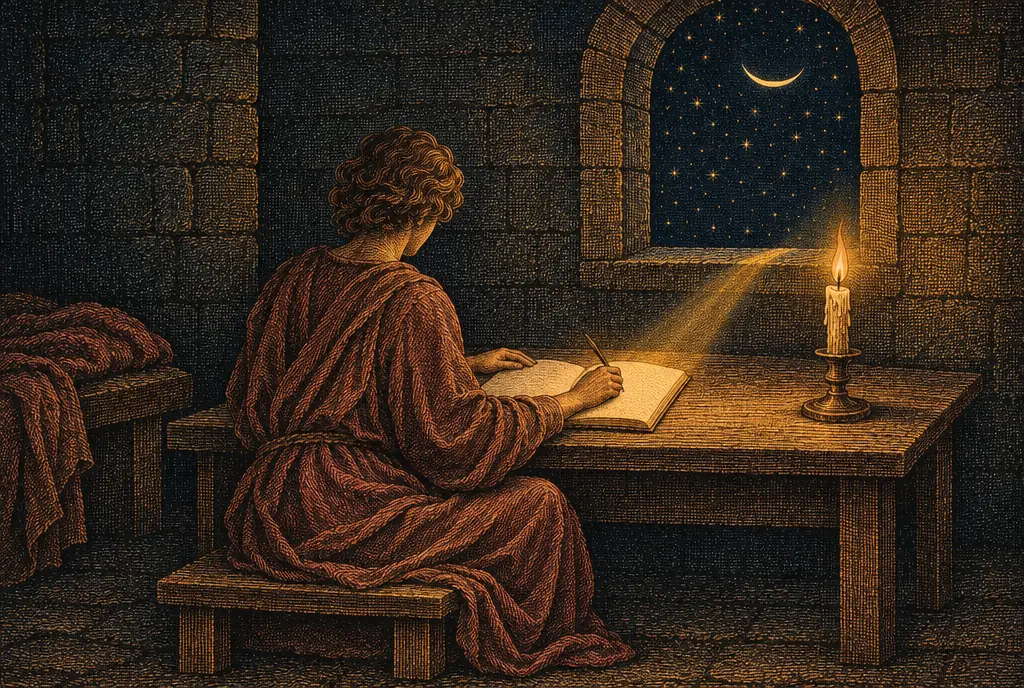
The collective unconscious is Carl Jung's term for a layer of the psyche that he held to be shared by all human beings and inherited, not formed from personal experience.
A plain educational schematic; it does not diagnose a condition or replace professional care.
Understand the chapter you are in.
Your life’s turning points, measured from your birth.
Walk through Alex’s whole example first


Prefer to explore first?
 The Road of AgesThe turning points of your whole life, from your own chart
Walk my road
What is the collective unconscious?
Jung divided the unconscious in two. The personal unconscious holds what an individual has forgotten or pushed away. Beneath it, he proposed, lies a collective unconscious that is the same in everyone and was never conscious in the individual at all. Its contents are the archetypes.
He pointed to dreams and visions whose imagery seemed to come from myths the dreamer had never met. The theory is the foundation of his psychology and has shaped much writing on myth and religion. It has not been confirmed by research, and most psychologists explain the same likenesses by common human experience and by culture.
On the tree of the hidden arts: Dreams.
What sets Collective Unconscious apart
The idea has a founding dream. Jung told of dreaming a house in which each lower floor was older, down to a cave with bones and broken pottery, and took it as a diagram: the further down in the psyche, the less personal. He was careful to say that what is inherited is the capacity to form certain images and not the images themselves. Later he also called it the objective psyche, to stress that a person meets it as something not of their own making.
- Term in use: from 1916, in the years after the break with Freud
- Contents: the archetypes, in contrast to personal complexes
- Upper layer: the personal unconscious: the forgotten and the repressed
- Founding image: Jung's dream of a house with ever older storeys below
- Standing: not confirmed by research; an interpretive theory
Often mistaken for something else: Freud's unconscious is personal, filled by what an individual has repressed; Jung added a second layer that he held was never personal at all.
The story behind Collective Unconscious
Jung introduced the idea in the years after his break with Freud in 1913 and used the term from 1916. He developed it over four decades of essays, later gathered as The Archetypes and the Collective Unconscious. His best known early example, a patient's vision that resembled an ancient ritual text, has been challenged by historians, who note that the text was already in print.
Why Collective Unconscious matters
The whole Jungian approach to dreams depends on it: without it, a dream figure is only personal, and comparison with myth has no ground.
How to read Collective Unconscious
It is invoked when a dream image feels impersonal and ancient, to suggest looking at how that image has been understood in myth and religion.
Collective Unconscious in practice: an example
A reader who dreams of a flood and a boat, having never thought about flood myths, might wonder with Jung whether the image is older than they are.
Where readings of Collective Unconscious go wrong
Collective Unconscious is a theory and not an established fact. It is not a store of other people's memories, and it gives no access to past lives or to messages.
Sources and editorial method
This entry summarizes the tradition in the Almanac's own words; where no source is listed, it is an editorial summary rather than a primary text, and symbolic readings are named as the tradition's, not as fact.
- Source
- The Great Almanac Dictionary
- Category
- Consciousness & Spiritual Psychology
- Aliases
- collective unconscious jung, collective unconscious meaning, what is the collective unconscious, objective psyche
- Last updated
- 2026-09-26
See Collective Unconscious in your personal almanac
A definition tells you what it is; your own birth chart tells you what it means for you. The Oracle casts your real chart and answers for your love, your work, and your year ahead, in conversation. It opens with the 7-day Oracle trial.
Speak with the OracleRelated terms
More in Consciousness & Spiritual Psychology
- Embodiment
- Hypervigilance
- Machiavellianism
- Prana
- Schrödinger's Cat
- Spiritual Calling
- Uncertainty Principle
- Attachment Wound
From the reference page to your own chart
Every word here
is in your own chart.
- Your life’s turning points, measured from your birth
- A practical next step to consider
- It opens with 7 days free: the AI Oracle on thirty hidden arts, and your daily horoscope
$0 today, then $19/month after 7 days. Cancel anytime.
Common questions
What is the collective unconscious?
It is Jung's proposal that below each person's own unconscious there is a deeper layer common to all humanity, made of inherited patterns he called archetypes.
How is it different from the personal unconscious?
The personal unconscious contains what one individual has forgotten or repressed. The collective unconscious, in Jung's theory, was never personal and is the same for everyone.
Is there evidence for the collective unconscious?
Jung offered clinical cases and parallels between myths. Controlled research has not confirmed it, and the parallels can be explained in other ways, so it remains a theory.


