

The inner life
Active Imagination
Direct answer
Active Imagination: Active imagination is a method devised by Carl Jung in which a person, while awake, lets an image from a dream or a mood unfold and then engages with it as if it were real.
$0 today, then $19/month after 7 days. Cancel anytime.
At a glance
- Also called
- dialogue with dream figures
- Found in
- Consciousness & Spiritual Psychology
- Related
- Archetype, Individuation, Shadow Work, Collective Unconscious
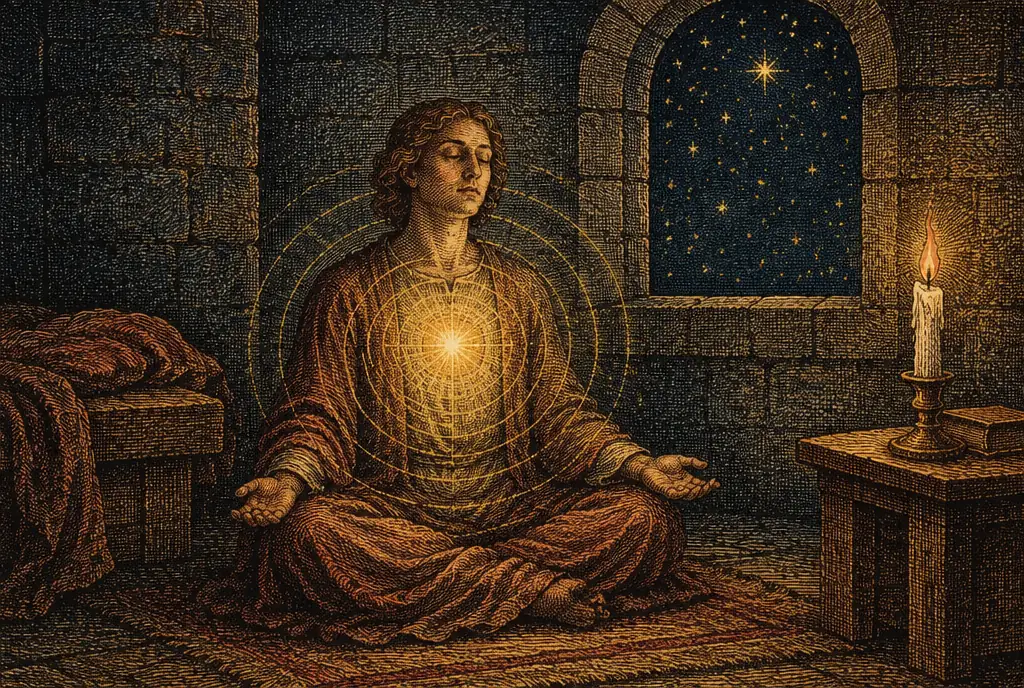
Active imagination is a method devised by Carl Jung in which a person, while awake, lets an image from a dream or a mood unfold and then engages with it as if it were real.
A plain educational schematic; it does not diagnose a condition or replace professional care.
Understand the chapter you are in.
Your life’s turning points, measured from your birth.
Walk through Alex’s whole example first


Prefer to explore first?
 The Road of AgesThe turning points of your whole life, from your own chart
Walk my road
What is active imagination?
In active imagination the person sits quietly, calls up an image, often from a recent dream, and watches it without steering. When it moves or speaks, they respond as themselves: asking, answering, disagreeing. Afterwards they give the encounter a form by writing, drawing or painting it.
Jung set it apart from daydreaming, in which the person drifts, and from guided fantasy, in which a script is followed. The point is a real meeting between the waking self and a figure of the unconscious, followed by the question of what it asks of one's life. He regarded it as powerful and as unsuitable for everyone.
On the tree of the hidden arts: Dreams.
What sets Active Imagination apart
Two conditions define the method. The first is letting the image act on its own: Jung said one must wait until it changes without being pushed. The second is taking part as oneself and with one's own values, not as a spectator, so that a figure who proposes something wrong is refused. He added a third step that is often forgotten, the ethical one: having learned something, the person is obliged to act on it in life.
- Devised: 1913 to 1916, recorded in the Red Book
- First described: The Transcendent Function, written 1916, published 1957
- Named: Tavistock Lectures, London, 1935
- Steps: let it happen, engage with it, give it form, draw the conclusion
- Forms used: writing, painting, sculpting, movement
Often mistaken for something else: Guided imagery follows a script someone else provides; active imagination has no script, and the image is allowed to surprise.
The story behind Active Imagination
Jung came to the method in the years from 1913 to 1916, during the crisis that followed his break with Freud, and recorded the results in the notebooks that became the Red Book. He described it in an essay written in 1916 and not published until 1957, and first used the name active imagination in lectures in London in 1935.
Why Active Imagination matters
Active Imagination is the way Jung proposed for going on from a dream, so that a figure met at night can be questioned by day.
How to read Active Imagination
Dream workers use it on an unfinished dream or a recurring figure, keeping sessions short and always writing them down.
Active Imagination in practice: an example
A reader whose dream ended at a locked door might, awake, picture the door again, knock, and write down who answers and what is said.
Where readings of Active Imagination go wrong
Jung warned that it can overwhelm a person whose footing is unsure. It is done gently, briefly and, if it stirs much, with a therapist.
Sources and editorial method
This entry summarizes the tradition in the Almanac's own words; where no source is listed, it is an editorial summary rather than a primary text, and symbolic readings are named as the tradition's, not as fact.
- Source
- The Great Almanac Dictionary
- Category
- Consciousness & Spiritual Psychology
- Aliases
- active imagination jung, active imagination technique, what is active imagination, dialogue with dream figures
- Last updated
- 2026-09-26
See Active Imagination in your personal almanac
A definition tells you what it is; your own birth chart tells you what it means for you. The Oracle casts your real chart and answers for your love, your work, and your year ahead, in conversation. It opens with the 7-day Oracle trial.
Speak with the OracleRelated terms
More in Consciousness & Spiritual Psychology
- Clairaudience
- Double-Slit Experiment
- Gateway Process
- Kosha
- Operation Northwoods
- REM Atonia
- Solfeggio Frequencies
- Throat Chakra
From the reference page to your own chart
Every word here
is in your own chart.
- Your life’s turning points, measured from your birth
- A practical next step to consider
- It opens with 7 days free: the AI Oracle on thirty hidden arts, and your daily horoscope
$0 today, then $19/month after 7 days. Cancel anytime.
Common questions
What is active imagination?
It is Jung's technique of deliberately engaging, while awake, with an image from a dream or fantasy: watching it, speaking with it, and then recording what took place.
How is active imagination different from daydreaming?
In a daydream the person is carried along passively. In active imagination they stay present as themselves, respond to what appears and take its meaning seriously afterwards.
Is active imagination safe to do alone?
For many people a short, gentle session is harmless. Jung advised against it for anyone whose sense of reality is fragile, and thought it best learned with an analyst.


