

The inner life
REM Atonia
Direct answer
REM Atonia: REM atonia is the near-total loss of muscle tone that accompanies REM sleep, a natural paralysis that keeps the sleeper from acting out dreams.
$0 today, then $19/month after 7 days. Cancel anytime.
At a glance
- Also called
- sleep atonia, REM sleep atonia, muscle atonia in REM sleep, REM paralysis
- Found in
- Consciousness & Spiritual Psychology
- Related
- REM Sleep, Sleep Paralysis, Lucid Dreaming, Wake-Initiated Lucid Dream (WILD)
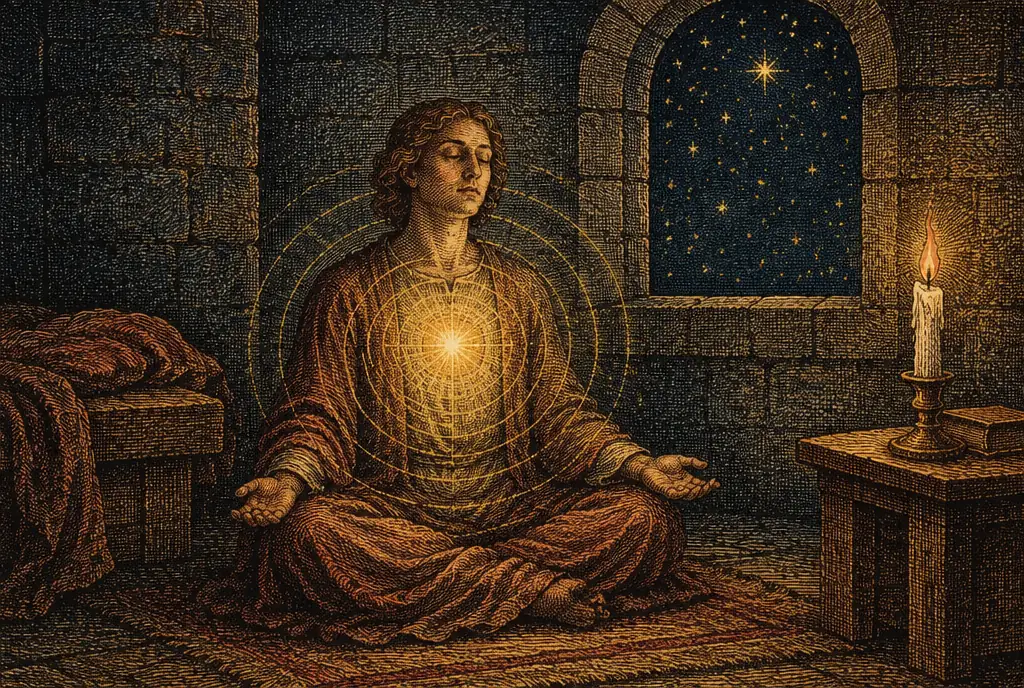
REM atonia is the near-total loss of muscle tone that accompanies REM sleep, a natural paralysis that keeps the sleeper from acting out dreams.
A plain educational schematic; it does not diagnose a condition or replace professional care.
Understand the chapter you are in.
Your life’s turning points, measured from your birth.
Walk through Alex’s whole example first


Prefer to explore first?
 The Road of AgesThe turning points of your whole life, from your own chart
Walk my road
What is REM atonia?
During REM sleep the brainstem sends signals down the spinal cord that switch off the motor neurons of the voluntary muscles. The body lies slack while the brain is highly active. The muscles that move the eyes are spared, as is the diaphragm, so the eyes dart and breathing continues.
This explains several things about dreaming. It is why a dreamer can run in a dream without moving in bed. It is why lucid dreamers in a laboratory signal with their eyes, the one voluntary channel left open. And when the mind wakes before the atonia lifts, the result is sleep paralysis: full awareness in a body that briefly cannot be moved.
On the tree of the hidden arts: Lucid dreaming.
What sets REM Atonia apart
REM atonia is an active process, not mere relaxation. Muscle tone falls through the stages of ordinary sleep, but in REM sleep the motor neurons are positively inhibited from the brainstem, and the chin muscle recording drops to its lowest level of the night. That flat line, with rapid eye movements and a waking-like brain trace, makes up the standard definition of the stage. The eyes escape because the nerve cells that drive their muscles, high in the brainstem, are not switched off in the same way.
- First described: Michel Jouvet, 1959, in cats
- Origin of the signal: the pons, relayed through the medulla to the spinal cord
- Muscles spared: those of the eyes, and the diaphragm
- How recorded: electromyogram of the chin
- When it fails: dreams are acted out physically, first shown in cats in 1965
Often mistaken for something else: Sleep paralysis is an experience, being awake and unable to move; REM atonia is the mechanism, which runs unnoticed in every night of normal sleep.
The story behind REM Atonia
The French neuroscientist Michel Jouvet described the loss of muscle tone in what he named paradoxical sleep in 1959, working with cats. In 1965 he and François Delorme showed that cats with damage to a region of the pons moved about during REM sleep as if acting out dreams. Carlos Schenck and Mark Mahowald described the matching human condition, REM sleep behaviour disorder, in 1986.
Why REM Atonia matters
REM Atonia is the physical fact behind sleep paralysis, behind the safety of vivid dreaming, and behind the eye signals that verified lucid dreams.
How to read REM Atonia
Sleep researchers read it on a recording as one of the three marks of REM sleep, and lucid dreamers invoke it to explain the heaviness felt on entering a dream from waking.
REM Atonia in practice: an example
In the dream she is sprinting for a train; on the sleep recording her chin muscle is flat and only her eyes are moving.
Where readings of REM Atonia go wrong
The paralysis is normal and passes within moments of waking; people who regularly move violently or leave the bed while dreaming should see a doctor.
Sources and editorial method
This entry summarizes the tradition in the Almanac's own words; where no source is listed, it is an editorial summary rather than a primary text, and symbolic readings are named as the tradition's, not as fact.
- Source
- The Great Almanac Dictionary
- Category
- Consciousness & Spiritual Psychology
- Aliases
- sleep atonia, REM sleep atonia, muscle atonia in REM sleep, REM paralysis, why can't you move in REM sleep
- Last updated
- 2026-09-26
See REM Atonia in your personal almanac
A definition tells you what it is; your own birth chart tells you what it means for you. The Oracle casts your real chart and answers for your love, your work, and your year ahead, in conversation. It opens with the 7-day Oracle trial.
Speak with the OracleRelated terms
More in Consciousness & Spiritual Psychology
- Somatic Awareness
- Tonglen
- Active Imagination
- Clairaudience
- Double-Slit Experiment
- Glimmer
- Kosha
- Operation Northwoods
From the reference page to your own chart
Every word here
is in your own chart.
- Your life’s turning points, measured from your birth
- A practical next step to consider
- It opens with 7 days free: the AI Oracle on thirty hidden arts, and your daily horoscope
$0 today, then $19/month after 7 days. Cancel anytime.
Common questions
What is REM atonia?
The temporary paralysis of the body's voluntary muscles during REM sleep. It is produced by the brainstem and stops the movements of a dream from being carried out by the real body.
Is REM atonia the same as sleep paralysis?
Atonia is the normal muscle paralysis of REM sleep, which the sleeper does not notice. Sleep paralysis is what happens when a person becomes conscious while that atonia is still in force.
Which muscles still work during REM sleep?
The muscles that move the eyes and the diaphragm, which drives breathing, stay active. Small twitches of the face, fingers and toes also break through from time to time.


