

The inner life
REM Sleep
Direct answer
REM Sleep: REM sleep, short for rapid eye movement sleep, is the recurring stage of sleep marked by darting eyes, an active brain and slack muscles, in which the most vivid dreams take place.
$0 today, then $19/month after 7 days. Cancel anytime.
At a glance
- Also called
- rapid eye movement sleep, paradoxical sleep
- Found in
- Consciousness & Spiritual Psychology
- Related
- Lucid Dreaming, False Awakening, Dream Journal, Continuity Hypothesis
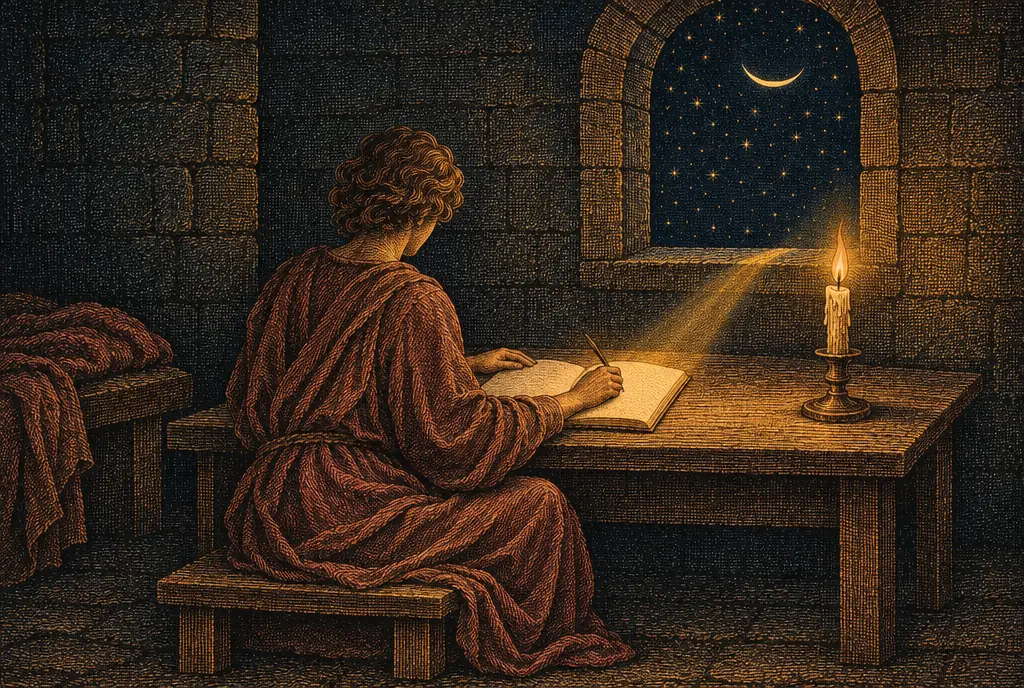
REM sleep, short for rapid eye movement sleep, is the recurring stage of sleep marked by darting eyes, an active brain and slack muscles, in which the most vivid dreams take place.
A plain educational schematic; it does not diagnose a condition or replace professional care.
Understand the chapter you are in.
Your life’s turning points, measured from your birth.
Walk through Alex’s whole example first


Prefer to explore first?
 The Road of AgesThe turning points of your whole life, from your own chart
Walk my road
What does REM sleep stand for?
Sleep runs in cycles of about ninety minutes, and each cycle ends in a period of REM sleep. The eyes move quickly under closed lids, the brain's activity looks much like waking, and the muscles of the limbs are switched off, so that dreams are not acted out. Adults spend roughly a fifth to a quarter of the night in it.
REM periods are short early in the night and long toward morning, which is why the dreams best remembered come before waking. Dreaming also occurs in other stages, but REM dreams are longer, more vivid and more story-like. Nearly all verified lucid dreams happen in REM.
On the tree of the hidden arts: Lucid dreaming.
What sets REM Sleep apart
The stage was found by watching eyelids. Aserinsky noticed bursts of jerky eye movement in sleepers, checked that his machine was not at fault, and tied them to a distinct brain pattern. Its odd mixture earned it a second name, paradoxical sleep: brain waves near waking, eyes darting, and the body's large muscles disconnected. The first period of the night may last ten minutes and the last close to an hour.
- Stands for: rapid eye movement
- First reported: Aserinsky and Kleitman, Science, 1953
- Cycle: returns about every ninety minutes, four or five times a night
- Share of adult sleep: roughly a fifth to a quarter
- Muscle tone: switched off in the limbs; eyes and breathing spared
- Other name: paradoxical sleep, Michel Jouvet, 1959
Often mistaken for something else: Deep sleep, with slow brain waves, comes mostly early in the night and yields few dream reports; REM gathers toward morning and yields the vivid ones.
The story behind REM Sleep
Eugene Aserinsky, a graduate student, and Nathaniel Kleitman reported the stage in the journal Science in 1953 after watching sleepers' eyes at the University of Chicago. William Dement, who worked with them, tied it to dreaming by waking sleepers and asking. In 1959 Michel Jouvet in Lyon showed the loss of muscle tone and called it paradoxical sleep, because the brain is so active while the body lies still.
Why REM Sleep matters
Knowing when vivid dreams happen explains most practical advice about recall and lucidity, including why the last hours of sleep matter so much.
How to read REM Sleep
The term is used to say when in the night a dream occurred and to explain recall: waking from REM gives a dream report about four times in five.
REM Sleep in practice: an example
A reader who wakes naturally at six and recalls a long dream has probably come straight out of the last and longest REM period of the night.
Where readings of REM Sleep go wrong
Cutting sleep short removes mostly REM, since it gathers toward morning. No dream practice is worth losing those hours.
Sources and editorial method
This entry summarizes the tradition in the Almanac's own words; where no source is listed, it is an editorial summary rather than a primary text, and symbolic readings are named as the tradition's, not as fact.
- Source
- The Great Almanac Dictionary
- Category
- Consciousness & Spiritual Psychology
- Aliases
- rapid eye movement sleep, rem sleep meaning, what is rem sleep, paradoxical sleep, rem sleep and dreams
- Last updated
- 2026-09-26
See REM Sleep in your personal almanac
A definition tells you what it is; your own birth chart tells you what it means for you. The Oracle casts your real chart and answers for your love, your work, and your year ahead, in conversation. It opens with the 7-day Oracle trial.
Speak with the OracleRelated terms
More in Consciousness & Spiritual Psychology
- Somatic Grounding
- Transcendental Meditation
- Affective Labeling
- Claircognizance
- Dream Control
- Gong
- Kundalini Awakening
- Out-of-Body Experience
From the reference page to your own chart
Every word here
is in your own chart.
- Your life’s turning points, measured from your birth
- A practical next step to consider
- It opens with 7 days free: the AI Oracle on thirty hidden arts, and your daily horoscope
$0 today, then $19/month after 7 days. Cancel anytime.
Common questions
What does REM sleep stand for?
Rapid eye movement sleep. It is named for the quick movements of the eyes under the lids that mark the stage, first reported in 1953.
Do we only dream in REM sleep?
No. People woken from other stages also report dreams, though less often, and those dreams tend to be shorter and more thought-like. REM dreams are the vivid, story-like kind.
Why are muscles paralysed in REM sleep?
The brain blocks signals to the voluntary muscles during REM, apart from the eyes and breathing, which keeps the sleeper from acting out dreams. It ends on waking.


