

The inner life
Gong
Direct answer
Gong: A gong is a disc of hammered bronze, hung from a frame and struck with a soft beater, whose sound swells after the stroke and spreads into many tones at once.
$0 today, then $19/month after 7 days. Cancel anytime.
At a glance
- Also called
- tam-tam
- Found in
- Consciousness & Spiritual Psychology
- Related
- Singing bowl, Overtone singing, Resonance
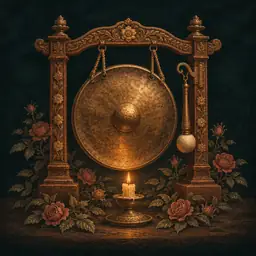

A gong is a disc of hammered bronze, hung from a frame and struck with a soft beater, whose sound swells after the stroke and spreads into many tones at once.
A plain educational schematic; it does not diagnose a condition or replace professional care.
Understand the chapter you are in.
Your life’s turning points, measured from your birth.
Walk through Alex’s whole example first


Prefer to explore first?
 The Road of AgesThe turning points of your whole life, from your own chart
Walk my road
What is a gong?
A gong is made by hammering a disc of bronze until it rings. There are two broad kinds. Flat gongs with a turned rim, such as the Chinese tam-tam, give a wash of sound with no clear pitch that grows for a moment after it is struck. Gongs with a raised boss at the centre, common in South-East Asia, give a definite note.
Bossed gongs in tuned sets are the heart of the gamelan orchestras of Java and Bali and of court and temple music from Burma to the Philippines, where the largest gong marks the end of each long cycle. In Chinese and Japanese temples a gong or bell signals the hours. The gong bath, in which large gongs are played for people lying down, is a Western practice of the last fifty years.
On the tree of the hidden arts: Sound and mantra.
What sets Gong apart
A gong differs from a bell in where it moves: a bell rings at its rim and is still at its crown, while a gong is hung from its rim and sounds most at its centre. The flat tam-tam has a further oddity. Struck softly it hums, but a firm stroke sets off a rush of ever higher tones that swells for a second or two after the beater has left, so that the instrument seems to answer late and to grow by itself. That delayed bloom, and a loudness that can fill a hall, are what sessions of gong playing depend on.
- Material: hammered bronze, roughly four parts copper to one of tin
- Two kinds: flat with a turned rim (tam-tam), and bossed with a definite pitch
- First named: in a Chinese text of the sixth century CE
- In gamelan: the great gong closes each cycle of the music
- In Western orchestras: from the 1790s onward
- Gong bath: a Western practice of the 1970s onward
Often mistaken for something else: A cymbal is thin, clashed or struck at the edge and quick to speak; a gong is thick, hung, struck at the centre and slow to bloom.
The story behind Gong
Bronze drums were cast in southern China and Vietnam in the first millennium BCE, and a Chinese text of the sixth century CE is the first to name the gong, as an instrument of the western regions. Gong-making centres grew up in Java, where the smiths of the large gongs held high standing. European orchestras adopted the tam-tam at the end of the eighteenth century for moments of dread. In the 1970s teachers of kundalini yoga in the United States played the gong in their classes, and the gong bath spread from there.
Why Gong matters
The gong is the loudest instrument played in sound sessions, so knowing what it is goes with knowing to keep a distance from it.
How to read Gong
It gives a reader the plain facts behind the gong bath: what the instrument is, where it is at home, and how recent the session is.
Gong in practice: an example
In a Javanese gamelan the great gong sounds once at the close of each cycle, and the whole orchestra seems to breathe out with it.
Where readings of Gong go wrong
A large gong played close can be loud enough to harm hearing for good. Sit well back, and leave if it hurts.
Sources and editorial method
This entry summarizes the tradition in the Almanac's own words; where no source is listed, it is an editorial summary rather than a primary text, and symbolic readings are named as the tradition's, not as fact.
- Source
- The Great Almanac Dictionary
- Category
- Consciousness & Spiritual Psychology
- Aliases
- gongs, tam-tam, gong bath, chinese gong, gong sound
- Last updated
- 2026-09-26
See Gong in your personal almanac
A definition tells you what it is; your own birth chart tells you what it means for you. The Oracle casts your real chart and answers for your love, your work, and your year ahead, in conversation. It opens with the 7-day Oracle trial.
Speak with the OracleRelated terms
More in Consciousness & Spiritual Psychology
- Law of Attraction
- REM Sleep
- Somatic Grounding
- Transcendental Meditation
- Affirmation
- Claircognizance
- Dream Control
From the reference page to your own chart
Every word here
is in your own chart.
- Your life’s turning points, measured from your birth
- A practical next step to consider
- It opens with 7 days free: the AI Oracle on thirty hidden arts, and your daily horoscope
$0 today, then $19/month after 7 days. Cancel anytime.
Common questions
What is a gong?
A gong is a disc of hammered bronze, hung from a frame and struck with a soft beater. Flat gongs give a wash of sound without a clear pitch; gongs with a central boss give a definite note.
Is a gong bath safe?
For most people it is, if the sound is kept moderate and the listener is not close to the gong. Very loud sound damages hearing, so anyone with tinnitus or sensitive hearing should sit far back or stay away.


