

The inner life
Singing bowl
Direct answer
Singing bowl: A singing bowl is a metal bowl that rings when struck and gives a sustained humming note when a padded stick is drawn round its rim. Its place in relaxation sessions is a Western custom of the 1970s.
$0 today, then $19/month after 7 days. Cancel anytime.
At a glance
- Also called
- himalayan bowl, standing bell
- Found in
- Consciousness & Spiritual Psychology
- Related
- Gong, Overtone singing, Resonance, Chakra
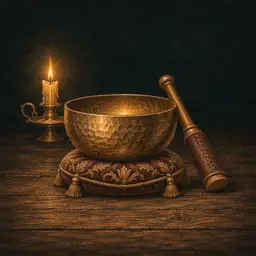

A singing bowl is a metal bowl that rings when struck and gives a sustained humming note when a padded stick is drawn round its rim. Its place in relaxation sessions is a Western custom of the 1970s.
A plain educational schematic; it does not diagnose a condition or replace professional care.
Understand the chapter you are in.
Your life’s turning points, measured from your birth.
Walk through Alex’s whole example first


Prefer to explore first?
 The Road of AgesThe turning points of your whole life, from your own chart
Walk my road
Are singing bowls really Tibetan?
A singing bowl is a kind of bell that sits with its mouth upward. Struck with a mallet it rings; rubbed round the rim with a wooden or leather-wrapped stick it gives a steady, wavering hum, as a wet finger does on a wine glass. Most are hammered or cast from bronze. Crystal bowls, made of fused quartz, give a purer and louder tone.
Bowls of this kind are sold as Tibetan and as tools of an ancient science of sound. The bells are real and old: standing bells mark the hours and the stages of chanting in Buddhist temples across East Asia. The rubbing technique and the sessions in which bowls are played around or on a person, however, are not found in Tibetan ritual and appear in the West from the 1970s.
On the tree of the hidden arts: Sound and mantra.
What sets Singing bowl apart
The bowl is a bell turned mouth upward and played two ways, which is what makes it distinctive: a strike gives a ringing that fades, and rubbing the rim gives a note that can be held as long as the hand keeps moving. Its wavering comes from slight unevenness in the metal, which splits the note into two close pitches that beat against each other. Sellers describe old bowls as an alloy of seven metals, one for each planet; the analyses published of antique bowls find ordinary bell bronze, copper and tin with traces of other metals.
- Kind of instrument: a standing bell, resting on its base with the rim free
- Material: bell bronze, copper and tin; crystal bowls are fused quartz
- Japanese temple names: rin for the small bell, keisu for the large
- Western story begins: the record Tibetan Bells, 1972
- An often cited study: sixty-two adults in 2016, with no comparison group
Often mistaken for something else: A hanging bell is struck and left to ring; a singing bowl can also be rubbed, which feeds the note and holds it steady.
The story behind Singing bowl
Bronze bowls have been made in Nepal, northern India and Tibet for centuries as household vessels and bells, and the standing bell reached Japan with Buddhism, where it is called rin or keisu. Western travellers bought old bowls in Kathmandu in the 1960s, and the record Tibetan Bells, released in 1972, made their sound known. A trade in new bowls grew from Nepal and India. Crystal bowls began as crucibles for growing silicon in the electronics industry and were adopted by sound practitioners in the 1980s.
Why Singing bowl matters
Singing bowl is the instrument most often met in sound sessions, and the one about which the most is claimed and the least has been tested.
Singing bowl in practice: an example
A player strikes a bowl once at the start of a class and lets the note die away before anyone moves.
Sources and editorial method
This entry summarizes the tradition in the Almanac's own words; where no source is listed, it is an editorial summary rather than a primary text, and symbolic readings are named as the tradition's, not as fact.
- Source
- The Great Almanac Dictionary
- Category
- Consciousness & Spiritual Psychology
- Aliases
- singing bowls, tibetan singing bowl, himalayan bowl, standing bell, crystal singing bowl
- Last updated
- 2026-09-26
See Singing bowl in your personal almanac
A definition tells you what it is; your own birth chart tells you what it means for you. The Oracle casts your real chart and answers for your love, your work, and your year ahead, in conversation. It opens with the 7-day Oracle trial.
Speak with the OracleRelated terms
More in Consciousness & Spiritual Psychology
- Terminal Lucidity
- Wish Fulfilment
- Breath Awareness
- Deathbed Visions
- Flow State
- Integration
- Nervous System Regulation
- Quantum Consciousness
From the reference page to your own chart
Every word here
is in your own chart.
- Your life’s turning points, measured from your birth
- A practical next step to consider
- It opens with 7 days free: the AI Oracle on thirty hidden arts, and your daily horoscope
$0 today, then $19/month after 7 days. Cancel anytime.
Common questions
Are singing bowls really Tibetan?
Metal bowls and bells are old across the Himalayas, but scholars and Tibetan musicians have found little sign of rubbed bowls in Tibetan ritual. The name and the sound sessions date from the West in the 1970s.
How does a singing bowl make its sound?
Striking or rubbing sets the rim flexing in and out. Rubbing keeps feeding the motion, as a bow does a string, so the note sustains, and two close pitches in the metal beat against each other to give the wavering.
Do singing bowls have health benefits?
A few small studies report less tension and better mood after a session, without comparison groups. A 2020 review found the evidence too thin for conclusions. Resting quietly for an hour is restful in itself.


