

The inner life
Continuity Hypothesis
Direct answer
Continuity Hypothesis: The continuity hypothesis holds that dreams are continuous with waking life: the people, concerns and emotions of a person's days are the main material of their dreams.
$0 today, then $19/month after 7 days. Cancel anytime.
At a glance
- Also called
- dream continuity theory, dreams reflect waking life, calvin hall dreams
- Found in
- Consciousness & Spiritual Psychology
- Related
- Dream Interpretation, Dream Incubation, Archetype, Imagery Rehearsal
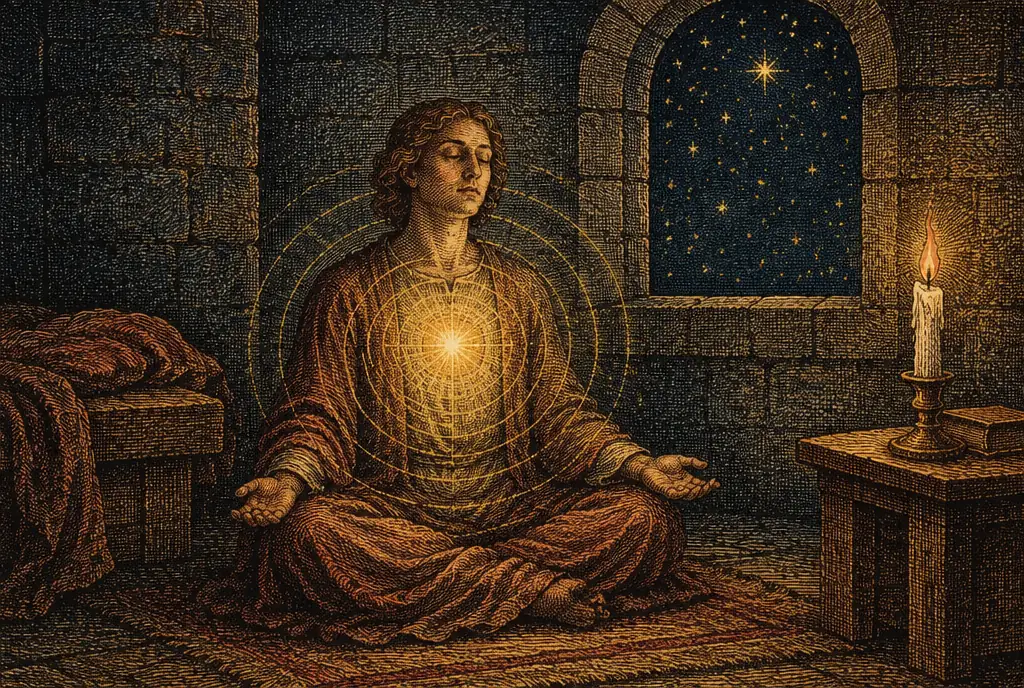
The continuity hypothesis holds that dreams are continuous with waking life: the people, concerns and emotions of a person's days are the main material of their dreams.
A plain educational schematic; it does not diagnose a condition or replace professional care.
Understand the chapter you are in.
Your life’s turning points, measured from your birth.
Walk through Alex’s whole example first


Prefer to explore first?
 The Road of AgesThe turning points of your whole life, from your own chart
Walk my road
What is the continuity hypothesis of dreaming?
The continuity hypothesis is a claim from dream research, built on counting. When large numbers of dream reports are coded for who appears, where it happens and what is felt, the results match the dreamer's waking world: their family and friends, their work, their worries and their interests.
Continuity Hypothesis does not say that dreams replay the day. Dreams recombine and exaggerate, and they favour what matters emotionally over what merely happened. What the hypothesis rules out is the notion that dreams come from somewhere wholly apart from the dreamer's life. It is the main scientific support for reading a dream against one's own days.
On the tree of the hidden arts: Dreams.
What sets Continuity Hypothesis apart
This hypothesis came from arithmetic and not from the couch. Hall's method was to code each report for characters, settings, actions and emotions and then compare the totals with what was known of the dreamer. A long journal from one person, read blind, lets researchers predict their relationships and preoccupations with fair accuracy. The finding has an edge: what a person thinks and worries about enters dreams more than what they merely do, so reading and screens are oddly rare.
- Named by: Calvin Hall and colleagues, early 1970s
- Method: content analysis: counting characters, settings and emotions
- Coding system: Hall and Van de Castle, 1966
- Later advocate: G. William Domhoff, The Scientific Study of Dreams, 2003
- What enters most: emotional concerns, more than routine daily activities
Often mistaken for something else: Jung's compensation says a dream supplies what waking life lacks; continuity says a dream mostly carries on what waking life already holds.
The story behind Continuity Hypothesis
The psychologist Calvin Hall collected tens of thousands of dream reports from the 1940s onward and, with Robert Van de Castle, published a coding system in 1966. Hall and his colleagues gave the hypothesis its name in the early 1970s. G. William Domhoff has since developed it using long dream journals kept by single dreamers, and Michael Schredl has studied which waking experiences are most likely to enter dreams.
Why Continuity Hypothesis matters
Continuity Hypothesis gives a tested reason for the house's rule that a dream is a mirror of waking life, and a first question for any dream: what in my days is this like?
How to read Continuity Hypothesis
Readers apply it by setting a dream beside the week it came in, looking for the shared concern before reaching for any symbol.
Continuity Hypothesis in practice: an example
A reader who starts a new job and then dreams for a month of being lost in a large building is seeing continuity at work.
Where readings of Continuity Hypothesis go wrong
Continuity Hypothesis describes what dreams tend to contain, not what they are for, and it does not make any single reading of a dream correct.
Sources and editorial method
This entry summarizes the tradition in the Almanac's own words; where no source is listed, it is an editorial summary rather than a primary text, and symbolic readings are named as the tradition's, not as fact.
- Source
- The Great Almanac Dictionary
- Category
- Consciousness & Spiritual Psychology
- Aliases
- continuity hypothesis of dreaming, dream continuity theory, dreams reflect waking life, calvin hall dreams
- Last updated
- 2026-09-26
See Continuity Hypothesis in your personal almanac
A definition tells you what it is; your own birth chart tells you what it means for you. The Oracle casts your real chart and answers for your love, your work, and your year ahead, in conversation. It opens with the 7-day Oracle trial.
Speak with the OracleRelated terms
More in Consciousness & Spiritual Psychology
- False Awakening
- Implementation Intention
- Mental Contrasting
- Primary Source
- Self-Observation
- Spoon Bending
- Visualisation
- Barnum Effect
From the reference page to your own chart
Every word here
is in your own chart.
- Your life’s turning points, measured from your birth
- A practical next step to consider
- It opens with 7 days free: the AI Oracle on thirty hidden arts, and your daily horoscope
$0 today, then $19/month after 7 days. Cancel anytime.
Common questions
What is the continuity hypothesis of dreaming?
It is the research finding that dream content largely reflects the dreamer's waking concerns, relationships and feelings. Dreams draw on the life the person is living.
Who proposed the continuity hypothesis?
Calvin Hall and his colleagues named it in the early 1970s on the basis of large collections of dream reports. G. William Domhoff is its best known later advocate.
Does continuity mean dreams have no deeper meaning?
No. It says where the material comes from. Whether a dream also has a purpose or a message is a separate question that research has not settled.


