

The inner life
Visualisation
Direct answer
Visualisation is the deliberate picturing of a scene in the mind, used to rehearse an act, to keep a goal vivid or, in spiritual teaching, to draw a wish toward fulfilment.
$0 today, then $19/month after 7 days. Cancel anytime.
At a glance
- Also called
- visualization, creative visualization, mental imagery, mental rehearsal
- Found in
- Consciousness & Spiritual Psychology
- Related
- Manifestation, Affirmation, Living in the End, Mental Contrasting
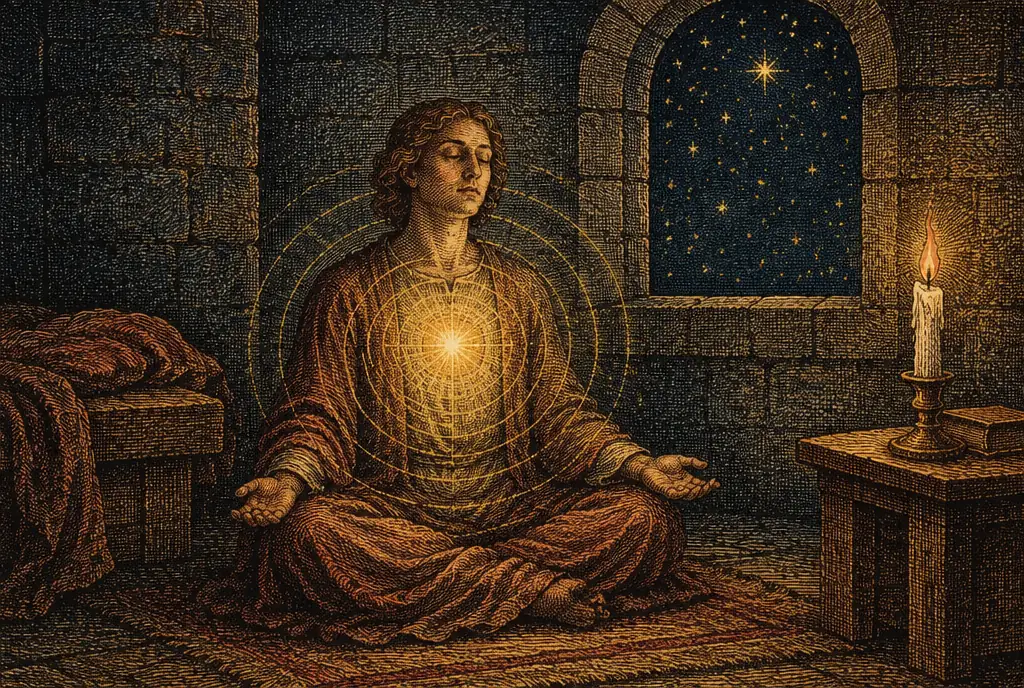
Visualisation is the deliberate picturing of a scene in the mind, used to rehearse an act, to keep a goal vivid or, in spiritual teaching, to draw a wish toward fulfilment.
A plain educational schematic; it does not diagnose a condition or replace professional care.
Understand the chapter you are in.
Your life’s turning points, measured from your birth.
Walk through Alex’s whole example first


Prefer to explore first?
 The Road of AgesThe turning points of your whole life, from your own chart
Walk my road
What is visualisation?
Visualisation means forming a mental picture on purpose and holding it. Athletes and musicians use it to rehearse: they run the movement in the mind, from the inside, with its timing and feel. Manifestation teachers use it differently, asking the student to see the wish already granted.
Research treats these as two kinds. Process simulation, picturing the steps one must take, improves planning and performance. Outcome simulation, picturing only the prize, feels good and can lower effort, because the mind takes some of the reward in advance. Mental practice adds to physical practice and does not replace it.
On the tree of the hidden arts: Imagination and intention.
What sets Visualisation apart
Vantage point and content decide what a mental picture does. Seen from the inside, through one's own eyes, a rehearsed movement engages some of the same brain regions as making it, which is why first-person rehearsal is the form coaches teach. Seen from outside, as on a screen, the picture informs more than it trains. And a picture of the route does different work from a picture of the arrival: the first prepares, the second rewards.
- Two kinds: process simulation (the steps) and outcome simulation (the result)
- Key experiment: Pham and Taylor, 1999: students who pictured studying outscored those who pictured the grade
- Sport review: Driskell, Copper and Moran, 1994: mental practice helps, less than physical practice
- Religious use: the composed scene in Ignatius of Loyola's Spiritual Exercises, sixteenth century
- New Age source: Shakti Gawain, Creative Visualization, 1978
Often mistaken for something else: Daydreaming drifts and is enjoyed for itself; visualisation is chosen, bounded in time and aimed at an act that follows.
The story behind Visualisation
Imagery has old roots in religious practice, from the composed scenes of Ignatius of Loyola's Spiritual Exercises to Tibetan deity meditation. Sport psychology studied mental practice through the twentieth century, and a 1994 review by James Driskell and colleagues confirmed a moderate benefit. Shakti Gawain's Creative Visualization (1978) made the word a staple of New Age teaching. Lien Pham and Shelley Taylor's 1999 study set process against outcome.
Why Visualisation matters
Visualisation is the half of manifestation practice that has been tested most, so it shows where the practice stands on firm ground.
How to read Visualisation
Readers picture the steps of what they mean to do, in the first person and in order, shortly before doing them.
Visualisation in practice: an example
Before an interview a reader pictures walking in, the first question and their own first sentence, not the letter of offer.
Where readings of Visualisation go wrong
A picture is rehearsal, not cause; picturing a result does nothing to events, and may weaken the drive to work for it.
Sources and editorial method
This entry summarizes the tradition in the Almanac's own words; where no source is listed, it is an editorial summary rather than a primary text, and symbolic readings are named as the tradition's, not as fact.
- Source
- The Great Almanac Dictionary
- Category
- Consciousness & Spiritual Psychology
- Aliases
- visualization, creative visualization, visualisation meaning, mental imagery, mental rehearsal
- Last updated
- 2026-09-26
See Visualisation in your personal almanac
A definition tells you what it is; your own birth chart tells you what it means for you. The Oracle casts your real chart and answers for your love, your work, and your year ahead, in conversation. It opens with the 7-day Oracle trial.
Speak with the OracleRelated terms
More in Consciousness & Spiritual Psychology
- Barnum Effect
- Continuity Hypothesis
- Extrasensory Perception
- Imagery Rehearsal
- Primary Source
- Self-Fulfilling Prophecy
- Spiritual Timing
From the reference page to your own chart
Every word here
is in your own chart.
- Your life’s turning points, measured from your birth
- A practical next step to consider
- It opens with 7 days free: the AI Oracle on thirty hidden arts, and your daily horoscope
$0 today, then $19/month after 7 days. Cancel anytime.
Common questions
What is visualisation?
It is forming a mental picture on purpose: of a movement to be made, a scene to be lived, or a goal reached. It is used in sport, in therapy, in religious practice and in manifestation teaching.
Does visualisation work?
Picturing the steps of a task improves performance, though less than real practice. Picturing only the reward tends to reduce effort. Nothing shows that picturing a thing makes it happen without action.
How long should I visualise for?
A few minutes is enough. Studies of mental practice find that short sessions help and that long ones add little. What counts is detail, the first-person view, and doing the real thing soon after.


