

The inner life
Living in the End
Direct answer
Living in the End: Living in the end is Neville Goddard's name for imagining from inside a wish already fulfilled, by replaying a short scene that implies it until it feels real.
$0 today, then $19/month after 7 days. Cancel anytime.
At a glance
- Also called
- live in the end, wish fulfilled, feeling of the wish fulfilled, law of assumption
- Found in
- Consciousness & Spiritual Psychology
- Related
- Visualisation, Manifestation, Law of Attraction, Affirmation
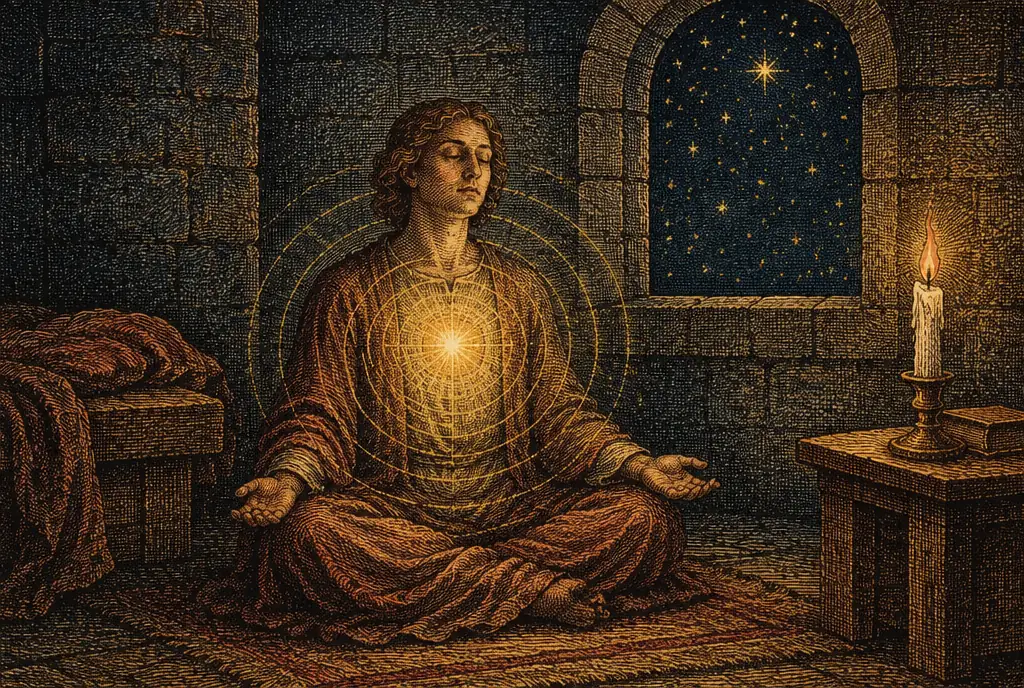
Living in the end is Neville Goddard's name for imagining from inside a wish already fulfilled, by replaying a short scene that implies it until it feels real.
A plain educational schematic; it does not diagnose a condition or replace professional care.
Understand the chapter you are in.
Your life’s turning points, measured from your birth.
Walk through Alex’s whole example first


Prefer to explore first?
 The Road of AgesThe turning points of your whole life, from your own chart
Walk my road
What does living in the end mean?
Living in the end is the core of Neville Goddard's teaching, which he also called the law of assumption. The student chooses an aim, invents a brief scene that would follow its fulfilment, and enters that scene in imagination in the first person, with touch and sound, while drowsy and close to sleep. The scene is looped until it has the feeling of fact.
Goddard taught that the assumption, held faithfully, hardens into fact by itself. That claim has no support. Taken as rehearsal the practice has some: a vivid first-person scene keeps an aim present and shows a person what they truly want. The house pairs it with the first real act on the following day.
On the tree of the hidden arts: Imagination and intention.
What sets Living in the End apart
Three details set Goddard's method apart from ordinary picturing. The scene is not of the wish but of something after it, an event that could only happen if the wish were already granted. It is entered in the first person, with one sense, such as touch, made vivid. And it is done on the threshold of sleep, so that the last waking impression is of fulfilment. Goddard asked for feeling above imagery: the test was a sense of relief, as if the thing were done.
- Teacher: Neville Goddard, born Barbados 1905, died Los Angeles 1972
- Key texts: Feeling Is the Secret (1944); The Power of Awareness (1952)
- His own names for it: the law of assumption; the wish fulfilled; thinking from the end
- Timing: the 'state akin to sleep', the drowsy minutes before sleep
- Teacher he named: 'Abdullah', known only from Goddard's own account
Often mistaken for something else: Visualisation in sport rehearses the doing of a task; living in the end skips the doing and imagines the aftermath, which is why it needs a real first step added to it.
The story behind Living in the End
Neville Goddard (1905 to 1972), born in Barbados, lectured in New York and Los Angeles from the late 1930s. He set out the method in Feeling Is the Secret (1944) and The Power of Awareness (1952), using the phrases the wish fulfilled, the state akin to sleep and thinking from the end. His books fell out of fashion after his death and found a large new readership online in the 2010s.
Why Living in the End matters
Living in the End is the most copied manifestation method of recent years, and its source and limits are plain once Goddard's own books are read.
How to read Living in the End
Readers who try it keep the scene short, enter it only when relaxed, and write down the next day the first act the wish requires.
Living in the End in practice: an example
A reader hoping to finish a degree imagines, for a minute before sleep, a friend reading out their name at the ceremony.
Where readings of Living in the End go wrong
Living in the End is never a substitute for medical care or effort, and never a way to make another person feel or do something.
Sources and editorial method
This entry summarizes the tradition in the Almanac's own words; where no source is listed, it is an editorial summary rather than a primary text, and symbolic readings are named as the tradition's, not as fact.
- Source
- The Great Almanac Dictionary
- Category
- Consciousness & Spiritual Psychology
- Aliases
- live in the end, wish fulfilled, feeling of the wish fulfilled, law of assumption, state akin to sleep
- Last updated
- 2026-09-26
See Living in the End in your personal almanac
A definition tells you what it is; your own birth chart tells you what it means for you. The Oracle casts your real chart and answers for your love, your work, and your year ahead, in conversation. It opens with the 7-day Oracle trial.
Speak with the OracleRelated terms
More in Consciousness & Spiritual Psychology
- Past Life
- Rumination
- Soul Purpose
- Tuning Fork
- Anima and Animus
- Cognitive Dissonance
- Dream Recall
- Heart Chakra
From the reference page to your own chart
Every word here
is in your own chart.
- Your life’s turning points, measured from your birth
- A practical next step to consider
- It opens with 7 days free: the AI Oracle on thirty hidden arts, and your daily horoscope
$0 today, then $19/month after 7 days. Cancel anytime.
Common questions
What does living in the end mean?
It is Neville Goddard's phrase for imagining as though a wish were already granted: seeing and feeling a short scene from after its fulfilment, instead of picturing the wish as something still to come.
What is the state akin to sleep?
It is Goddard's name for the drowsy, relaxed state just before sleep, in which he told students to replay their scene. It is the same borderland that sleep researchers describe at the onset of sleep.
Does living in the end work?
As rehearsal it can sharpen an aim and steady the resolve to act. The claim that the imagined scene brings about the event with no action has never been shown, and Goddard's success stories were not checked.


