
Keeping your dreams
Write on waking, before the day takes them.
How do I remember my dreams better?
A dream is read here as a mirror of your waking life, never as a prediction: its strongest image, its strongest feeling, and where in your days that feeling lives.
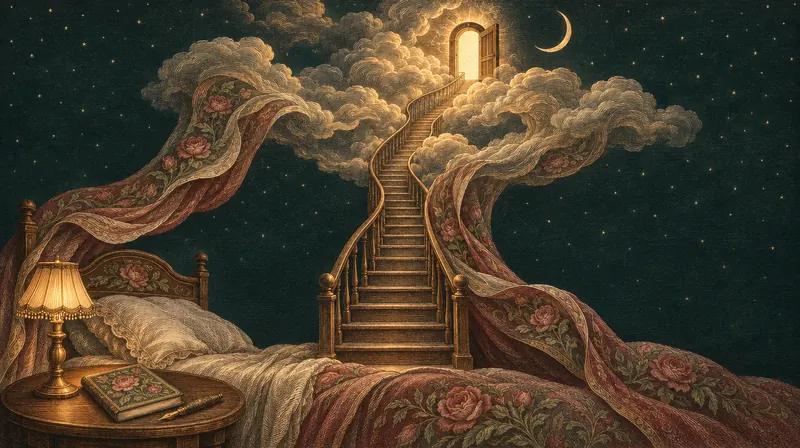

A dream read as a mirror of your days
Ask the OracleHow do I read my dreams, and what should I write down?
Everyone dreams, most of it in the hours before waking, and most of it is forgotten by breakfast. People have written their dreams down and argued over them for at least three thousand years: Egyptian scribes listed them as good or bad omens, the sick slept in Greek temples hoping for one, and Artemidorus filled five books with their meanings in the second century.
The modern argument began with Freud in 1899 and Jung after him, and moved into the sleep laboratory in 1953 with the discovery of rapid eye movement sleep. Science has not agreed on what dreams are for. What the counting of many thousands of dream reports does show is that dreams stay close to the dreamer's own people, places and worries, and that is how the house reads them: as a mirror, never as a forecast. The scientific study of dreaming has its own name, oneirology.
As the craft of reading dreams, from Artemidorus to Freud and Jung teaches it.
The one dream book that comes down whole from antiquity, the Oneirocritica of Artemidorus, lays down the craft's first rule: a dream cannot be read apart from its dreamer. The same dream, Artemidorus teaches, means one thing to a sailor and another to a farmer, one thing to the rich and another to the poor, so the reader asks first who dreamt it and how their life stands. Every later school keeps this rule in its own way, and the house keeps it most simply: the dreamer is the judge of what their dream means, and no book of symbols can say it for them.
Artemidorus opens by dividing dreams in two. The first kind, which he calls enhypnion, shows only the dreamer's present state, as the lover dreams of the beloved, the frightened of what they fear and the hungry of food; the second, oneiros, he held to point to what is coming. The house reads every dream in the first way, as a picture of the dreamer's life as it stands, and leaves the foretelling to the old books.
Everyone dreams several times a night. Sleep runs in cycles of about an hour and a half, and in each comes a period of rapid eye movement sleep, REM, in which the longest and most vivid dreams arise; these periods lengthen toward morning, so the richest dreaming waits in the last hours of a full night. Dreams come in the other stages too, shorter and more like thinking. And a dream is fragile: unless something holds it, it is gone within minutes of waking.
So the craft begins in the first minute of the day: a notebook by the bed, a moment of lying still with the eyes closed, the question of what was just happening, and a few dated words before anything else, the setting, the people, what happened and above all the feelings. Recall is a habit more than a gift, and it grows quickly once practised. The branch Keeping your dreams teaches it, with the old rite of sleeping on a question, which the Greeks kept in the temples of Asklepios.
A dream is made of the dreamer's own life. It borrows from the day before, a face on a bus, a word in a letter, a worry pushed aside at bedtime, which Freud called the day's residues. It fills itself with the dreamer's own family, friends and familiar places, and with strangers too, and it turns the dreamer's concerns into scenes. Calvin Hall taught that a dream pictures the dreamer's own thoughts: how they see themselves, the people around them and their troubles. This is called the continuity of dreams with waking life, and it is why a dream is read against the days around it.
A dream has parts, and naming them makes it easier to read: the setting, the people, the dream-self and what it does, what befalls it, the feeling, and the way the dream ends or breaks off. Jung saw many dreams built like a play in four acts, a setting of the scene, a thickening of the plot, a turning point and an outcome, and he noted where a dream stopped short. Of all the parts the feeling is the least disguised, and often the surest guide.
On what a dream is doing, the two great modern teachers part. Freud taught that a dream is the disguised fulfilment of a wish. The dream as remembered, its manifest content, stands in for latent thoughts that an inner censor will not let pass, and the dream work makes the disguise. Condensation folds many thoughts into one image or one composite figure; displacement moves the feeling from what matters to something trivial; thoughts are turned into pictures; and a last revision smooths the whole into a seeming story. The way back is free association, letting each part lead where it will. He called the dream the guardian of sleep, and its interpretation the royal road to the unconscious.
Jung held that a dream hides nothing. It states the dreamer's inner situation in images, and its usual work is compensation, supplying what a one-sided waking attitude leaves out. He read each figure on two levels, as the real person it resembles and as a part of the dreamer wearing that face, and he widened an image with parallels from myth and art, which he called amplification. The house takes from Freud the day's residues and the dreamer's own associations, and from Jung the plain reading of the image. The branch Jung's way teaches his method and the figures he saw return: the persona, the shadow, the anima and animus, and the Self.
The house's own way of reading begins with two things only. The first is the central image, the one that will not leave on waking, which Ernest Hartmann taught pictures the dreamer's strongest feeling. The second is that feeling, named in a single word: dread, longing, shame, relief. Then comes the question the whole craft turns on: where does that feeling live in my waking life now? A dream of missing a train, in dread, asks where one fears being too late. The answer is often close and ordinary, and a reading is kept only if it fits.
Dreams often think as language does, in figures of speech: a person out of their depth dreams of deep water, and someone who feels exposed dreams of being naked in a crowd. The dreamer's own associations come before any dictionary's. The branch Image and feeling teaches the reading step by step, with the group method in which others say what the dream would mean if it were theirs.
No single dream should be read too confidently. Jung held that dreams are best read in series, each lighting the others, and a diary read back each week shows what no single morning can: the places, people and feelings that return, the theme that rises in hard weeks and falls away in easier ones. A dream that comes back in the same form, or on the same theme, is a recurring dream, read by what it keeps asking and by the one thing the dream-self never does. The branch Recurring dreams teaches that work, with Jung's active imagination and the Gestalt way of speaking as each part of the dream.
The house also sets each dream beside the Moon of the night it came, its phase and its sign, and beside the dreamer's own Moon. Used so, the Moon is a filing system and a set of questions, never a forecast, and Dreams and the Moon teaches the phases and the signs and how to use them.
A nightmare is a frightening dream that wakes the dreamer, who remembers it clearly. An occasional one is read like any other dream, in daylight, by its central image and its ruling feeling. For nightmares that keep coming, sleep clinics use imagery rehearsal: the dream is written down, changed in any way the dreamer chooses, and the new version pictured for a few minutes each day while the old one is left alone. Nightmares that come most nights, that replay something that really happened, or that make sleep a thing to dread belong with a doctor or therapist. A nightmare foretells nothing, and it can be changed.
Begin with a notebook by the bed and a full night. Each morning, write the date, a title, the dream as it happened, the strongest image underlined and the strongest feeling in one word. Then write one line that joins the dream to the day: when did I last feel exactly this while awake, and what happened yesterday? On mornings when nothing comes, write that. Once a week, read everything back. Within a few weeks most dreamers recall far more than they did, and begin to learn the language of their own dreams.
The branches follow from there. Keeping your dreams comes first, then Image and feeling for the reading itself; Recurring dreams and Jung's way for the dreams that return and the figures within them; Dreams and the Moon for sorting a diary over months; and Nightmares for the dreams that frighten, with the signs that it is time to ask for help.
A dream is read here as a mirror of your waking life, never as a prediction. You are the judge of what fits. If nightmares come most nights, or replay something that happened to you, a doctor or therapist can help.
Each one is a question you can ask.
Write on waking, before the day takes them.
How do I remember my dreams better?
Take the strongest image and the strongest feeling first.
How do I read my dream by its strongest image and its strongest feeling?
The same dream again: what it tends to point at.
Why do I keep having the same dream, and how do I read a recurring dream?
The dream as the psyche speaking in pictures.
How did Carl Jung interpret a dream, and what would he look for in mine?
A dream set beside the Moon of the night it came.
How do I read a dream beside the Moon and my chart?
What they are, and when to ask for help.
How do I read a nightmare, and when should I ask for help with my dreams?
Each opens its page in the dictionary.
Swiss psychiatrist, founder of analytical psychology. He studied alchemy, Gnosticism, astrology and the I Ching as pictures of the psyche: Psychology and Alchemy (1944), the idea of synchronicity, and The Red Book, written from 1914 to 1930 and published in 2009. He wrote that he sometimes cast a patient’s horoscope to understand them, and his own statistical test of astrology and marriage proved nothing either way.
Austrian-born physicist, Nobel laureate of 1945 for the exclusion principle, one of the makers of quantum mechanics. From 1932 he was analysed in Carl Jung’s circle, and the two exchanged letters until his death. In 1952 they published a book together: Jung’s essay on synchronicity beside Pauli’s on the archetypes in Kepler’s astronomy. Pauli hoped for one language for matter and psyche; he never claimed that physics had proved it.
Zosimos of PanopolisIbn ArabiJoseph CampbellZhuangziGilgameshCupid and PsycheJekyll and Hyde
Physics and the mysticsTarot, runes, I ChingAlchemyThe sixth sense
Make today specific
The same sky reaches everyone differently. Your birth details turn a general forecast into one theme, and one thing worth doing about it.
One instrument, one answer. Explore the preview; membership opens every tool.
Read more

